
Walk down the cat food aisle and every bag claims to be premium, natural, or vet recommended. None of those words are regulated, and none of them tell you whether the food inside meets your cat's nutritional needs. The best cat food is not the one with the nicest packaging. It is the one that satisfies a short list of measurable standards, set by AAFCO and the National Research Council, for your cat's specific life stage.
This guide walks through what those standards are, how to check a label against them in under a minute, and how to confirm the food is working once your cat starts eating it.
Key takeaways
- Look for an AAFCO nutritional adequacy statement matched to your cat's life stage, since anything missing one, or labeled "supplemental only," cannot be a sole diet.
- A named animal protein (chicken, turkey, salmon) should sit near the top of the ingredient list, since cats are obligate carnivores that run on protein, not carbohydrates.
- Compare wet and dry foods on a dry matter basis, not their as-fed percentages, since a can's high moisture content dilutes every other number.
- Nutrient needs shift across life stages: kittens need more of everything, adults need portion control after spay/neuter, and seniors need managed phosphorus with enough protein to preserve muscle.
- A label predicts what a food should do, so confirm it is working by tracking body condition and weight over the following month.
Table of Contents
Quick answer: Look for an AAFCO nutritional adequacy statement matching your cat's life stage, a named animal protein in the first few ingredients, and a caloric density you can plug into the free cat food calculator for an exact daily portion.
Start With Biology: What Cats Need
Cats are obligate carnivores, a category that includes few domestic pets. Their liver enzymes are built to run continuously on protein for energy, and they lack several metabolic pathways that let omnivores like dogs and humans get by on plant-based nutrients. That biology, not a marketing trend, is why ingredient quality matters more for cats than for almost any other companion animal.
Why Protein Has to Come From Meat
Carbohydrates are not a required nutrient for cats. Protein is their primary fuel source, and the amino acids that make it up need to come from animal tissue in concentrations that plant-based ingredients cannot match. When you scan a label, a named muscle meat or meat meal (chicken, turkey, salmon) near the top of the ingredient list is a better signal of quality than any claim printed on the front of the bag.
Taurine and Arachidonic Acid Are Non-Negotiable
Unlike most mammals, cats cannot synthesize enough taurine or arachidonic acid on their own and must get both from their diet. Taurine deficiency causes a form of heart failure called dilated cardiomyopathy, a link researchers identified in cats during the 1970s and 1980s according to PetMD, which is why commercial cat food has carried a mandatory taurine minimum since the late 1980s. Arachidonic acid, a fatty acid found in animal fat, supports skin, reproductive, and inflammatory health in the same way essential fatty acids do for humans. Both nutrients are one more reason a complete-and-balanced statement on the label matters more for cats than for dogs.
Reading the Label Like a Nutritionist
Check the AAFCO nutritional adequacy statement first. It tells you in one line whether the food is built to be a complete diet or only a supplement, before you look at a single ingredient.
The AAFCO Statement Comes First
Every legitimate cat food carries a nutritional adequacy statement from the Association of American Feed Control Officials (AAFCO), confirming the food is formulated or tested to meet complete nutrient requirements for a specific life stage: growth, maintenance, or all life stages. If a label does not carry this statement, or if it says the food is intended for "intermittent or supplemental feeding only," it is not built to be your cat's entire diet.
Meat Meal and By-Products Are Not Automatically Bad
Meat meal is rendered meat with the moisture and fat removed, which concentrates protein rather than diluting it. By-products, meanwhile, cover organ meats like liver and kidney that most humans skip but that cats seek out instinctively in a natural diet, since organs carry nutrients muscle tissue alone does not provide. Both terms describe a category, not a quality level. The supplier behind the ingredient matters more than the label word used to describe it.
Comparing Foods on a Dry Matter Basis
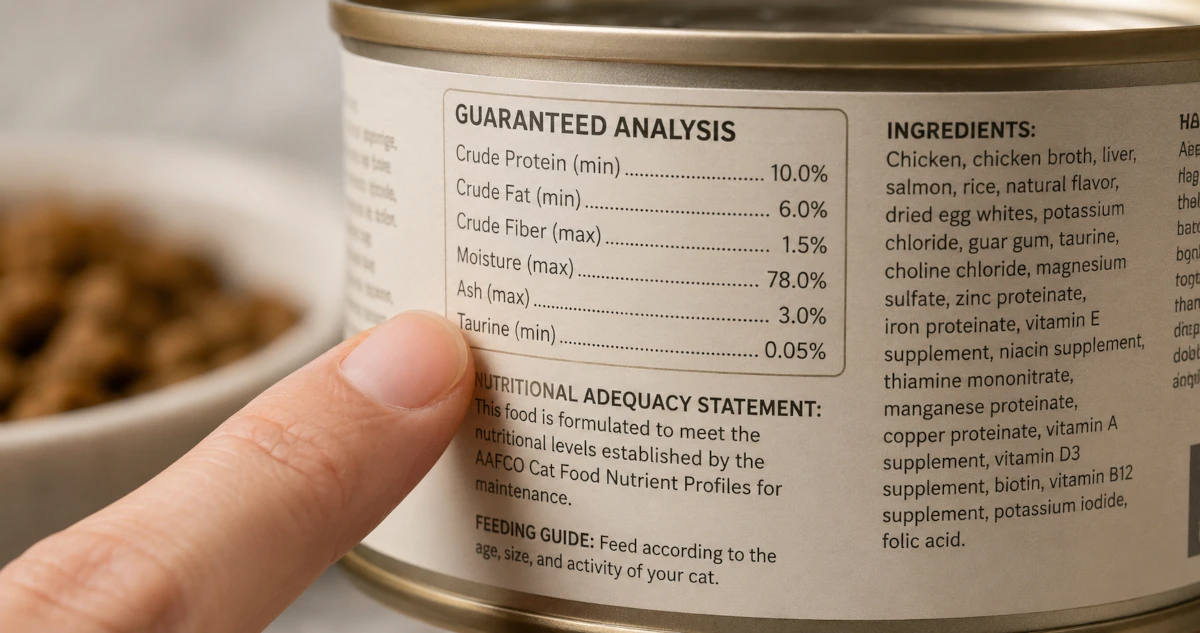
Wet and dry foods cannot be compared by their as-fed percentages alone, since a can that is 78% water dilutes every other number on the label. Converting to a dry matter basis (DMB) removes moisture from the comparison:
- Find the moisture percentage on the guaranteed analysis panel.
- Subtract it from 100 to get the dry matter percentage.
- Divide the as-fed protein (or fat) percentage by the dry matter percentage, then multiply by 100.
For example, a dry kibble listing 10% moisture and 30% protein has 90% dry matter, giving a DMB protein figure of 30 ÷ 90 × 100 ≈ 33%. A canned food listing 78% moisture and 11% protein has 22% dry matter, giving a DMB protein figure of 11 ÷ 22 × 100 = 50%. The canned food is the more protein-dense option once water is factored out, the opposite of what the as-fed numbers suggest.
Matching the Food to Your Cat's Life Stage
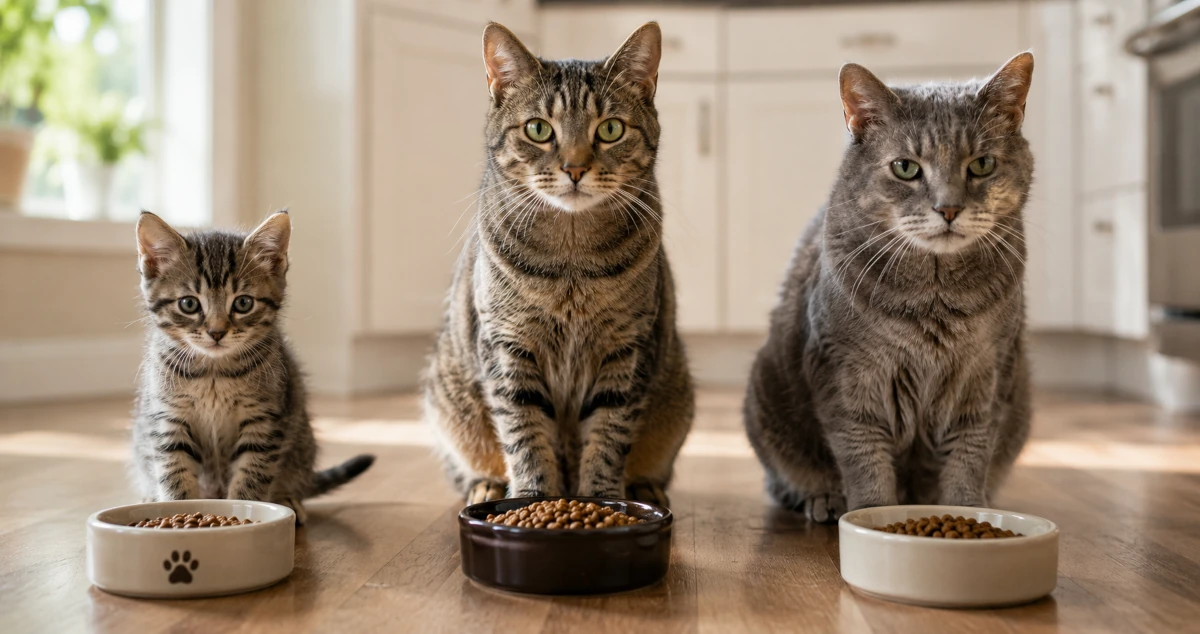
Kittens need roughly twice the protein and fat per pound that adult cats do, while seniors often need less phosphorus and more digestible protein to protect aging kidneys. A food can pass every label check above and still be wrong for your cat if it is built for the wrong stage.
Kittens Need More of Everything
Kittens grow fast enough that their protein, fat, and calorie needs per pound of body weight run well above an adult cat's. Look for an AAFCO growth (or growth and reproduction) statement and a calcium-to-phosphorus ratio suited to developing bones. Kitten-specific formulas are built around these higher targets. Adult food is not. Use the Kitten Feeding Schedule Calculator to see exactly how many calories and meals a day your kitten needs at their current age and weight.
Adults Need Consistency in More Than Ingredients
Adult cats do well on a maintenance-formula food, but the bigger risk at this stage is portion creep, not ingredient quality. Metabolic rate drops meaningfully after spaying or neutering, so an unchanged bowl size after the procedure is one of the most common paths to feline weight gain.
Seniors Benefit From a Different Balance
Aging cats often deal with reduced kidney filtration and some muscle loss at the same time, which calls for a food that manages phosphorus while still supplying enough high-quality protein to maintain muscle mass. Watch body condition closely during this stage, since weight loss can signal both underfeeding and an underlying medical issue.
Cat Foods That Meet the Standard, by Life Stage
These 4 foods each carry the right AAFCO statement for the life stage and situation they are picked for, from kitten growth through senior maintenance and weight control.
Affiliate disclosure: Some links below go to Amazon. If you purchase through them, this site may earn a small commission at no additional cost to you. It does not affect which foods are recommended or how they are evaluated.
1. Royal Canin Kitten Dry Cat Food: Best for Growth
Formulated with an AAFCO growth statement and a calcium-to-phosphorus ratio built for kittens up to 12 months, with a kibble shape sized for smaller jaws. A simple choice while your kitten is still building skeletal and muscle mass.
2. Purina Pro Plan Complete Essentials Adult Dry Cat Food: Best for Everyday Maintenance
Carries an AAFCO adult maintenance statement with a named real meat as the first ingredient and formulation input from Purina's veterinary nutrition team. A solid default for a healthy, average-activity adult cat.
3. Hill's Science Diet Adult 7+ Dry Cat Food: Best for Seniors
Built around an easily digestible formula for cats age 7 and up, with a nutrient balance tuned for aging kidneys while still supporting lean muscle. A reasonable starting point when transitioning a cat out of standard adult food.
4. Hill's Science Diet Perfect Weight Adult Dry Cat Food: Best for Weight Management
A maintenance-formula food built around a lower calorie density for cats that need to lose weight or hold steady at an ideal body condition score. Pair it with the calculator to confirm the exact daily portion rather than relying on the bag's generic feeding chart.
Turn the Right Food Into the Right Portion
Once you've picked a quality food, get your cat's exact daily calories and cups.
🐾 Use the Free CalculatorFormat Matters Too: Wet, Dry, or Both
A quality formula can come in either format, but the two differ substantially in moisture and calorie density.
| Food Type | Average kcal per cup or can | Density |
|---|---|---|
| Dry Kibble | 300 – 450 kcal | High |
| Canned Pâté | 150 – 200 kcal | Moderate |
| Fresh or Raw | 40 – 50 kcal per oz | Low |
Cats also have a low natural thirst drive, so many veterinary nutritionists favor at least some wet food in the diet to support hydration and urinary tract health. For the full comparison and a blended-diet formula, see Wet vs. Dry Pet Food: How Much of Each?
Confirming It Is Working: Watch Body Condition, Not the Bag
A label tells you what a food is supposed to do. Whether it is working for your cat is a separate question, answered by tracking body condition and weight rather than reading the packaging a second time.
Use the WSAVA's 9-point body condition scale to check your cat by sight and touch, feeling for ribs that are easy to find under a thin layer of fat and a visible waist from above. For a full walkthrough of the scale, see How to Tell If Your Pet Is Overweight. Weigh your cat monthly, and if weight trends up or down for more than a few weeks in a row, adjust the daily portion by about 10% and recheck. For the exact math behind that daily portion, see How Much Should I Feed My Cat?
Frequently Asked Questions
Why do cats need so much protein?
Cats are obligate carnivores whose livers are built to run on protein as a primary energy source, not carbohydrates. Their metabolism constantly breaks down amino acids for fuel, which is why a named meat source near the top of the ingredient list matters more for cats than it does for most other pets.
Is grain-free food better for cats?
Not inherently. Grains are a source of fiber and some vitamins, and their presence or absence says little about a food's overall quality. Protein source, AAFCO adequacy, and life-stage fit matter far more than whether a formula happens to contain grain.
Are meat by-products bad for cats?
No. By-products include organ meats like liver and kidney, which cats seek out in a wild diet and which carry nutrients muscle meat alone does not provide. Quality depends on the supplier and processing standards, not on the by-product label itself.
Can I mix wet and dry cat food?
Yes, and it is a common way to balance hydration with cost or convenience. Track the calories from both formats separately so the combined total still matches your cat's daily energy need.
How do I switch my cat to a new food without stomach upset?
Transition over seven to ten days, mixing in a growing share of the new food with the old. Start around 25% new food for the first few days, move to a 50/50 mix, then finish at 75% before dropping the old food entirely.
How often should I re-evaluate my cat's food?
Recheck the fit whenever your cat moves between life stages, after a spay or neuter, or if body condition or weight trends start moving in the wrong direction. Otherwise, an annual review alongside a vet visit is enough for a healthy adult cat.
This article is for general informational purposes and is not a substitute for individualized veterinary advice. Consult your veterinarian about your cat's specific nutritional needs before switching foods.