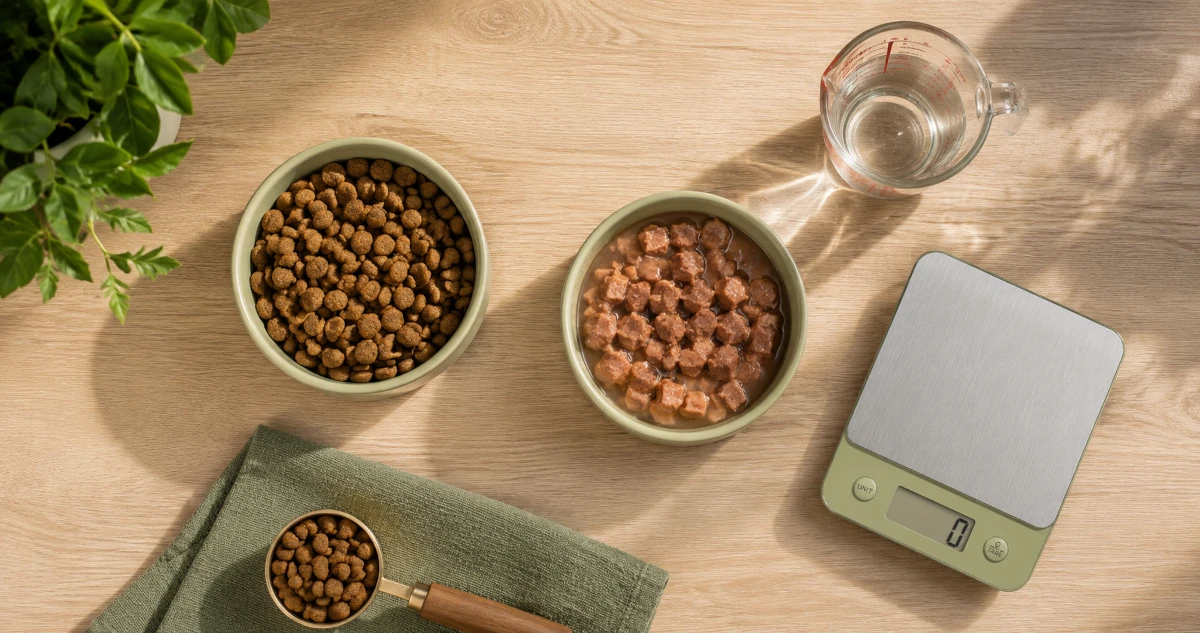
Many pet owners feed a mix of wet and dry food, perhaps dry kibble in the morning and a portion of wet food in the evening. It is a great approach for palatability, hydration, and nutritional variety. But how do you calculate the right amounts so you are not accidentally overfeeding or underfeeding?
The answer is simpler than it might seem: it is all about calories, not volume or weight.
Key takeaways
- Always base portion size on calories, not volume or weight.
- Check the "Calorie Content" section of your food label rather than assuming a standard value.
- When mixing wet and dry, calculate each portion from the same daily calorie budget.
- For cats especially, prioritizing wet food is a significant health benefit for hydration and urinary health.
- Check your pet's body condition monthly instead of waiting for vet visits to adjust portions.
Table of Contents
Quick answer: Use our free calculator to find your pet's daily calorie target (MER), then split that number between wet and dry food using the formula in Step 3 below.
Step 1: Know Your Pet's Daily Calorie Target (MER)
A 20 lb (9.1 kg) neutered adult dog needs a Maintenance Energy Requirement (MER) of approximately 586 kcal/day. That number is the starting point for every portion calculation below, so get your own pet's MER before moving on. Use our calculator for a personalized number, or refer to the reference tables in the dog feeding guide or cat feeding guide.
Step 2: Find the Caloric Density of Each Food
Every complete-and-balanced commercial pet food in the US must list caloric content on the label under "Calorie Content." This is expressed as kcal per cup (dry) or kcal per can / per 100g (wet).
Typical values (these vary, so always use your actual label):
| Food Type | Typical Range | Common Default |
|---|---|---|
| Dry kibble (dogs) | 280–550 kcal/cup | ~350 kcal/cup |
| Dry kibble (cats) | 280–520 kcal/cup | ~350 kcal/cup |
| Wet/canned (3 oz / 85g can) | 60–110 kcal | ~90 kcal |
| Wet/canned (5.5 oz / 156g can) | 120–200 kcal | ~150 kcal |
| Raw/fresh (per cup / 8 oz) | 300–550 kcal | ~450 kcal |
Step 3: The Blended-Diet Formula
When feeding both wet and dry food, decide what percentage of daily calories will come from each source, then calculate the portion size for each separately.
Formula:
Wet food portion = (MER × wet %) ÷ kcal per can
Dry food portion = (MER × dry %) ÷ kcal per cup
Worked Example
This 20 lb dog needs 586 kcal/day, split 50% wet and 50% dry. The wet food is 90 kcal per 3-oz can, and the dry food is 350 kcal/cup.
- Wet: (586 × 0.5) ÷ 90 = 3.3 cans per day
- Dry: (586 × 0.5) ÷ 350 = 0.84 cups per day
Spread across 2 meals: 1.7 cans + 0.42 cups per meal. If that many cans seems like a lot, consider shifting to 25% wet / 75% dry, which would be 1.6 cans + 1.3 cups per day.
⚖️ Tip: For wet food especially, a digital kitchen scale is more accurate than counting cans. Partial cans, different can sizes, and scooping inconsistency all add up. Weighing in grams removes the guesswork.
Common Split Ratios
| Ratio | When It Works Well |
|---|---|
| 100% Dry | Budget-focused, dogs/cats who drink plenty of water |
| 25% Wet / 75% Dry | Good balance of hydration, palatability, and cost |
| 50% Wet / 50% Dry | Strongly recommended for cats, good for picky eaters |
| 75% Wet / 25% Dry | Ideal for cats with urinary issues or chronic dehydration |
| 100% Wet | Best for cats with kidney disease or urinary conditions |
Wet vs Dry: Nutrition Comparison
| Factor | Dry Kibble | Wet / Canned |
|---|---|---|
| Moisture content | ~8–12% | ~70–82% |
| Caloric density (per gram) | Higher (4–5 kcal/g) | Lower (0.9–1.3 kcal/g) |
| Protein content (dry matter) | Moderate (26–34%) | Higher (42–52%) |
| Carbohydrates | Higher (30–50%) | Lower (2–10%) |
| Hydration benefit | Minimal | High (mimics prey moisture) |
| Palatability | Varies | Generally higher |
| Dental benefits | Some (kibble friction) | Minimal |
| Cost per calorie | Lower | Higher |
| Shelf life (open) | 6–8 weeks (sealed) | 3–5 days (refrigerated) |
Recommended Wet Cat Foods
If you are moving your cat toward a wetter diet, these three are consistently well-regarded, carry AAFCO adequacy statements for adult maintenance, and are easy to find. Check the current label before purchasing, since formulations can change.
Affiliate disclosure: Some links below go to Amazon. If you purchase through them, this site may earn a small commission at no additional cost to you. It does not affect which foods are recommended or how they are evaluated.
1. Purina Fancy Feast Classic Pâté: Best Everyday Value
Fancy Feast Classic is a smooth pâté with no added gravy fillers, which means the calorie density is more predictable than chunky or gravy-style varieties. Named animal proteins (chicken, turkey, beef, or seafood depending on the variety) appear at the top of the ingredient list. At roughly 80–90 kcal per 3-oz can and a low per-can price, it is one of the most cost-effective ways to significantly increase your cat's daily moisture intake. Widely available in multipacks that bring the per-can cost down further.
2. Purina Pro Plan Wet Cat Food: Best Science-Backed Pick
Board-certified veterinary nutritionists formulate Pro Plan's wet line and validate it through AAFCO feeding trials rather than relying on nutrient-profile calculations alone. The adult chicken and turkey varieties lead with named animal proteins, provide a solid EPA/DHA source from fish oil, and contain no artificial colors or preservatives. The caloric density runs approximately 80–100 kcal per 3-oz serving, which keeps the portioning math simple. A good choice if you want the research credibility of Purina's main line in a wet format.
3. Hill's Science Diet Adult Wet Cat Food: Most Vet-Recommended
Hill's has maintained a full staff of veterinary nutritionists since 1939 and is among the most frequently recommended brands in clinical practice. The adult wet formulas carry AAFCO adequacy statements validated through feeding trials, use chicken or tuna as the primary protein, and include omega-6 and omega-3 fatty acids for coat and urinary support. Caloric density sits around 70–90 kcal per 2.9-oz can. Available at most major grocery chains, pet retailers, and veterinary offices, useful if you want to buy locally rather than online.
Calculate Your Pet's Mixed-Diet Portions
Select "Mixed (Dry + Wet)" in the food type field for a tailored estimate.
🐾 Use the Free CalculatorFrequently Asked Questions
Is wet food or dry food better for dogs?
Both complete-and-balanced wet and dry foods can meet a dog's nutritional needs. Dry kibble is lower cost per calorie and may offer mild dental friction benefits. Wet food provides significantly more moisture and is often more palatable. A combination of both is a popular and practical choice for most dog owners.
Is wet food or dry food better for cats?
Wet food is generally recommended for cats because cats have a low natural thirst drive and evolved to get most of their hydration from prey (~70% water). Chronic mild dehydration is associated with urinary tract disease and kidney disease, the leading causes of death in domestic cats. Most veterinary nutritionists prefer wet food or a wet-heavy combination. For cans-per-day math instead of the cup-based estimates on this page, use the dedicated Wet Food Calculator for Cats.
How do I calculate portions when mixing wet and dry food?
Base everything on calories, not volume. Find your pet's daily MER using the calculator. Decide what percentage comes from each food type. Then: wet portion = (MER × wet%) ÷ kcal per can. Dry portion = (MER × dry%) ÷ kcal per cup. Always use the actual caloric content from your food label.
This article is for general informational purposes and is not a substitute for individualized veterinary advice. Consult your veterinarian about your pet's specific nutritional needs.