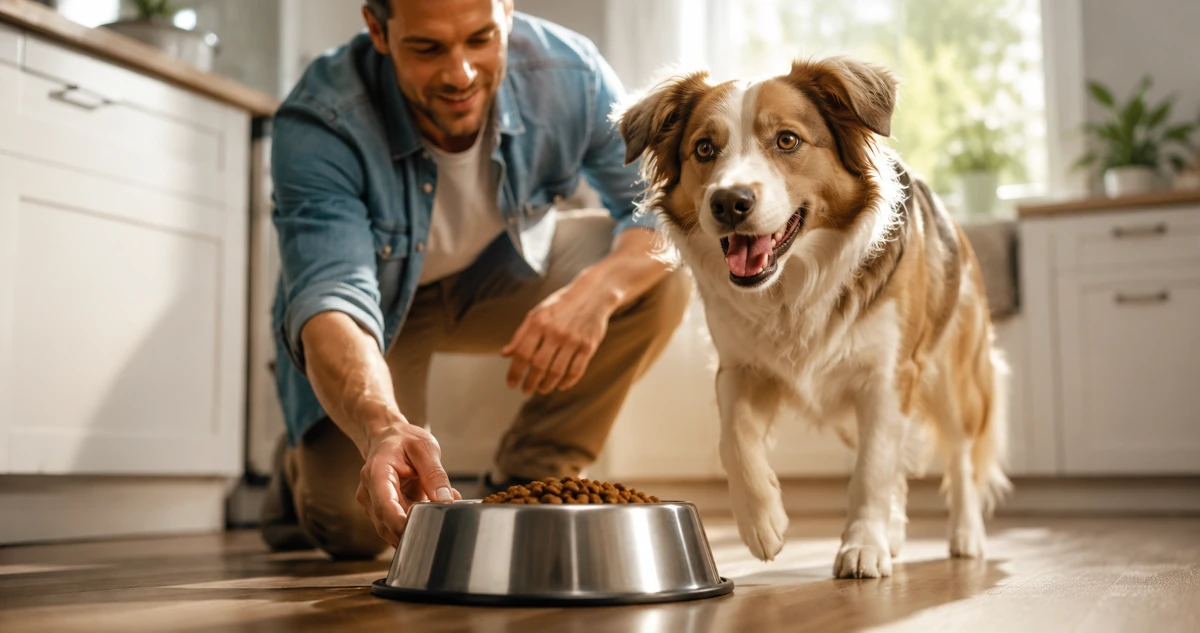
One of the most common questions dog owners ask their vet is how much to feed their dog, whether that means too much or not enough. It is a surprisingly hard question to answer from a pet food bag, because the back-of-bag feeding guides are notoriously generous (more food sold = more profit). The good news is that veterinary nutritionists have a precise, evidence-based method for how much to feed your dog, and you can use it right now.
Key takeaways
- Bag feeding charts are calibrated for an intact adult at moderate activity, so spay/neuter status, activity level, and age all shift actual needs.
- Calculate RER (70 × weight in kg0.75), then multiply by a life-stage factor to get MER, the real daily calorie target.
- Divide MER by your food's kcal-per-cup to get cups per day, a figure that varies significantly between brands.
- 2 meals a day suits most adults, while puppies need 3 to 4 to support growth and avoid hypoglycemia.
- Check body condition monthly and adjust the portion by about 10% if it is drifting off target.
Table of Contents
Quick answer: Use our free dog food calculator: enter your dog's weight, age, and activity level and get an instant calorie and cups-per-day estimate based on the same formula vets use.
Why Bag Feeding Guides Are Not Enough
Every bag of dog food prints a feeding chart on the back. These charts are better than nothing, but they have a fundamental flaw: they are designed for a generic "average" dog, usually an intact adult at moderate activity. They do not account for:
- Whether your dog is spayed or neutered (lowers needs by ~20–30%)
- Your dog's actual activity level
- Age (puppies need 2–3× the calories of adults, while seniors often need less)
- Body condition (overweight dogs need fewer calories than their current weight suggests)
Studies have shown that up to 59% of dogs in the United States are overweight or obese, the number one preventable chronic disease in companion animals. Getting the calories right is the most important thing you can do for your dog's long-term health.
The Vet-Standard Formula: RER and MER
Start with Resting Energy Requirement (RER): 70 × (body weight in kg)0.75. A life-stage multiplier then converts RER into Maintenance Energy Requirement (MER), the number your dog needs each day. This two-step formula comes from the National Research Council's Nutrient Requirements of Dogs and Cats (2006):
Step 1: Resting Energy Requirement (RER)
RER is the energy your dog needs at complete rest: to breathe, circulate blood, and maintain body temperature. The formula is:
Example: a 10 kg (22 lb) dog has an RER of 70 × 10^0.75 = 394 kcal/day.
Step 2: Maintenance Energy Requirement (MER)
MER is what your dog burns in real life. You multiply the RER by a life-stage factor:
| Life Stage / Status | Multiplier | Example (10 kg dog, RER = 394) |
|---|---|---|
| Puppy < 4 months | 3.0 | 1,182 kcal/day |
| Puppy 4 mo – 1 yr | 2.0 | 788 kcal/day |
| Neutered adult, moderate activity | 1.6 | 630 kcal/day |
| Intact adult, moderate activity | 1.8 | 709 kcal/day |
| Neutered adult, sedentary | 1.2 | 473 kcal/day |
| Neutered adult, very active | 2.0 | 788 kcal/day |
| Senior neutered | 1.4 | 552 kcal/day |
| Weight loss | 1.0 | 394 kcal/day |
| Lactating | 4.0 | 1,576 kcal/day |
Source: NRC 2006 and WSAVA Global Nutrition Guidelines.
How Many Cups of Dog Food Per Day?
Once you have your dog's MER in kcal/day, divide by the caloric density of your food (kcal per cup, printed on the bag under "Calorie Content").
Typical dry dog food ranges from 300–500 kcal/cup. Many premium brands land around 350–400 kcal/cup. Always use the number from your specific bag. It varies significantly by brand and formula.
Quick Reference: Cups per Day (350 kcal/cup, neutered adult)
| Dog Weight | RER | MER (×1.6) | Cups/Day |
|---|---|---|---|
| 5 lbs (2.3 kg) | 129 kcal | 206 kcal | 0.6 cups |
| 10 lbs (4.5 kg) | 218 kcal | 349 kcal | 1.0 cups |
| 20 lbs (9.1 kg) | 366 kcal | 586 kcal | 1.7 cups |
| 30 lbs (13.6 kg) | 496 kcal | 794 kcal | 2.3 cups |
| 50 lbs (22.7 kg) | 727 kcal | 1,163 kcal | 3.3 cups |
| 70 lbs (31.8 kg) | 936 kcal | 1,498 kcal | 4.3 cups |
| 100 lbs (45.4 kg) | 1,223 kcal | 1,957 kcal | 5.6 cups |
Calculated at 350 kcal/cup. Adjust for your actual food's caloric density. For personalized results, use the calculator.
How Many Meals Per Day?
Most adult dogs do well on 2 meals a day, morning and evening. This is better than 1 large meal, which can contribute to bloat in large breeds and leaves dogs hungry for long stretches. Puppies should eat 3–4 times per day to support steady growth and prevent hypoglycemia in small breeds.
Senior dogs and dogs with metabolic conditions may benefit from smaller, more frequent meals. Ask your vet.
Adjusting for Your Dog's Response
Check your dog's body condition monthly using the same scale vets use, then adjust the daily portion based on what you find. Individual metabolisms vary by up to ±20% from the RER/MER calculation, so treat the formula as a starting point rather than a fixed prescription:
- Ribs easily felt but not visible: ideal, stay the course
- Ribs hard to feel under fat: reduce daily portion by 10%
- Ribs prominent and easily seen: increase by 10%
Make changes gradually: a 10% adjustment over 2 weeks is safer than an abrupt cut or increase. Re-weigh your dog monthly for the first few months after any change.
🩺 Vet tip: If your dog is overweight, use the MER calculated at their ideal weight (not current weight) multiplied by 1.0 for a weight-loss plan. Always confirm weight-loss diets with your veterinarian.
Feeding Adjustments for Puppies, Large Breeds, and Seniors
Puppies need more calories per pound than adults, large and giant breeds need controlled growth to protect their joints, and seniors need closer monitoring as their metabolism slows.
Puppies
Puppies have significantly higher caloric needs per pound of body weight than adults. Feed puppy-specific food (higher protein, fat, calcium, and phosphorus ratios) until your dog reaches approximately 80% of their expected adult weight, around 9–12 months for most breeds, 18–24 months for giant breeds (Great Dane, Mastiff, etc.).
Large & Giant Breeds
Large-breed puppies are at risk for developmental orthopedic disease if they grow too fast. Use a large-breed puppy formula and avoid overfeeding. Aim for lean, steady growth rather than maximum growth rate. For a full breed-specific breakdown, including an age-by-age feeding chart, see the Labrador puppy feeding guide.
Senior Dogs
Senior age depends on size, and it runs opposite to what many owners assume: larger dogs age faster and become senior earlier. Following AAHA guidelines, most small breeds (under 20 lb) are considered senior around age 10, medium breeds around 9, large breeds around 7, and giant breeds as early as 6. Senior dogs often have lower activity levels and reduced metabolic rates, typically needing 10-20% fewer calories than they did as younger adults. Monitor body condition closely, as some seniors lose muscle mass while gaining fat, which can mask unhealthy weight changes. For age, size, and neuter-adjusted senior portions plus joint and kidney health guidance, use the dedicated Senior Dog Food Calculator.
Get Your Dog's Exact Numbers
Enter your dog's weight, age, and activity level for a personalized calorie and portion estimate.
🐾 Use the Free CalculatorFrequently Asked Questions
Can I use the bag feeding guide as a starting point?
Yes, but keep in mind that bag guides typically use intact adult dogs at moderate activity as their baseline. If your dog is spayed/neutered, lower the amount by ~20%. If your dog is sedentary, lower by a further 10–15%. Use the bag as a rough upper limit, not a target.
My dog seems hungry all the time. Am I underfeeding?
Not necessarily. Many dogs are opportunistic eaters and will act hungry regardless of how much they've eaten. Assess body condition (ribs should be easily felt but not visible) rather than relying on your dog's behavior. If body condition is ideal, your dog is not underfed.
How does wet food compare to dry kibble?
Wet food is ~70–80% moisture, so it is far less calorie-dense per gram than kibble. A standard 3-oz can of wet dog food typically provides 70–100 kcal. See the guide: Wet vs Dry Food: How Much of Each?
How many times a day should I feed my dog?
Most adult dogs do best on 2 meals per day, morning and evening. This is preferable to one large meal, which can contribute to bloat in large breeds. Puppies should eat 3–4 times per day to support growth and prevent hypoglycemia in small breeds.
I recently adopted a puppy. How much should I feed him each day by weight and age?
Puppies under 4 months need roughly 3× RER, and puppies 4 months to 1 year need roughly 2× RER, both split across 3-4 meals a day, well above the 1.6-1.8× multiplier used for adult dogs. For example, a 10 kg puppy under 4 months needs about 1,182 kcal/day versus 630 kcal/day for a neutered adult at the same weight. Use the calculator with your puppy's current weight and age, and recalculate every few weeks since puppies gain weight quickly and the multiplier changes as they age. For a full age-by-age chart, see the Labrador puppy feeding guide.
This article is for general informational purposes and is not a substitute for individualized veterinary advice. Consult your veterinarian about your dog's specific nutritional needs.