
Labrador puppies eat like they have never seen food before, even minutes after finishing a full bowl. That is not a training problem you can fix with more discipline. About 25% of Labradors carry a genetic mutation that keeps them feeling hungry between meals, and the breed's feeding guides on most bags are written for the average dog in the litter, not yours. Getting the daily amount right matters more here than for most breeds, because a Labrador puppy that grows too fast is more likely to develop joint problems as an adult.
This guide walks through the same RER/MER formula veterinary nutritionists use, a feeding chart by age and weight, and the specific reasons Labrador puppies need a large-breed growth formula rather than a standard puppy food.
Key takeaways
- Calculate your puppy's calorie needs from their actual weight, not their age alone: RER × 3.0 under 4 months, RER × 2.0 from 4 months to 1 year.
- About 25% of Labradors carry a POMC gene mutation that makes them feel hungrier between meals, so begging is not a reliable feeding signal.
- Use a large-breed puppy formula with controlled calcium and phosphorus to support steady, joint-safe skeletal growth.
- Feed 4 meals a day under 12 weeks, tapering to 2 meals by 6 months.
- Most Labradors are ready to transition to adult food between 12 and 18 months, once growth has leveled off.
Table of Contents
- Why Labrador Puppies Need Closer Portion Control
- The Formula: RER and Growth Multipliers
- Labrador Puppy Feeding Chart by Age and Weight
- Why a Large-Breed Puppy Formula Matters
- Meal Frequency and Schedule
- Checking Body Condition as You Go
- Puppy Food Well-Suited to Labrador Retrievers
- Transitioning to Adult Food
- Frequently Asked Questions
Quick answer: Use the free Large-Breed Puppy Feeding Calculator to get your Labrador puppy's exact daily calorie and cup target based on their current weight, age, and estimated adult size. Results in under 60 seconds, no account required.
Why Labrador Puppies Need Closer Portion Control
2 things set Labrador puppies apart from a typical medium-sized breed. First, they carry a well documented genetic predisposition to obesity. Researchers at the University of Cambridge found that around 25% of Labradors carry a deletion in the POMC gene, which disrupts hormones that normally signal fullness. Dogs with the mutation do not need to eat more to feel satisfied in the moment, but they get hungry again faster and burn fewer calories at rest. The study, published in the Journal of Veterinary Internal Medicine, is a big part of why Labradors show up so consistently at the top of "most food-motivated breed" lists. Begging in this breed is closer to a personality trait than a reliable hunger signal.
Second, Labradors are a large breed by AKC standards, with adult males reaching 65 to 80 pounds and adult females 55 to 70 pounds, according to the American Kennel Club breed standard. Getting that much size onto a frame in roughly 18 months puts real strain on developing joints. Labrador Retrievers are also one of the breeds most studied for hip dysplasia. Historical Orthopedic Foundation for Animals data put breed-wide prevalence at roughly 11.5%, and overfeeding during growth is one of the modifiable risk factors that makes the condition worse. Combine a dog that always wants more food with a skeleton that grows faster than it should on excess calories, and precise portioning stops being optional.
The Formula: RER and Growth Multipliers
The starting point is the Resting Energy Requirement (RER): the energy your puppy burns keeping their body running, before counting any activity or growth. The veterinary formula, drawn from the National Research Council's Nutrient Requirements of Dogs and Cats, is:
RER = 70 × (body weight in kg)0.75
Growing puppies need substantially more than RER to fuel bone and muscle development, so you multiply RER by a life-stage factor to get the Maintenance Energy Requirement (MER):
| Life Stage | Multiplier | Example (15 kg / 33 lb puppy, RER = 583) |
|---|---|---|
| Puppy under 4 months | × 3.0 | 1,749 kcal/day |
| Puppy 4 months to 1 year | × 2.0 | 1,166 kcal/day |
Worked example: a 15 kg (33 lb) 3-month-old Labrador puppy has an RER of 70 × 150.75 ≈ 583 kcal. At the under-4-months multiplier of 3.0, MER comes to roughly 1,749 kcal per day. Divide that by the kcal-per-cup figure printed under "Calorie Content" on the food bag to get the daily cup amount, then split it across 3 to 4 meals.
These multipliers, and the formula itself, are the same ones used throughout this site's general dog feeding guide. The one thing that changes for Labradors specifically is how often you should re-run the numbers: weekly during the first 4 months, since a fast-growing large-breed puppy can gain a pound or more per week.
Labrador Puppy Feeding Chart by Age and Weight
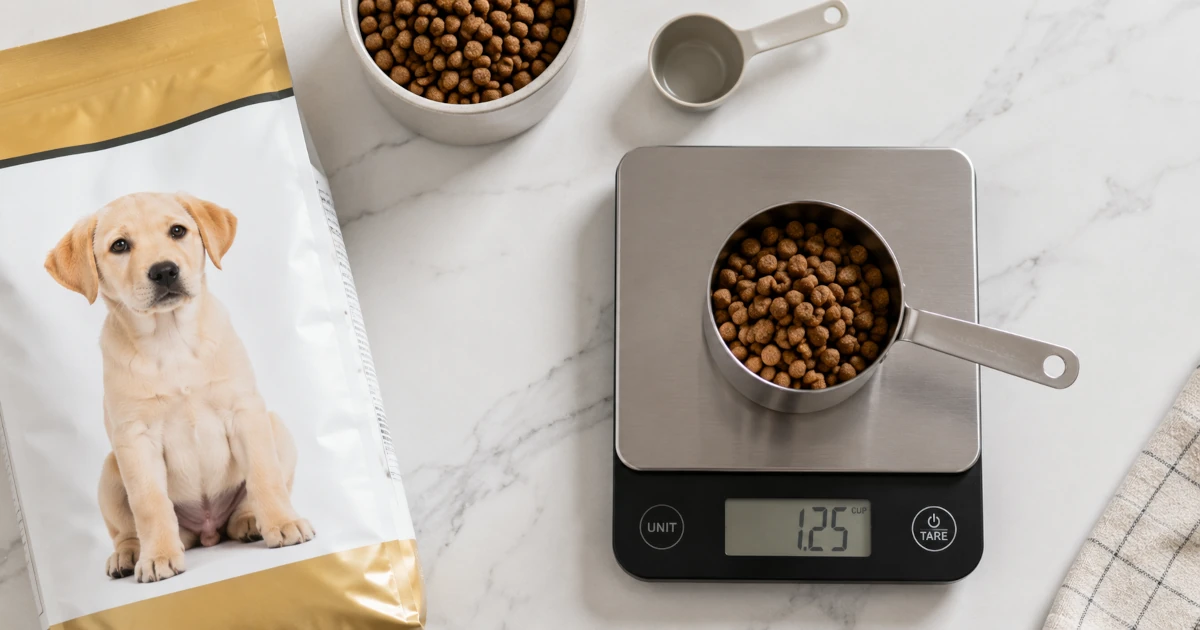
The chart below sets meal count and growth multiplier by age, from 4 meals a day at 8 weeks down to 2 meals at 12 months and beyond. Labrador puppies vary widely in size depending on lineage, sex, and individual growth rate, so treat the weight ranges as typical rather than a target. Weigh your puppy weekly and use their actual weight in the RER formula above, or let the Large-Breed Puppy Feeding Calculator do the math automatically, including the 12-18 month extended growth stage that a standard puppy calculator doesn't account for.
 PetFeedCalculator
petfeedcalculator.com
PetFeedCalculator
petfeedcalculator.com
Labrador Puppy Feeding Chart by Age and Weight
| Age | Typical Weight Range | Meals/Day | Multiplier |
|---|---|---|---|
| 8 weeks | 8–15 lbs (3.6–6.8 kg) | 4 | × 3.0 |
| 3 months | 18–28 lbs (8.2–12.7 kg) | 4 | × 3.0 |
| 4–6 months | 30–55 lbs (13.6–25 kg) | 3 | × 2.0 |
| 6–12 months | 45–78 lbs (20.4–35.4 kg) | 2–3 | × 2.0 |
| 12+ months (adult) | 55–80 lbs (25–36.3 kg) | 2 | × 1.6 (neutered, moderate activity) |
Weight ranges are illustrative, based on common breed growth patterns for both English and American Labrador lines. Individual puppies can fall outside these ranges and still be perfectly healthy. Multipliers follow NRC 2006 and WSAVA growth guidance.
Get your puppy's exact portion at petfeedcalculator.com
Once your puppy's weight is close to the adult range for their sex, the calorie math shifts from a growth multiplier to an adult maintenance multiplier. That transition is covered in more detail in Transitioning to Adult Food below.
Why a Large-Breed Puppy Formula Matters
A persistent myth holds that big puppies need extra calcium to build strong bones. It is the opposite: excess calcium and phosphorus, or simply too many calories, push bone growth faster than a puppy's joints can safely keep up with, raising the risk of developmental orthopedic disease. VCA Animal Hospitals recommends a calcium-to-phosphorus ratio between 1.1:1 and 1.4:1 for large-breed puppies, along with calorie control precise enough to keep growth steady rather than maximal. A food labeled "large breed puppy" or "growth, large size" is formulated to do exactly this. A standard puppy formula sized for a Beagle or Cocker Spaniel is not.
Look for an AAFCO nutritional adequacy statement that specifically references "growth of large size dogs (70 lb. or more as adults)." A food that only meets the general growth profile, without the large-breed qualifier, has not been formulated with the calcium ceiling this breed needs.
🩺 Vet tip: Do not add calcium, cottage cheese, or bone meal supplements to a complete large-breed puppy food. Doing so can push the calcium-to-phosphorus ratio out of the safe range and increase orthopedic risk rather than reducing it.
Meal Frequency and Schedule
Splitting the daily total into more, smaller meals matters more for Labrador puppies than for most breeds, for 2 reasons: it steadies blood sugar during rapid growth, and it reduces the risk of gastric dilatation-volvulus (bloat), a life-threatening condition that deep-chested large breeds are more prone to than average.
- 8–12 weeks: 4 meals a day
- 3–6 months: 3 meals a day
- 6–12 months: 2 to 3 meals a day
- 12 months and older: 2 meals a day
Avoid vigorous exercise for an hour before and after meals, and use a slow-feeder bowl if your puppy tends to eat quickly. Both habits reduce bloat risk without changing how much food they get.
Checking Body Condition as You Go
The formula gets you close, but your hands are the final check. Run them along your puppy's ribcage every couple of weeks: you should feel the ribs easily under a thin layer of fat, without pressing hard. Viewed from above, there should be a visible waist behind the ribcage, and from the side, a slight upward tuck of the abdomen. A step-by-step walkthrough of the full 9-point scale is in Is My Dog Overweight?
If the waist disappears or the ribs get harder to feel, cut the daily amount by about 10% and recheck in two weeks. If ribs or spine become sharp to the touch, increase by the same margin. Small, early corrections are far easier to make than fixing several months of drift in either direction.

Puppy Food Well-Suited to Labrador Retrievers
The 3 formulas below all carry an AAFCO adequacy statement for large-breed growth and hold calcium in the controlled range Labrador puppies need.
Affiliate disclosure: Some links below go to Amazon. If you purchase through them, this site may earn a small commission at no additional cost to you. It does not affect which foods are recommended or how they are evaluated.
Food formulations change without public notice. Verify the current AAFCO statement and ingredient list on the product label before purchasing.
1. Royal Canin Labrador Retriever Puppy: Best Breed-Specific Formula
Royal Canin builds this formula specifically for purebred Labrador puppies from 8 weeks to 15 months old, with a kibble shape designed to slow down a breed known for gulping its food. The guaranteed analysis lists 31% crude protein and 12% crude fat, with calcium held at 1.08% to support the controlled growth rate large-breed puppies need. It carries an AAFCO adequacy statement for growth of large-size dogs.
2. Purina Pro Plan Development Large Breed Puppy (Chicken & Rice): Best Science-Backed Pick
Purina employs board-certified veterinary nutritionists and validates its adequacy statements through feeding trials rather than nutrient math alone. This formula lists chicken as the first ingredient, includes natural glucosamine for developing joints, and adds DHA from fish oil for brain and vision development. Calcium sits at 1.1%, in line with large-breed growth guidance.
3. Hill's Science Diet Puppy Large Breed (Chicken & Brown Rice): Most Widely Available
Hill's has produced veterinarian-recommended nutrition since 1939 and maintains a full staff of board-certified veterinary nutritionists. This formula is built around an optimal calcium level (1.16%) for controlled bone growth, with DHA and fish oil for brain and eye development. It is stocked at most major pet retailers and veterinary practices, making it a reliable default when availability matters as much as formulation.
Get Your Puppy's Exact Daily Portion
Enter their weight, age, and estimated adult size for a calorie and cups-per-day estimate that accounts for the large-breed growth timeline. Free, no account needed.
🐾 Use the Large-Breed Puppy CalculatorTransitioning to Adult Food
Most Labradors are ready to move to an adult maintenance formula between 12 and 18 months, once growth has visibly slowed and they are close to their adult weight, according to VCA Animal Hospitals. Switching earlier cuts off the controlled calcium and calorie profile that large-breed puppy food provides, right when the growth plates are still closing. There is little downside to staying on puppy food a few months longer than necessary. There is real downside to switching too early.
Make the switch gradually over 7 to 10 days, mixing increasing proportions of the new food into the old to avoid digestive upset. Once fully transitioned, recalculate the daily amount using the adult multiplier (1.6 for a neutered adult at moderate activity) covered in the general dog feeding guide, and continue checking body condition every few weeks rather than assuming the growth-phase portion still applies.
Frequently Asked Questions
How much should I feed my Labrador puppy?
It depends on current weight and age, not a fixed cup measurement. Calculate RER (70 × body weight in kg0.75), then multiply by 3.0 under 4 months or 2.0 from 4 months to 1 year. Divide by the kcal-per-cup value on your food's label, and split the result across 3 to 4 meals. Use the Large-Breed Puppy Feeding Calculator for a number personalized to your puppy's exact weight, age, and estimated adult size.
Why does my Labrador puppy always act hungry?
Around 25% of Labradors carry a mutation in the POMC gene that disrupts the hormones responsible for signaling fullness, according to a University of Cambridge study. Affected dogs feel hungrier between meals even when they are eating enough. Begging is not a reliable signal that your puppy needs more food.
When should I switch my Labrador puppy to adult food?
Most Labradors can transition between 12 and 18 months, once growth has slowed and the puppy is close to its adult weight. Switching earlier risks cutting off the controlled calcium and calorie profile that supports proper skeletal development.
Is it bad to overfeed a Labrador puppy?
Yes. Overfeeding accelerates bone growth even without visible weight gain, which raises the risk of developmental orthopedic problems like hip and elbow dysplasia in a breed already predisposed to joint disease. Steady, controlled growth produces a healthier adult frame than rapid growth.
Do Labrador puppies need a large-breed puppy formula?
Yes. Labradors typically exceed 50 to 70 pounds as adults, which puts them in the large-breed category. A large-breed puppy formula controls calcium and phosphorus levels and calorie density to slow bone growth to a safe rate, reducing the risk of joint problems later in life.
How many meals a day should a Labrador puppy eat?
Feed 4 meals a day up to 12 weeks old, 3 meals a day from 3 to 6 months, and 2 meals a day from 6 months onward. Splitting the daily total into multiple meals supports steady digestion and helps prevent the stomach bloating that large-breed dogs are prone to.
This article is for general informational purposes and is not a substitute for individualized veterinary advice. Consult your veterinarian about the right feeding plan for your Labrador puppy, especially regarding growth rate and joint health.