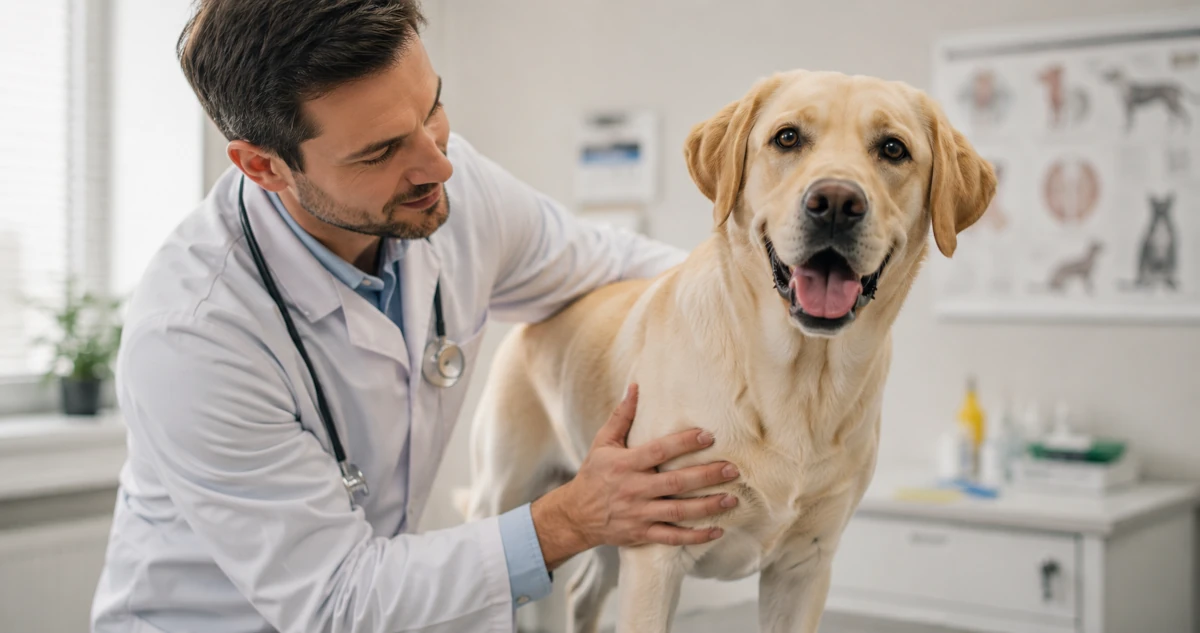
Is your dog or cat carrying more weight than is healthy? Most owners cannot tell on their own: in surveys, the majority of owners of overweight pets rate their pet's weight as "normal." The Association for Pet Obesity Prevention classifies more than 59% of dogs and 61% of cats in the United States as overweight or obese, and that widespread normalization of excess weight is shortening their lives.
The good news: you can assess your pet's weight at home, right now, using the same tool veterinarians use: the Body Condition Score (BCS).
Key takeaways
- More than half of dogs and cats in the US are overweight or obese, and most owners misjudge their own pet's condition as normal.
- Body Condition Score (BCS), not scale weight, is the reliable measure: it accounts for frame size via the rib test, waist check, and abdominal tuck.
- A BCS of 4 to 5 on the WSAVA 9-point scale is ideal, while a score of 6 or higher signals it is time to reduce portions.
- Weight loss should be gradual: 0.5 to 1% of body weight per week for cats, 1 to 2% for dogs, since crash diets in cats risk fatty liver disease.
- Measuring with a kitchen scale instead of a cup avoids the 10 to 80% overfeeding error common with volume-based scoops.
Table of Contents
🩺 Why scale weight alone is not enough: A Labrador at 80 lbs might be perfectly lean, or significantly overweight, depending on their frame. Body condition assesses fat coverage and muscle mass relative to body structure, not raw pounds alone. Once you know your pet's body condition, use the free calculator to find their daily calorie target.
The Body Condition Score (BCS) Scale
The WSAVA (World Small Animal Veterinary Association) uses a 9-point BCS scale: 1 = emaciated, 9 = severely obese, 4–5 = ideal. Here's how to assess your pet at home using 3 key areas:
How to Assess Your Pet's BCS at Home
Run 3 hands-on checks: feel the ribs, look at the waist from above, and check the abdominal tuck from the side. Together, these tell you more than the scale does.
1. The Rib Test
Place both hands flat on your pet's ribcage, thumbs on the spine, fingers spread over the ribs. Apply gentle pressure, about the pressure you'd use on your own closed eyelid.
- Ribs feel like knuckles (prominent, no coverage): BCS 1–3 (underweight)
- Ribs feel like the back of your hand (slight coverage, easily felt): BCS 4–5 (ideal)
- Ribs feel like your palm (hard to feel, padded): BCS 6–7 (overweight)
- Ribs almost impossible to feel: BCS 8–9 (obese)
2. The Waist Check (from above)
Look down at your pet from directly above. Between the ribcage and hips, you should see a visible "waist," a slight inward taper.
- Hourglass shape visible: ideal or lean
- Slightly narrowed but not pronounced: BCS 5–6
- Straight line from ribs to hips (no taper): overweight
- Wider at the middle than at ribs or hips: obese
3. The Tummy Tuck (side profile)
View your pet from the side. The abdomen should tuck upward behind the ribcage, not hang down.
- Visible abdominal tuck: lean to ideal
- Level with or slightly below ribcage: slightly overweight
- Hangs down: overweight to obese
BCS Quick Reference
| BCS | Description | What You'll Notice | Action |
|---|---|---|---|
| 1–2 | Emaciated / Very thin | Ribs, spine, and hip bones visible with no muscle mass | Vet visit urgently |
| 3 | Thin | Ribs visible, minimal fat, waist prominent | Increase calories, monitor |
| 4–5 | ✅ Ideal | Ribs easily felt, visible waist, abdominal tuck present | Maintain current feeding |
| 6 | Slightly overweight | Ribs feel with light pressure, waist less pronounced | Reduce by ~10%, recheck in 4 wks |
| 7 | Overweight | Ribs require moderate pressure, little waist, fat deposits at base of tail | Reduce by 15–20%, vet check |
| 8–9 | Obese | Ribs hard to feel even with firm pressure, no waist, pendulous abdomen, heavy fat deposits | Vet-supervised weight loss plan |
Health Risks of Excess Weight
Carrying extra weight is not cosmetic. It is a significant medical issue for pets. Research links obesity in dogs and cats to:
- Shorter lifespan: Overweight Labrador Retrievers in a landmark study lived nearly 2 years less than their lean counterparts (Kealy et al., JAVMA 2002)
- Osteoarthritis and joint pain
- Type 2 diabetes (especially in cats)
- Hypertension and cardiac disease (especially consequential for breeds like the Cavalier King Charles Spaniel)
- Breathing difficulties (especially in brachycephalic breeds)
- Surgical and anesthetic complications
- Urinary tract disease (cats)
- Reduced immune function and increased cancer risk
How to Help Your Pet Lose Weight Safely
Never put a cat on a crash diet. Rapid caloric restriction in cats can trigger hepatic lipidosis (fatty liver disease), a potentially fatal condition. A safe rate of weight loss for cats is 0.5–1% of body weight per week. For dogs, 1–2% per week is generally safe.
Step-by-step weight loss plan
- Get a starting weight and BCS, ideally at a vet visit
- Calculate MER using your pet's target ideal weight with a weight-loss multiplier (1.0× for dogs, 0.8× for cats)
- Switch to measured portions using a digital kitchen scale, since volume cups are inaccurate
- Eliminate treats, or deduct their calories from the daily budget (treats should be ≤10% of total calories)
- Reweigh every 2–4 weeks and adjust by 10% if not losing at the target rate
- Increase low-impact exercise gradually (short walks for arthritic dogs, wand toys for cats)
📏 Use a scale, not a cup: A study by Coe et al. (JAVMA 2011) found that when using measuring cups, pet owners consistently measured 10–80% more food than intended, depending on kibble size and cup design. A digital kitchen scale is far more accurate.
When to See a Vet
A veterinarian should always supervise weight loss goals for obese pets (BCS 7–9). Your vet can rule out underlying medical causes of weight gain (hypothyroidism in dogs, Cushing's disease, etc.), recommend a therapeutic weight-loss diet, and monitor for any complications during the process.
Calculate Calories for Your Pet's Ideal Weight
Use the BCS field in our calculator: it will show your pet's estimated target weight range and the calories needed to reach it.
🐾 Open the CalculatorFrequently Asked Questions
How can I tell if my dog is overweight?
The most reliable method is the Body Condition Score (BCS). Place your hands on your dog's ribcage. Ribs should be easily felt without pressing hard, but not visibly prominent. From above, a visible waist taper should be present. From the side, the abdomen should tuck up behind the ribcage. If ribs are hard to feel or no waist is visible, your dog is likely overweight. An ideal dog has a BCS of 4–5 on the 9-point WSAVA scale.
How can I tell if my cat is overweight?
Use the same 3-point check as for dogs: rib test, overhead waist check, and side profile abdominal tuck. For cats specifically, also check for fat pads in the groin and at the base of the tail, and a pendulous belly. More than 61% of domestic cats in the US are classified as overweight or obese, making this a common concern.
What is a healthy weight for my pet?
There is no single healthy weight. It depends on breed, frame size, and sex. That is why veterinarians use Body Condition Score rather than a weight target. An ideal BCS of 4–5 on the 9-point scale means your pet has appropriate muscle coverage and fat levels regardless of their exact weight in pounds or kg.
How quickly should my pet lose weight?
A safe rate of weight loss is 0.5–1% of body weight per week for cats, and 1–2% per week for dogs. Faster weight loss in cats can trigger hepatic lipidosis (fatty liver disease), which is potentially fatal. Always have weight-loss programs for obese pets (BCS 7+) supervised by a veterinarian.
How do I tell if my dog is overweight and how much should I cut back his food?
Run the rib, waist, and abdominal-tuck check above to get a Body Condition Score. A BCS of 6 means ribs are felt only with firm pressure and the waist is barely visible: cut daily food by about 10% and recheck in 4 weeks. A BCS of 7 or higher, with ribs hard to feel and no visible waist, calls for a 15-20% reduction and a vet visit to rule out medical causes. Recalculate the target using the calculator with a weight-loss multiplier instead of eyeballing a smaller scoop.
References
Kealy RD, et al. "Effects of diet restriction on life span and age-related changes in dogs." JAVMA 2002;220(9):1315–1320. | Brooks D, et al. "2014 AAHA Weight Management Guidelines for Dogs and Cats." JAAHA 2014. | Coe JB, et al. "Measurement of dry dog food using volume-based measuring cups." JAVMA 2011;238(11):1450–1454. | WSAVA Global Nutrition Guidelines (2011, updated 2013).
This article is for general informational purposes and is not a substitute for individualized veterinary advice. Consult your veterinarian before starting a weight-loss plan, especially for pets with existing health conditions.