
Cavalier King Charles Spaniels are among the most affectionate dogs you will find, and among the most medically vulnerable. Approximately half develop a detectable heart murmur by age 5, and the prevalence approaches 100% by age 10, a reality documented across decades of veterinary cardiology research. Nutrition cannot prevent mitral valve disease (MVD), but the right diet directly affects 2 things that slow its progression: your dog's body weight and the health of the cardiovascular system that supports it.
This guide covers what Cavaliers specifically need from their food, what to look for on a label, 3 foods well-suited to the breed, and how to translate a daily calorie target into the right amount per meal.
Key takeaways
- Cavaliers carry a high genetic risk of mitral valve disease, so body weight and cardiac-supportive nutrients like taurine and EPA/DHA matter more here than for most breeds.
- Look for a named animal protein (chicken, salmon, turkey) as the first ingredient, not vague terms like "meat" or "poultry."
- Whole grains are the lower-risk default given the FDA's ongoing investigation into grain-free diets and dilated cardiomyopathy.
- Adult Cavaliers typically need 397 to 544 kcal per day, calculated from RER × MER rather than read off the bag's feeding chart.
- Check body condition score every two to four weeks, since even one pound of extra weight adds meaningful cardiac strain in this breed.
Table of Contents
- Why Cavalier Nutrition Is a Different Conversation
- Core Nutritional Priorities for the Breed
- A Note on Grain-Free Diets for Cavaliers
- How Much to Feed a Cavalier by Life Stage
- Reading the Label: What Matters
- 3 Foods Well-Suited to Cavalier King Charles Spaniels
- Calculating the Right Daily Portion
- Frequently Asked Questions
Quick answer: Use the free dog food calculator to find your Cavalier's exact daily calorie and portion target based on their current weight, age, and activity level. Results in under 60 seconds, no account required.
Affiliate disclosure: Some links in this guide go to Amazon. If you purchase through them, this site may earn a small commission at no extra cost to you. It does not affect which foods are recommended or how they are evaluated.
Formulas change. Manufacturers reformulate lines and update ingredients without public notice. Last reviewed: September 2026. Before purchasing, verify the current AAFCO statement and ingredient list on the product label.
Why Cavalier Nutrition Is a Different Conversation
2 factors set Cavalier nutrition apart from general dog feeding advice: strict weight management and cardiac-support nutrients. The Association for Pet Obesity Prevention reports that approximately 59% of dogs in the United States are overweight or obese, and for a breed with an elevated baseline risk of heart disease, that extra weight carries more danger than it does for a Labrador or Border Collie. A Cavalier carrying even a pound of extra body fat places measurably more strain on a heart already working against a genetic predisposition.
The second factor is nutrients that support cardiac muscle function directly. Taurine (an amino acid derived from animal protein) and the long-chain omega-3 fatty acids EPA and DHA have established roles in cardiac health. A diet built around quality animal protein and supplemented with fish-derived omega-3s addresses both priorities.
Core Nutritional Priorities for the Breed
A Cavalier's diet should prioritize high-quality animal protein, taurine-supporting nutrition, and precise calorie control, the 3 factors most directly tied to this breed's cardiac health.
High-Quality Animal Protein
Protein is the foundation. Named animal proteins (chicken, turkey, beef, salmon, lamb) should appear as the first ingredient. They deliver complete amino acid profiles, including the taurine precursors methionine and cysteine that your dog uses to synthesize taurine internally. Generic descriptors like "meat" or "animal protein" with no species identified offer no useful information. "Deboned chicken" or "chicken meal" is what belongs at the top of the list.
A minimum crude protein content of 25% (on a dry matter basis) is appropriate for a healthy adult Cavalier. Higher is fine, provided the protein comes from quality animal sources rather than plant ingredients added to inflate the percentage on the guaranteed analysis panel.
Taurine and Omega-3 Fatty Acids
Taurine is essential for the electrical and contractile function of cardiac muscle. Dogs synthesize taurine from animal-derived amino acids, so a diet grounded in whole animal protein is generally sufficient for healthy dogs. If your Cavalier has been diagnosed with any cardiac condition, your veterinarian may recommend testing taurine levels and supplementing directly if values are low.
EPA (eicosapentaenoic acid) and DHA (docosahexaenoic acid) are the omega-3 fatty acids found in cold-water fish and fish oil. Both reduce systemic inflammation. EPA in particular has been studied for its role in lowering inflammatory markers associated with cardiac stress. Look for fish, fish meal, or fish oil in the ingredient list, or a food that states EPA and DHA content explicitly on the label.
Calorie Density and Portion Precision
An adult Cavalier weighs between 12 and 18 pounds, per the AKC breed standard. Within that range, the daily calorie requirement for a neutered adult at moderate activity sits between roughly 400 and 545 kcal per day. Those are not large numbers. A single cup of a calorie-dense premium kibble can approach or exceed a full day's intake for a smaller Cavalier, which is why measuring by feel or by the bag's generic scoop guide tends to produce overweight dogs.
Precision portioning, based on the actual kcal content of your food, is the single most effective dietary habit you can build for a Cavalier's long-term health. The math is simple once you have 2 numbers: your dog's daily calorie target and the kcal-per-cup value from the bag label.

A Note on Grain-Free Diets for Cavaliers
Since 2018, the FDA has been investigating a potential association between grain-free diets and dilated cardiomyopathy (DCM), a form of heart muscle disease distinct from, but sometimes coexisting with, MVD. Researchers have not established a causal link as of 2026, and the investigation remains open. For a breed already carrying elevated cardiac risk, choosing a food that includes whole grains (brown rice, oats, barley) is the lower-risk default unless your veterinarian has identified a specific clinical reason to avoid them. For the FDA's current advisory, see the FDA's grain-free DCM investigation page.
🩺 Vet tip: If your Cavalier has an existing murmur or cardiac diagnosis, discuss any diet change, including switching protein sources or adding supplements, with your veterinarian before making it.
How Much to Feed a Cavalier by Life Stage
Puppies need more calories per pound than adults, adults need the most consistent portion control, and seniors need less food but more protein per calorie. Here's how requirements shift at each stage.
Cavalier Puppies (Under 10–12 Months)
Puppies have significantly higher calorie needs per pound of body weight than adults, along with elevated calcium and phosphorus requirements to support rapid skeletal development. Use a food carrying an AAFCO nutritional adequacy statement for "growth" or "all life stages." A small-breed puppy formula is appropriate for Cavaliers. Large-breed puppy formulas are specifically designed to slow growth rates and should not be used for this breed. Feed 3 meals daily until around 16 weeks, then transition to 2.
Adult Cavaliers (Ages 1–7)
Adult maintenance is where most Cavaliers spend the majority of their lives, and where weight creep most commonly begins. A neutered adult at moderate activity requires a Maintenance Energy Requirement (MER) equal to 1.6 times their Resting Energy Requirement (RER). The full RER/MER calculation is covered in the dog feeding guide. The calculator on this site does the math automatically. Weigh your dog monthly and adjust portions in 10% increments if body condition drifts in either direction.
Senior Cavaliers (Age 7 and Up)
As activity decreases with age, total calorie needs drop, but protein requirements do not. Senior dogs need higher-quality protein to preserve lean muscle mass even as overall intake decreases. A MER multiplier of 1.4 is a reasonable starting point for a moderately active senior Cavalier. If dental health has become a factor, wet food or softened kibble may be more comfortable and better tolerated. Discuss glucosamine and chondroitin supplementation with your vet if mobility has become a concern.
| Dog Weight | RER | MER: Neutered Adult (×1.6) | Est. Cups/Day at 350 kcal/cup |
|---|---|---|---|
| 12 lbs (5.4 kg) | 248 kcal | 397 kcal | ~1.1 cups |
| 15 lbs (6.8 kg) | 295 kcal | 472 kcal | ~1.4 cups |
| 18 lbs (8.2 kg) | 340 kcal | 544 kcal | ~1.6 cups |
Calculated using RER = 70 × (body weight in kg)0.75. Source: NRC 2006 and WSAVA Global Nutrition Guidelines. Cup estimates assume 350 kcal/cup. Verify the caloric density of your specific food before calculating portions.
Reading the Label: What Matters
2 things matter most on a Cavalier food label: the AAFCO adequacy statement and the first ingredient. Everything else is secondary.

The AAFCO Statement
Every nutritionally complete dog food sold in the United States must carry an AAFCO nutritional adequacy statement. "Complete and balanced" is the phrase to look for. Any food labeled "for intermittent or supplemental feeding only" cannot serve as your dog's primary diet, regardless of what the front of the bag claims. The statement also specifies life stage: "for adult maintenance," "for growth," or "for all life stages." Match it to your dog.
If the adequacy statement indicates the food was validated through an actual AAFCO feeding trial (rather than formulated to meet a nutrient profile on paper), that adds weight to the claim. Purina and Hill's are 2 brands that consistently use feeding trial validation.
The First Ingredient
Named animal proteins (chicken, beef, salmon, lamb, turkey) should occupy the top position. Chicken meal and turkey meal are concentrated, acceptable sources and often appear alongside fresh meat. What you want to avoid is vague descriptors like "meat" or "poultry" with no species identified, or plant proteins such as corn gluten meal appearing in the first 2 or 3 ingredient slots.
Fillers and Additives to Watch For
Corn, wheat, and soy used as primary bulk ingredients add protein numbers to the guaranteed analysis without delivering the complete amino acid profiles that animal protein provides. A whole grain like brown rice or oats mid-list is fine and nutritionally appropriate. A food where the first 3 ingredients are grains is not optimized for a Cavalier's protein or cardiac needs. Artificial colors, synthetic preservatives (BHA, BHT), and excessive added flavor enhancers are also indicators of lower-quality formulation. Mixed tocopherols (vitamin E) as a natural preservative is the preferred alternative.
| Nutritional Factor | Why It Matters for Cavaliers | What to Look For on the Label |
|---|---|---|
| Animal Protein (first ingredient) | Provides taurine precursors and a complete amino acid profile for cardiac and muscle health | Named species: chicken, beef, salmon, turkey, lamb, meal forms are acceptable |
| Omega-3s (EPA & DHA) | Anti-inflammatory, EPA in particular supports cardiovascular function | Fish, fish meal, or fish oil in the ingredient list, or EPA/DHA listed in nutrient content |
| Calorie Density | Small daily calorie budgets make overfeeding easy, high-density foods shrink the margin for error | Kcal/cup in the "Calorie Content" section, 320–400 kcal/cup allows controlled portioning |
| Grain Content | Grain-free formulas carry an unresolved DCM risk signal for this cardiac-vulnerable breed | Whole grains (brown rice, oats, barley) are preferred over legume-heavy grain-free bases |
3 Foods Well-Suited to Cavalier King Charles Spaniels
These 3 foods each carry named animal protein and fish-derived omega-3s, matched to different priorities and budgets for a Cavalier owner.
Quick comparison before the full breakdown:
| Food | Protein (dry matter basis) | Price | AAFCO life stage |
|---|---|---|---|
| 1. Royal Canin CKCS Adult | 27.8% | $$$ (~$7.70-9.20/lb) | Adult maintenance |
| 2. Purina Pro Plan Small & Toy Breed Adult | 33.0% | $ (~$2.24/lb) | Adult maintenance |
| 3. Hill's Science Diet Adult Small Paws | 22.2% | $$ (~$2.65/lb) | Adult maintenance |
Protein is shown on a dry-matter basis so formulas with different moisture content are comparable. Prices are per-pound estimates from current bag pricing at major retailers and fluctuate. Use them for relative comparison, not as quoted totals.
1. Royal Canin Cavalier King Charles Spaniel Adult: Best Overall
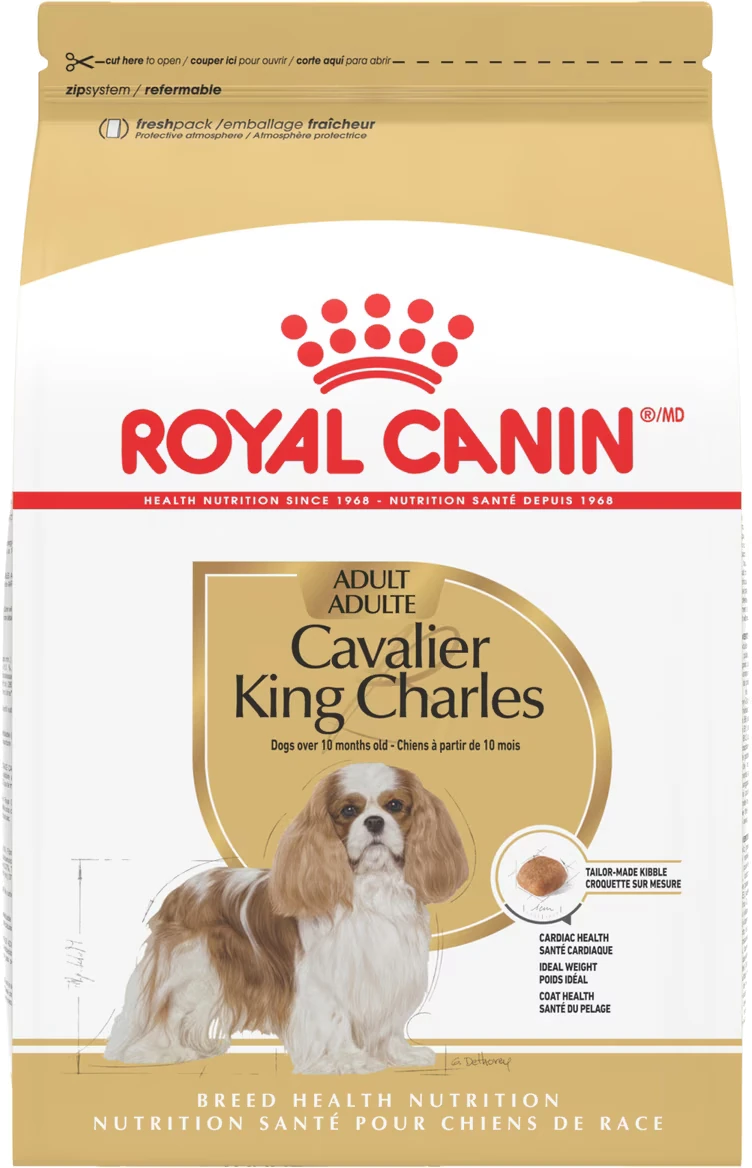
Royal Canin produces a formula designed specifically for this breed, accounting for the Cavalier's slightly flattened muzzle, silky coat, and, most relevantly, cardiac predisposition. The kibble's shape encourages the dog to pick up each piece rather than vacuum it off the floor, which supports slower eating and better digestion. The formula includes fish oil as a source of EPA and DHA, along with nutrients added specifically to support cardiac and skin-coat health. It carries an AAFCO adequacy statement for adult maintenance and is not grain-free.
Ingredient quality in Royal Canin's breed-specific line is moderate compared to whole-food premium brands. Chicken meal appears near the top, alongside several by-products. For many Cavalier owners, the breed-targeted cardiac nutrient profile and the clinical formulation research behind it justify that trade-off. If your dog has no ingredient sensitivities, this is the most targeted option available without a veterinary prescription.
2. Purina Pro Plan Small & Toy Breed Adult (Chicken & Rice): Best Science-Backed Pick
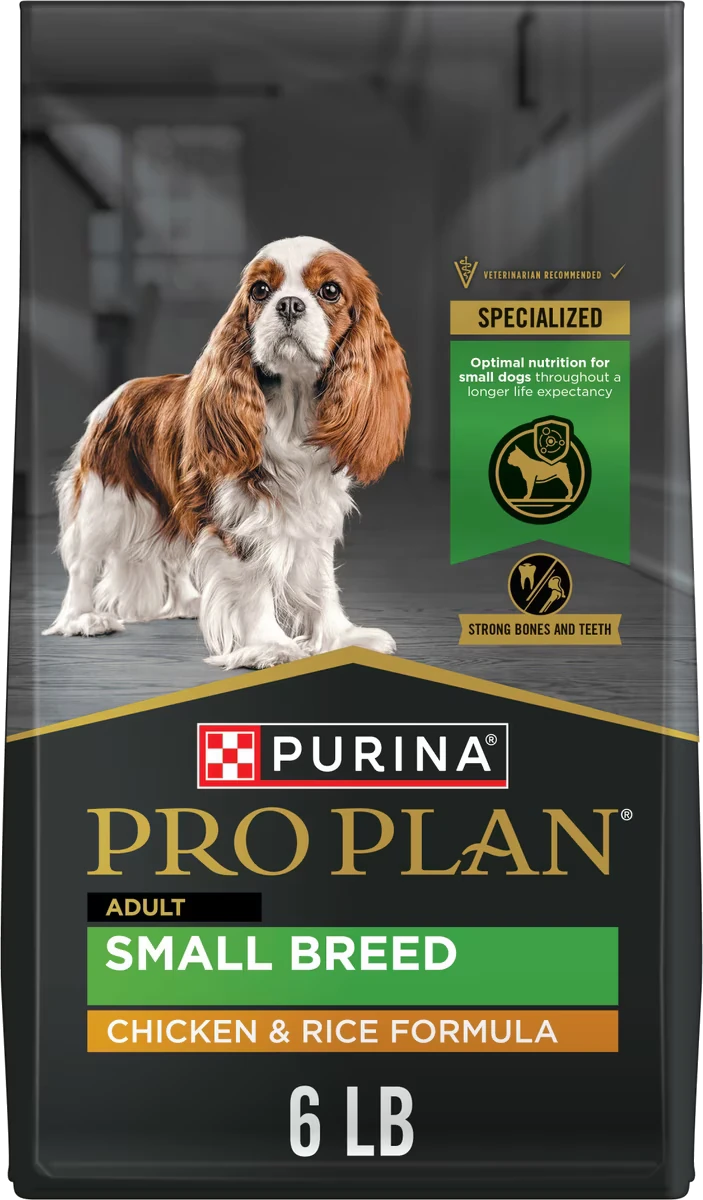
Purina Pro Plan is the most rigorously researched mainstream dry food available without a prescription. Purina employs board-certified veterinary nutritionists full-time and validates its AAFCO adequacy statements through actual feeding trials rather than nutrient profile calculations on paper alone. The Small & Toy Breed Adult Chicken & Rice formula lists deboned chicken as the first ingredient, includes whole-grain brown rice, and adds fish oil for EPA and DHA.
The kibble size is appropriate for a Cavalier's mouth, the formula is not grain-free, and the brand's distribution means it is consistently available through most pet retailers and online. If your primary concern is research backing and ingredient quality without committing to a breed-specific formula, Pro Plan Small & Toy Breed is the most defensible choice for a healthy adult Cavalier.
3. Hill's Science Diet Adult Small Paws: Most Widely Available
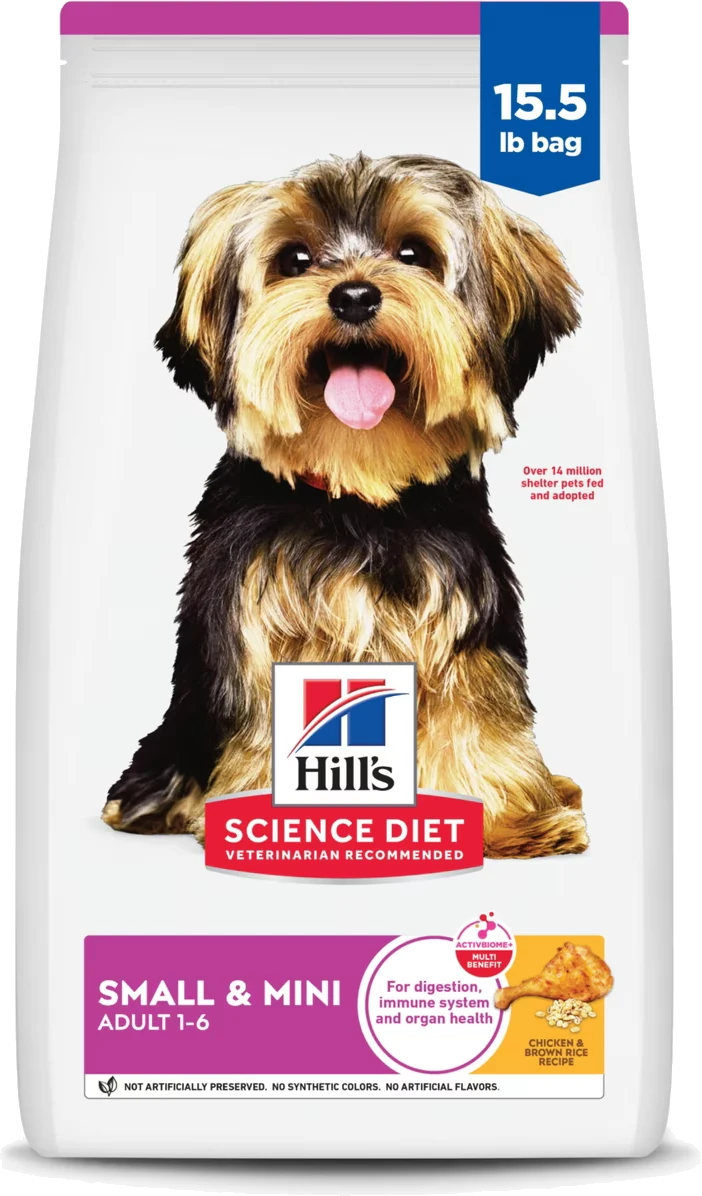
Hill's has produced veterinarian-recommended nutrition since 1939 and maintains a full staff of board-certified veterinary nutritionists. The Adult Small Paws formula targets dogs under 25 lbs and lists chicken as the first ingredient, alongside whole grains and omega-6 and omega-3 fatty acids for coat and cardiovascular support. The AAFCO adequacy statement covers adult maintenance and the formula is not grain-free.
Hill's Science Diet is one of the most broadly distributed small-breed dry foods in the United States, stocked at most major grocery chains, big-box pet retailers, and veterinary practices. Caloric density runs approximately 330–360 kcal per cup depending on the specific formulation, which keeps portioning manageable for a small dog. It is a reliable, accessible default for Cavalier owners who want strong veterinary credibility and consistent supply.
Calculating the Right Daily Portion
The back-of-bag feeding guide is a rough upper limit calibrated for an intact adult dog at moderate activity. If your Cavalier is spayed or neutered, as most are, their actual needs run approximately 20–25% lower than the bag assumes. The reliable method is the veterinary RER/MER formula:
- Convert your dog's weight to kilograms: divide pounds by 2.205.
- Calculate RER: 70 × (weight in kg)^0.75. This is the energy your dog needs at complete rest.
- Multiply by the appropriate life-stage factor: 1.6 for a neutered adult at moderate activity, 1.4 for a sedentary senior. For the full multiplier table and worked examples, see the dog feeding guide.
- Find the kcal-per-cup value under "Calorie Content" on your food label.
- Divide your MER by the kcal-per-cup figure to get total daily cups. Split into 2 meals.
The free calculator handles all 5 steps in under a minute. Enter your Cavalier's weight, age, and activity level and get an instant daily calorie and cup estimate.
Monitoring Body Condition Between Weigh-Ins
Use the Body Condition Score (BCS) system as a hands-on check every two to four weeks. Run your hands along the ribcage: the ribs should be easy to feel without pressing through a layer of fat. Viewed from above, the waist should be clearly visible behind the ribcage. Viewed from the side, there should be a slight abdominal tuck. If either check is borderline, reduce the daily portion by 10% and reassess in 2 weeks. For a visual walkthrough of the BCS assessment, see Is My Dog Overweight?
One detail specific to this breed: even a single pound of extra weight is a meaningful burden for a 13-pound dog. Cavaliers do not need to be visibly obese for excess weight to elevate cardiovascular load. The BCS check catches small gains before they compound.
Treats and the 10% Rule
Treats should account for no more than 10% of total daily caloric intake. For a Cavalier eating 450 kcal per day, that is 45 kcal, roughly 2 or 3 small commercial treats. Low-calorie options like baby carrots (about 4 kcal each) or thin cucumber slices make effective training rewards without compressing the main meal budget. Deduct the caloric value of any treats from the day's main-meal total. It is the only method that keeps the math accurate.
If you mix wet and dry food in the same meal, calculate the calories from each source separately and confirm they sum to your dog's daily target. The full blended-diet formula is covered in Wet vs. Dry Pet Food: How Much of Each?
Get Your Cavalier's Exact Daily Portion
Enter their weight, age, and activity level for a calorie and cups-per-day estimate based on vet-standard formulas. Free, no account needed.
🐾 Use the Free CalculatorFrequently Asked Questions
What is the ideal weight for an adult Cavalier King Charles Spaniel?
The AKC breed standard specifies 12 to 18 pounds. The right weight for your specific dog depends on frame size and should be confirmed through a body condition assessment. Ribs should be easy to feel without pressing, and the waist should be visible from above. Your veterinarian can help establish a target weight at your dog's next annual exam.
Should I feed my Cavalier grain-free food?
Not without a specific reason. The FDA has been investigating a potential association between grain-free diets and dilated cardiomyopathy (DCM) since 2018. Given the Cavalier's already elevated cardiac risk, choosing a food with whole grains is the lower-risk default. If your dog has a confirmed grain intolerance or other clinical reason to avoid grains, discuss alternatives with your veterinarian before switching.
How many cups of food does a Cavalier need per day?
Most adult Cavaliers need between 397 and 544 kcal per day, depending on their weight, activity level, and reproductive status. At 350 kcal per cup, that is roughly 1.1 to 1.6 cups daily, split across 2 meals. Always verify the kcal-per-cup value on your specific food's label. Caloric density varies significantly between brands and formulas.
Do Cavaliers need supplements for heart health?
A complete and balanced diet with adequate animal protein, taurine, and EPA/DHA covers the nutritional baseline for cardiac support. Whether additional supplementation (fish oil capsules, taurine, L-carnitine) is appropriate depends on your individual dog's health status and cardiac monitoring results. Discuss this with your veterinarian, particularly if your dog is approaching the age where annual cardiac auscultation is recommended for the breed.
How often should I check my Cavalier's body condition score?
Every two to four weeks is a practical interval. Run your hands along the ribcage. The ribs should be easy to feel without pressing through fat. Even small gains increase the cardiovascular burden on a breed already predisposed to heart disease, so catching weight creep early is preferable to correcting established excess weight in a dog with a cardiac history.
Can I feed my Cavalier puppy the same food as my adult Cavalier?
No. Puppies require elevated calcium, phosphorus, and caloric density to support rapid skeletal development. An adult maintenance formula does not meet those requirements, and feeding it to a growing puppy risks nutritional gaps during a critical window. Use a food labeled "for growth" or "for all life stages" until your Cavalier reaches approximately 10 to 12 months of age, then transition to an adult formula over seven to ten days.
What is the best food and daily feeding amount for a Cavalier King Charles Spaniel?
Royal Canin's breed-specific Cavalier formula, Purina Pro Plan Small & Toy Breed Adult, and Hill's Science Diet Adult Small Paws are the 3 best-suited picks, each using named animal protein and fish-derived omega-3s for cardiac support, and none grain-free given the breed's elevated heart-disease risk. Daily amount depends on weight: a 12-18 lb adult neutered Cavalier needs roughly 397-544 kcal per day, about 1.1-1.6 cups at 350 kcal/cup, split across 2 meals. Use the calculator for the exact number.
This article is for general informational purposes and is not a substitute for individualized veterinary advice. Consult your veterinarian about your Cavalier's specific nutritional needs, especially given the breed's elevated risk of heart disease.