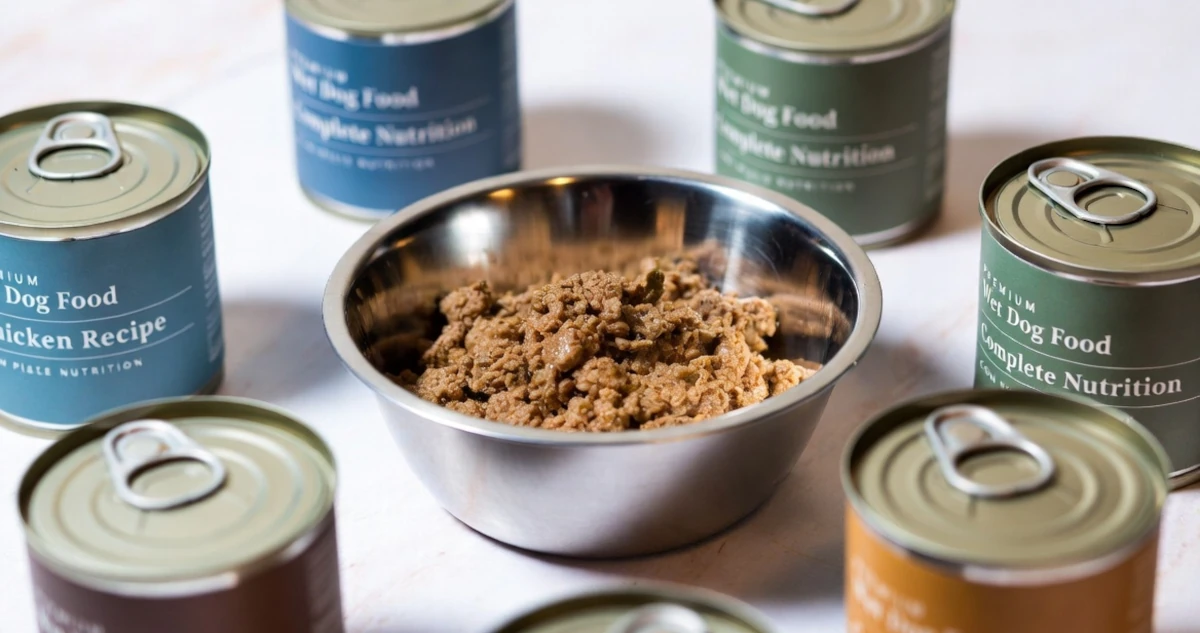
Walk into any pet store and the canned dog food aisle looks the same from one brand to the next: "real meat," "natural ingredients," "premium nutrition." None of those phrases are regulated, and none of them tell you whether the food is good for your dog.
This guide evaluates 7 canned dog foods on the criteria that matter: the AAFCO nutritional adequacy statement, the quality and transparency of protein sources, moisture content, and calorie density per can. Each pick includes what you need to calculate the correct daily portion for your specific dog.
Key takeaways
- Look for an AAFCO "complete and balanced" statement matched to your dog's life stage, since anything labeled "for intermittent or supplemental feeding only" cannot be a primary diet.
- A named animal protein (chicken, beef, salmon) should be the first ingredient, not vague terms like "meat" or "animal."
- Canned food runs 75 to 82% moisture, so a 13-oz can typically delivers only 300 to 450 kcal, far less than an equivalent volume of dry kibble.
- Always calculate portions from the can's listed kcal content, never by volume or weight alone.
- For weight management, apply a 20 to 25% reduction from maintenance calories and recheck body condition monthly.
Affiliate disclosure: Some links in this guide go to retailers including Chewy, Amazon, and Petco. If you purchase through them, this site may earn a small commission at no extra cost to you. It does not affect which brands are recommended or how they are ranked.
Formulas change. Manufacturers reformulate lines and update ingredients without public notice. Last reviewed: June 2026. Before purchasing, verify the current AAFCO statement and ingredient list on the product label.
Table of Contents
Quick answer: Use our free dog food calculator to find your dog's daily calorie target, then check the "Calorie Content" on the can's label to see how many cans per day that adds up to.
What Separates a Good Canned Dog Food from a Poor One
A good canned dog food carries an AAFCO "complete and balanced" statement, lists a named animal protein first, and keeps thickeners and additives to a minimum. Here's what to check on the label before you buy.
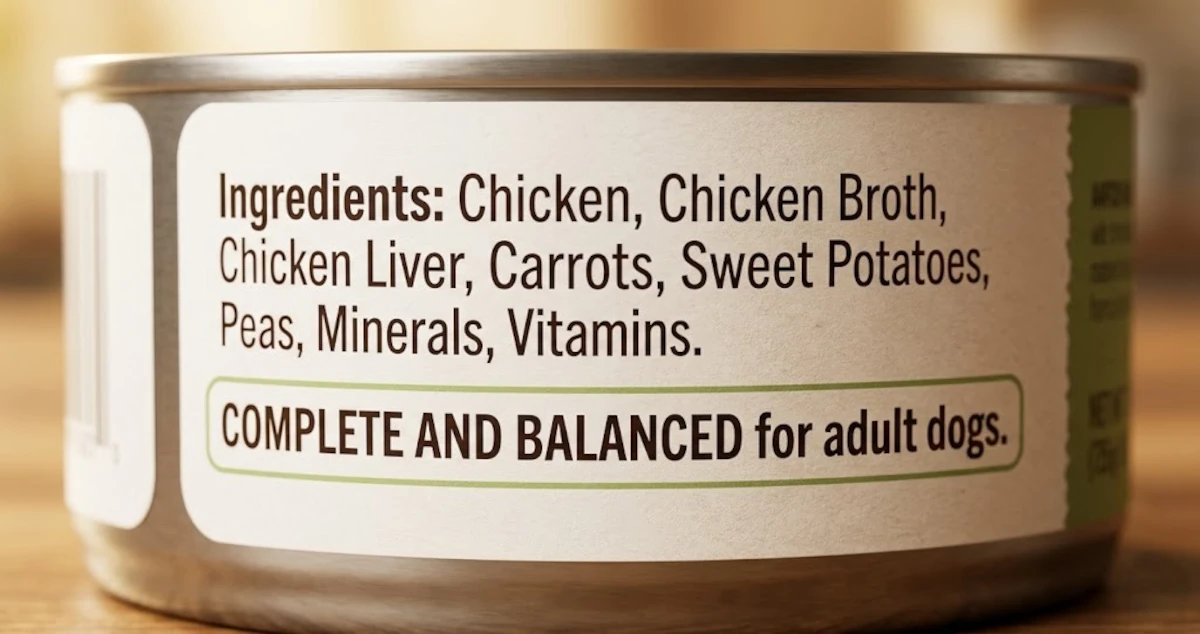
The AAFCO Statement
Every nutritionally complete dog food sold in the United States must carry an AAFCO (Association of American Feed Control Officials) nutritional adequacy statement. The phrase to look for is "complete and balanced." Any product labeled "for intermittent or supplemental feeding only" is not suitable as a primary diet, no matter what the front of the can says.
The statement also tells you which life stage the food covers. "For adult maintenance" is not appropriate for puppies. "For all life stages" covers growth and adults both, which is why it is often recommended for multi-dog households. Match the life stage on the label to your dog.
The First Ingredient
Named animal proteins (chicken, beef, salmon, turkey, lamb) should appear as the first ingredient. "Meat by-products" as the primary source are not inherently dangerous (they include organ meats, which are nutrient-dense), but named by-products like "chicken liver" or "turkey heart" are more transparent. Generic terms like "meat" or "animal" give you no useful information about what you are feeding.
Thickeners and Additives
Virtually all canned dog foods use some form of thickener to hold texture. Carrageenan, derived from red seaweed, is the most debated. Some in vitro and rodent studies have associated a degraded form of carrageenan with intestinal inflammation. The FDA has not restricted food-grade carrageenan in pet food, but there is enough uncertainty that avoiding it is a reasonable choice for dogs with sensitive digestive systems. Gums such as xanthan, guar, and locust bean are less controversial but signal more processing. Neither type disqualifies a food outright. A shorter ingredient list is generally the better sign.
Moisture Content and Calorie Density
Canned food is typically 75–82% moisture, far less calorie-dense per gram than dry kibble. A standard 13-oz can delivers roughly 300–450 kcal depending on the formula. A single cup of dry food, by comparison, provides 300–500 kcal. Never estimate wet food portions by weight or volume. Always use the kcal content printed on the can under "Calorie Content," then calculate your dog's daily amount from there.
For the math on blending wet and dry food in the same meal, see Wet vs. Dry Pet Food: How Much of Each?
The 7 Best Canned Dog Foods for 2026
Here are the seven canned dog food brands that came out on top after comparing AAFCO statements, ingredient panels, and pricing across dozens of options. Quick comparison before the full breakdown:
| Brand | Protein (dry matter basis) | Price | AAFCO life stage |
|---|---|---|---|
| 1. Purina Pro Plan | 40.9% | $ (~$0.22/oz) | Adult maintenance |
| 2. Hill's Science Diet | 25.5% | $$ (~$0.28/oz) | Adult maintenance |
| 3. Royal Canin | 39.5% | $$$ (~$0.40/oz) | Adult maintenance |
| 4. Wellness CORE 95% | 45.5% | $$$ (~$0.35/oz) | Adult maintenance |
| 5. Merrick Grain-Free Pâté | 40.9% | $$ (~$0.30/oz) | Adult maintenance |
| 6. Blue Buffalo Homestyle | 38.5% | $ (~$0.24/oz) | Adult maintenance |
| 7. Weruva Dogs in the Kitchen | 57.1% | $$$ (~$0.40/oz) | Adult maintenance |
Protein is shown on a dry-matter basis so formulas with different moisture content are comparable. Prices are per-ounce estimates from current case pricing at major retailers and fluctuate; use them for relative comparison, not as quoted totals.
1. Purina Pro Plan: Best Overall
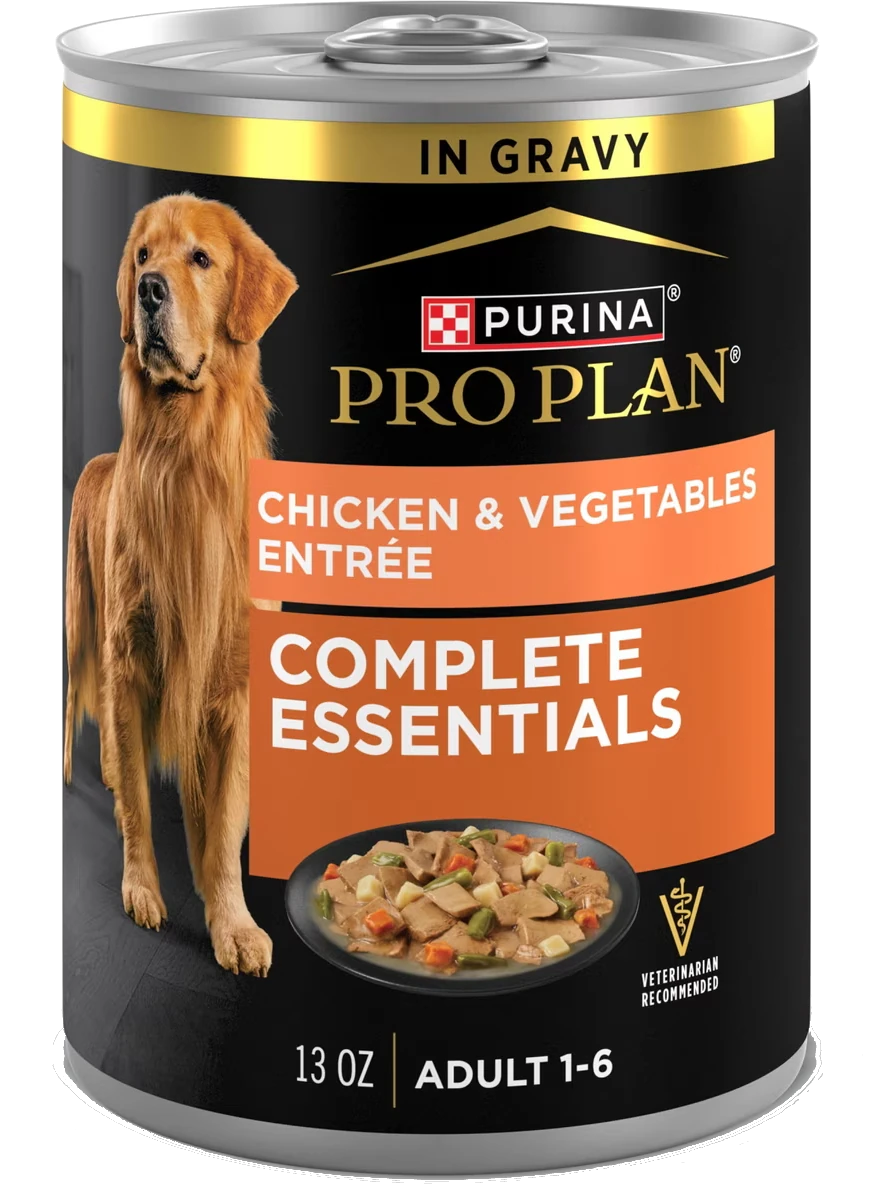
Purina Pro Plan is the most research-backed mainstream brand available without a prescription. Purina employs veterinary nutritionists and conducts actual AAFCO feeding trials, meaning they back their nutritional adequacy statements with real-world data rather than nutrient profile calculations alone.
The canned lines most worth your attention: the Savor series uses named protein as the first ingredient and is complete and balanced for all life stages. The Focus Sensitive Skin & Stomach line (salmon and rice) includes prebiotic inulin fiber, which supports digestive health in dogs prone to loose stools or stomach upset. For dogs with diagnosed conditions, the Pro Plan Veterinary Diets range (available through veterinarians) covers kidney disease, GI disorders, weight management, and more with clinical-grade precision.
If you are unsure where to start with canned food and your dog has no specific health issues, Pro Plan is the safest default for most healthy adult dogs.
Pros: Backed by real AAFCO feeding trials rather than nutrient calculations alone, multiple specialized lines cover sensitive stomachs and diagnosed conditions, and it's the most affordable pick in this comparison (~$0.22/oz).
Cons: Not every line is grain-free, and the Veterinary Diets range requires purchase through a vet.
2. Hill's Science Diet: Best for Specific Health Needs
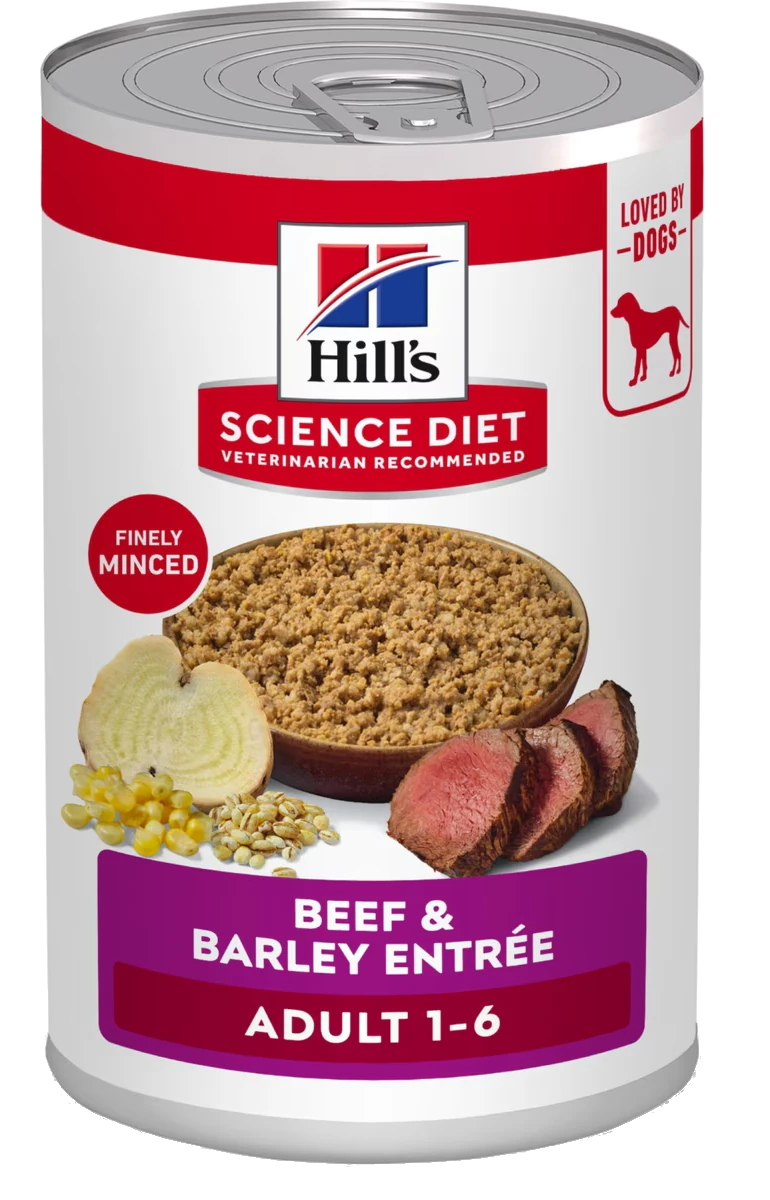
Hill's has been producing veterinary-recommended dog food since 1939. The Science Diet line is their over-the-counter range. Hill's Prescription Diet offers formulas your veterinarian can prescribe for conditions including kidney disease, bladder stones, liver support, and GI disorders.
The Adult Beef and Barley Entree is one of their most recommended mainstream options: balanced macros, named meat first, well-tolerated by most healthy adult dogs. The Adult Sensitive Stomach & Skin formula (chicken) is frequently suggested by veterinarians for dogs with recurring digestive complaints.
Worth knowing: Hill's issued a significant voluntary recall in January 2019 for elevated vitamin D levels in several canned formulas. They subsequently revised their manufacturing quality-control protocols. Current formulas have not been subject to comparable recalls, and Hill's remains one of the most clinically studied pet food companies available.
Pros: Decades of veterinary-backed research, the widest Prescription Diet range for diagnosed conditions, and a well-tolerated Sensitive Stomach & Skin formula.
Cons: The 2019 vitamin D recall (since resolved) may still give some owners pause, and dry-matter protein (25.5%) is the lowest of the 7 picks.
3. Royal Canin: Best for Breed-Specific and Condition-Specific Nutrition
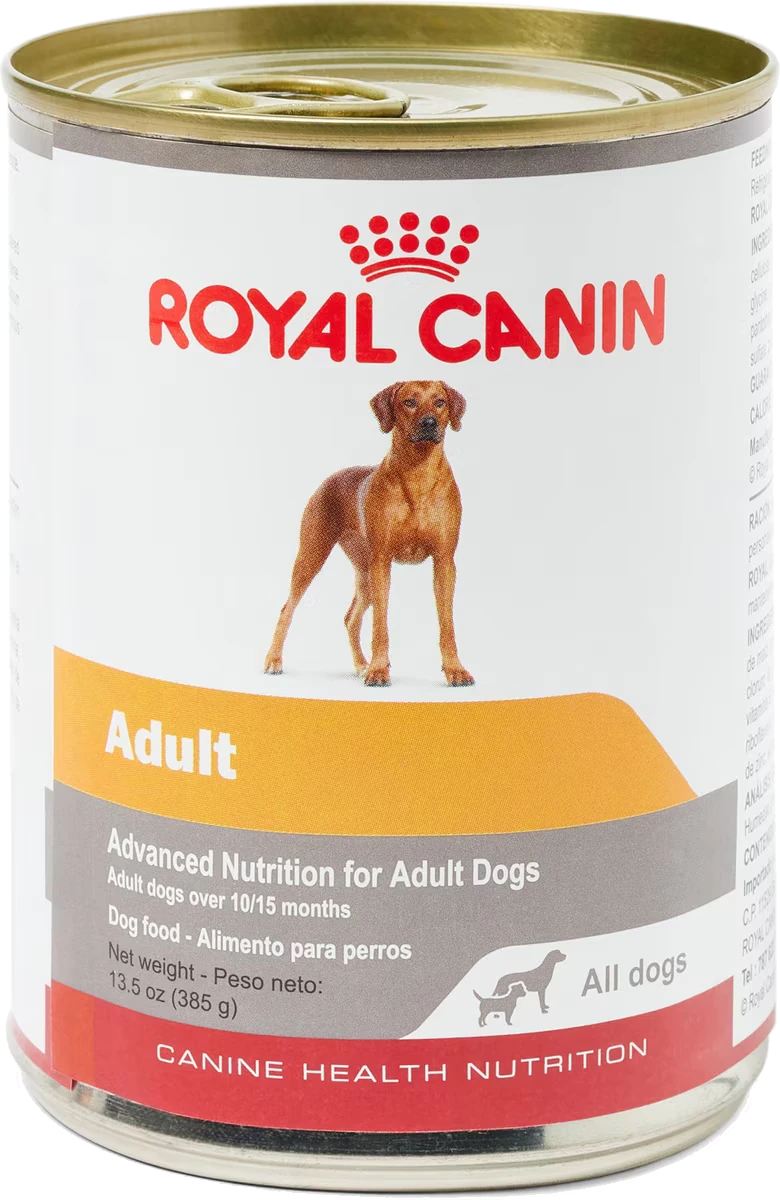
No mainstream brand matches Royal Canin's specificity. They produce canned formulas tailored to individual breeds, size categories, and medical conditions, built around the documented characteristics and health vulnerabilities of specific dogs rather than a generic adult profile.
Their standard Size Health Nutrition wet line (X-Small through Large) is complete and reliable, though ingredient quality in the non-prescription range is moderate. Where Royal Canin earns its place is in their veterinary formula range, which covers GI health, joint support, urinary issues, cardiac support, and weight management. If your veterinarian has recommended Royal Canin for a specific condition, that recommendation is almost always grounded in clinical data from their formulation research and clinical trials, not marketing.
Pros: The most breed-, size-, and condition-specific formulas of any mainstream brand, with veterinary-range products grounded in clinical trial data.
Cons: The highest price of the 7 picks (~$0.40/oz), and ingredient quality in the standard non-prescription line is only moderate.
4. Wellness CORE 95%: Best High-Protein Option
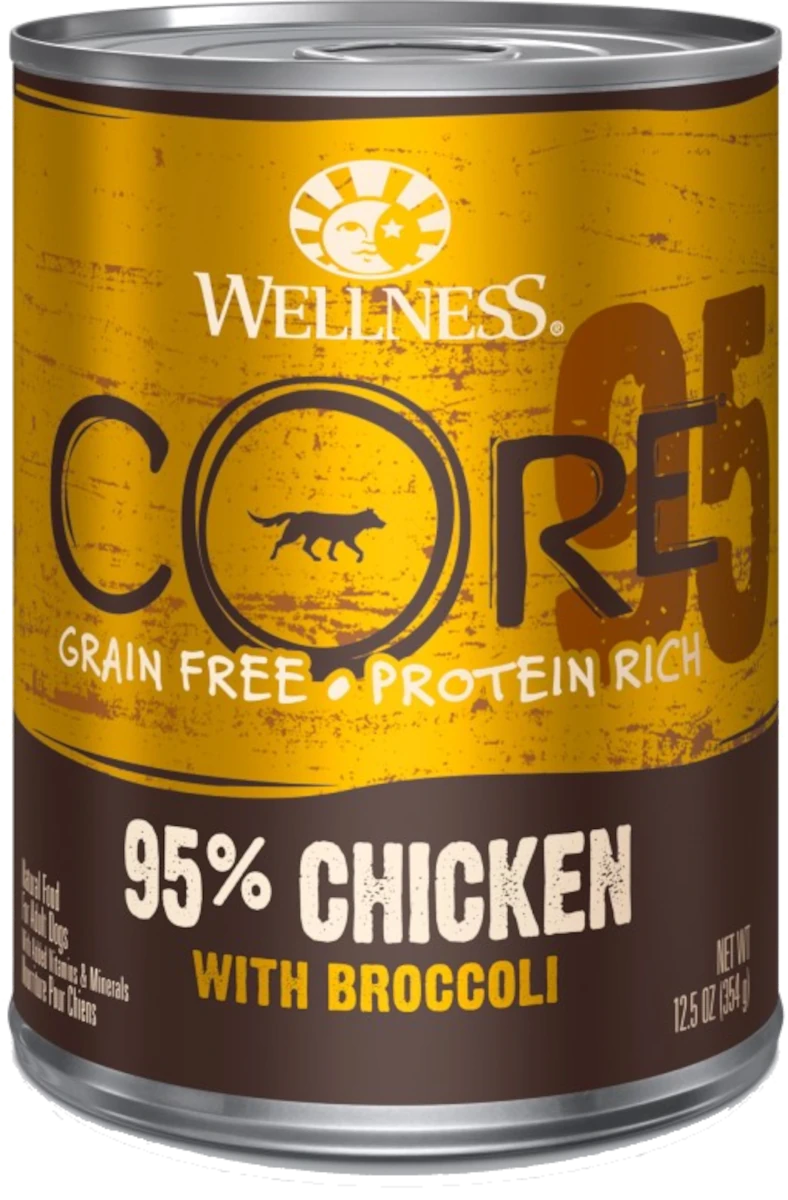
The Wellness CORE 95% line does exactly what the name implies: 95% animal protein, no grains, no artificial preservatives, and an ingredient list short enough to read in under 10 seconds. Available in chicken, beef, turkey, salmon, and lamb, it is a strong choice for active dogs, dogs with grain sensitivities, or owners who want maximum ingredient transparency.
Because the protein and fat content are higher than average for canned food, calorie density per can is also higher. Use the kcal-per-can figure from the label and run your dog's daily target through our calculator to avoid unintentional overfeeding.
One consideration: like all grain-free formulas, Wellness CORE falls within the FDA's ongoing review of a potential association between grain-free diets and dilated cardiomyopathy (DCM) in dogs. Researchers have not established a causal link as of 2026. If DCM is a concern for your breed (Cavalier King Charles Spaniels carry an elevated genetic risk of heart disease), discuss it with your veterinarian.
Pros: Highest named-meat protein of any mainstream pick (45.5% dry matter), no grains or artificial preservatives, and a short, transparent ingredient list.
Cons: Higher calorie density means portion math matters more to avoid overfeeding, and like all grain-free formulas it falls within the FDA's ongoing DCM review.
5. Merrick Grain-Free Pâté: Best Clean-Label Option
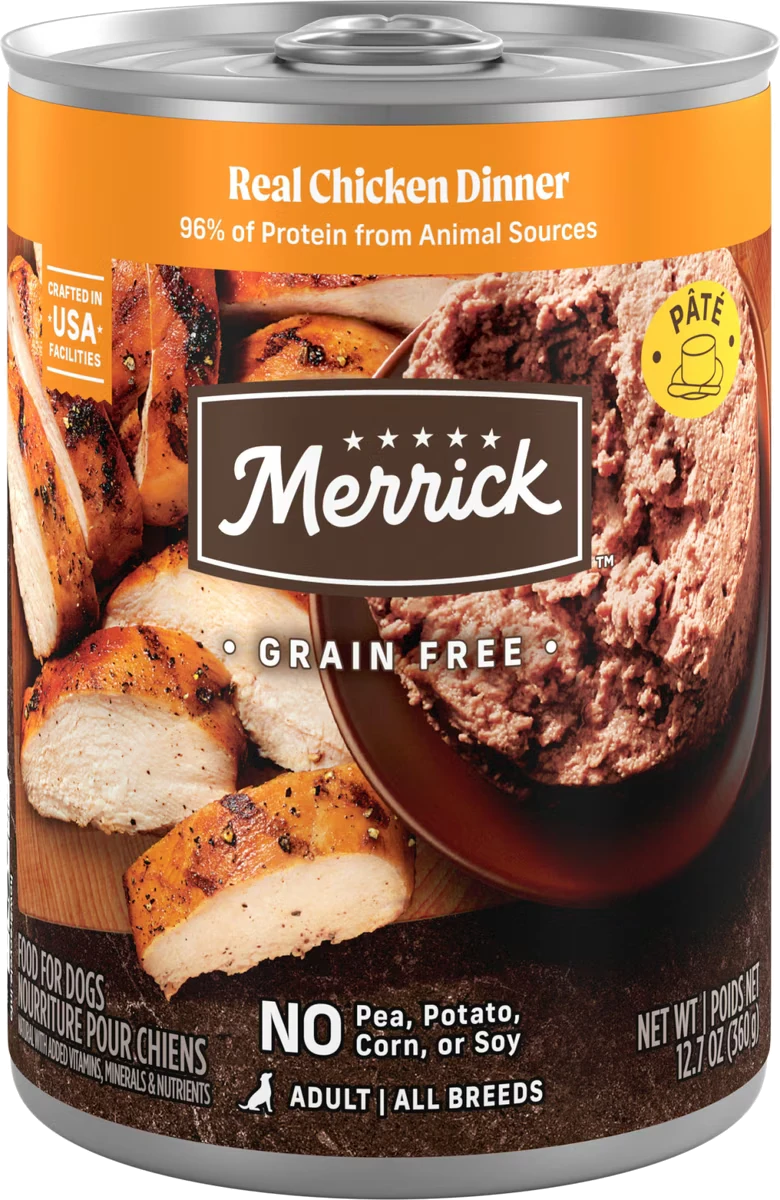
Merrick uses named meats as the first ingredient across their entire wet food line. Their Grain-Free Pâté formulas (Real Texas Beef + Sweet Potato and Real Chicken + Sweet Potato among the most consistently reviewed) offer a short ingredient list, recognizable whole foods, and no artificial additives. For dogs that do well with grains, the Healthy Grains Pâté line incorporates quinoa and brown rice.
A piece of context some buyers factor into their decisions: Nestlé Purina acquired Merrick in 2015. The recipes have remained largely consistent post-acquisition, manufacturing meets AAFCO standards, and quality control has been generally stable. Whether the change of ownership matters to your purchasing decision is personal.
Pros: Named meats as the first ingredient across the entire line, a short and recognizable ingredient list, and a mid-range price (~$0.30/oz).
Cons: Owned by Nestlé Purina since 2015, and the Grain-Free formulas carry the same FDA DCM-review caveat as other grain-free picks.
6. Blue Buffalo Homestyle Recipe: Best Widely Available Pick
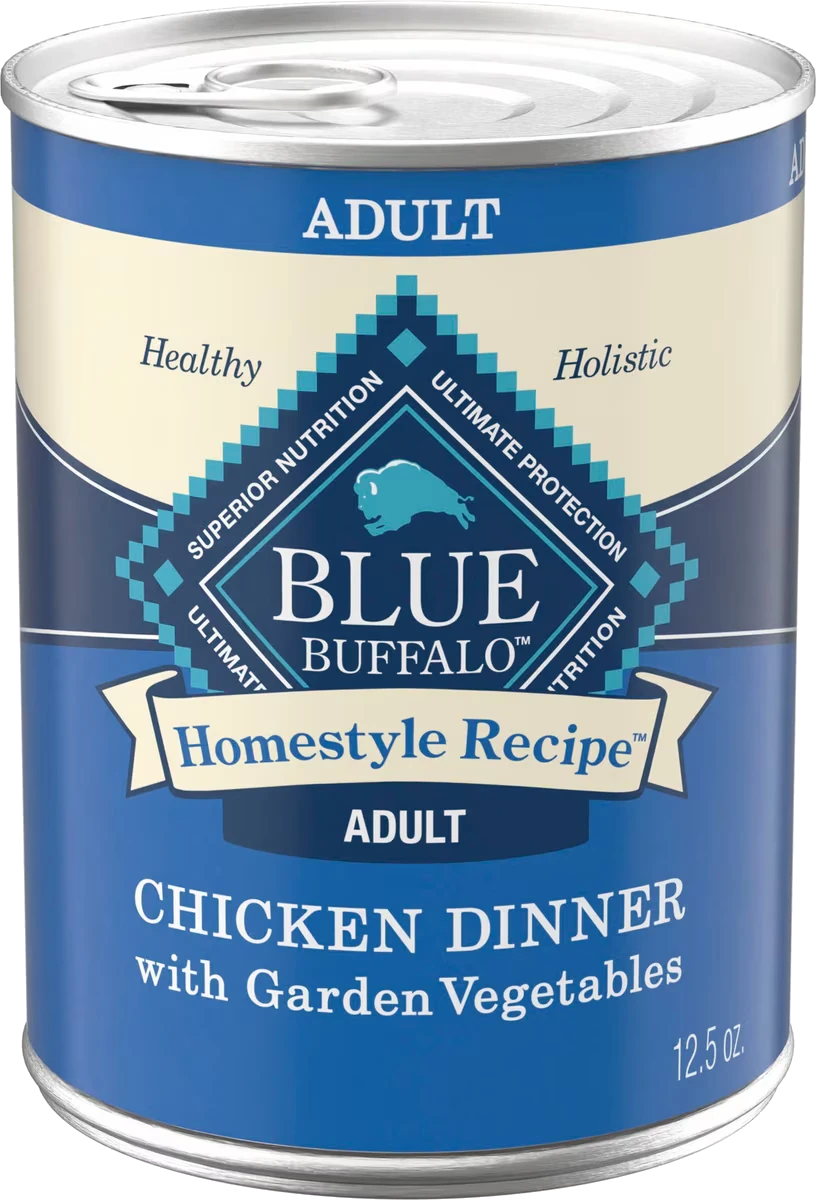
Blue Buffalo's Homestyle Recipe line uses real meat as the first ingredient, and most major grocery stores and big-box pet retailers stock it. That distribution advantage matters when you run out of food on a Sunday evening and cannot wait for a delivery. The chunky stew and gravy formulas are well-tolerated by most healthy adult dogs, and some varieties are grain-free or poultry-free for dogs with common protein sensitivities.
Some formulas include thickeners such as guar gum or modified starch. These are not harmful, but they do signal more processing than the top picks above. Calorie counts vary meaningfully by variety, so check the kcal per can before assuming portion size. Some Homestyle recipes run higher than comparably priced options from other brands. If your dog is managing their weight, use the body condition score guide as your benchmark, not hunger cues.
Pros: Stocked at nearly every major grocery and big-box pet retailer, one of the most affordable picks (~$0.24/oz), and available in grain-free or poultry-free varieties.
Cons: Uses more thickeners (guar gum, modified starch) than the top picks, and calorie counts vary meaningfully by variety.
7. Weruva Dogs in the Kitchen: Best for Lean Protein
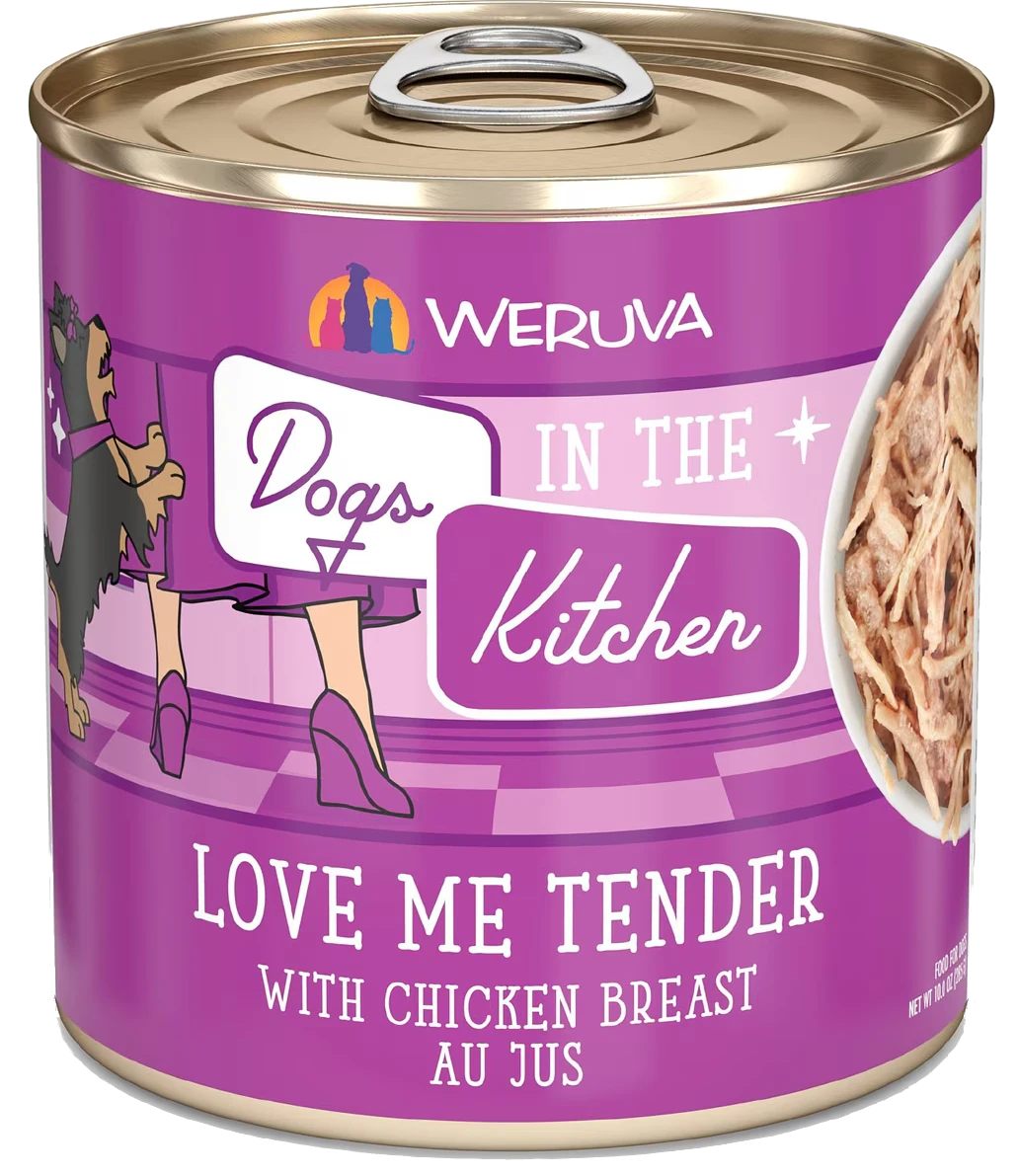
Weruva built their brand on recognizable, human-quality ingredients: actual chunks of chicken breast, beef, or fish in an au jus broth, rather than ground meat formed into a pâté. The Dogs in the Kitchen line extends that approach, delivering high protein alongside lower fat than most comparable wet foods. The ingredient list is short and largely self-explanatory.
That nutritional profile (lean protein, low fat, high moisture) makes it a good fit for dogs that need protein without excess calories: less active adults prone to weight gain, or seniors preserving muscle mass while controlling overall intake. Because the calorie density per can is often lower than average, larger dogs may need more volume to meet their daily target. Check the kcal per can for the specific recipe and calculate from there using the free calculator.
Weruva runs higher per ounce than Blue Buffalo or Hill's. Factor that into the comparison alongside your dog's specific nutritional needs.
Pros: Highest protein of any pick by a wide margin (57.1% dry matter), whole recognizable chunks of meat instead of pâté, and low fat for weight-conscious dogs.
Cons: The highest price tier alongside Royal Canin (~$0.40/oz), and lower calorie density per can means larger dogs need more volume to hit their daily target.
How to Calculate the Right Portion for Any Canned Food
Wet food portions trip people up because moisture content skews the weight-to-calorie ratio dramatically. A cup of dry food might contain 350 kcal. The equivalent weight of wet food might contain 80–100 kcal. Volume and weight are not reliable guides. Only calories are.
The correct method has 3 steps:
- Find your dog's daily calorie target using the free calculator. Enter your dog's weight, age, activity level, and whether they are spayed or neutered. The result is based on the RER/MER veterinary formula, the same method used by veterinary nutritionists. For more on how the formula works, see How Much Should I Feed My Dog?
- Find the kcal per can (or per 100g) listed under "Calorie Content" on the product label.
- Divide your dog's daily calorie target by the calories per can to get the number of cans per day. Split that amount into 2 meals for adult dogs, 3 meals for puppies.
If you are combining wet and dry food in the same day, calculate the calories from each source separately and confirm they sum to your dog's daily target. The full blended-diet formula is in Wet vs. Dry Pet Food: How Much of Each?
Canned Food for Weight Management, Seniors, and Puppies
Canned dog food serves 3 specific situations especially well: cutting calories for an overweight dog, supporting a senior with a smaller appetite, and feeding a puppy that needs calorie-dense, easy-to-eat meals during growth. The right approach differs for each.
Weight Management
Wet food's high moisture content makes it practically useful for weight management: dogs get more volume per calorie, which can reduce food-seeking behavior without reducing the satisfaction of a meal. Choose a formula with a clear kcal count per can, apply a 20–25% reduction from your dog's maintenance calorie target, and recheck body condition score monthly. If weight loss has stalled after four to six weeks, reduce by a further 10%. According to the Association for Pet Obesity Prevention, approximately 59% of dogs in the United States are classified as overweight or obese. Getting the calories right is the most controllable variable in your dog's health.
Senior Dogs
Most dogs reach senior status around age 7 for large breeds and 9–10 for small breeds. Seniors often have lower activity levels and reduced overall calorie needs, but some require more dietary protein to maintain muscle mass even as their total intake decreases. A food labeled "for adult maintenance" is appropriate for most healthy seniors unless your veterinarian recommends a specialized formula. Monitor body condition closely. Muscle loss and fat gain can occur simultaneously and obscure what is happening with overall health.
Puppies
Puppies require food labeled "for growth" or "for all life stages." Adult maintenance formulas do not meet the higher demands of growth, particularly for calcium, phosphorus, and protein. Wet food works well for puppies (for palatability, hydration, and ease of eating) whether as the sole diet or alongside an appropriate kibble, provided the formula carries an AAFCO statement for growth. Large-breed puppies specifically need a large-breed growth formula that controls calcium intake during skeletal development. See the Labrador puppy feeding guide for an age-by-age breakdown. Use the puppy multipliers in the dog feeding guide to calculate portions. Puppy calorie needs can be 2 to 3 times those of an adult dog at the same weight.
Get Your Dog's Exact Daily Portion
Enter your dog's weight, age, and activity level for a calorie estimate based on vet-standard formulas. Free, no account needed.
🐾 Use the Free CalculatorFrequently Asked Questions
How long does an opened can of dog food last in the refrigerator?
Three to four days, covered, at or below 40°F (4°C). Discard any wet food that has been at room temperature for more than 2 hours.
Can I mix canned and dry dog food?
Yes. Both foods should carry AAFCO "complete and balanced" statements for your dog's life stage. Calculate the calories from each source separately and confirm they sum to your dog's daily target. The full blended-diet calculation is covered in Wet vs. Dry Pet Food: How Much of Each?
Is grain-free canned dog food safe?
The FDA has been investigating a potential link between grain-free diets and dilated cardiomyopathy (DCM) in dogs since 2018. As of 2026, researchers have not established a causal link. If your dog has no specific reason to avoid grains, choosing a food with whole grains is a lower-risk approach while the research continues. Consult your veterinarian if you own a breed with known cardiac predispositions, such as the Cavalier King Charles Spaniel.
What is the difference between pâté and chunks in gravy?
Pâté is a smooth, uniform texture formed from finely ground meat. Chunks in gravy or stew contain identifiable pieces of meat in a thin sauce. Both formats can be nutritionally complete. The difference is texture and palatability. Pâté is generally easier for puppies, seniors with dental problems, or dogs that struggle to chew. Many dogs show a clear preference for one or the other, and switching formats can sometimes resolve a picky eating problem.
What does the AAFCO statement on a dog food label mean?
It confirms that the food meets the minimum nutrient profiles published by the Association of American Feed Control Officials for a specific life stage. "Complete and balanced" means the food can serve as a dog's entire diet. "For intermittent or supplemental use only" means it cannot. The life stage modifier (adult maintenance, growth, all life stages) tells you which dogs the formula was designed for.
What are the best canned wet dog food brands and how much should I feed per meal?
Purina Pro Plan, Hill's Science Diet, and Royal Canin lead for research-backed, AAFCO-tested formulas, with Wellness CORE 95% and Weruva Dogs in the Kitchen standing out for high-protein, minimally processed options. To find the per-meal amount, take your dog's daily calorie target from the free calculator, divide by the calories per can listed on the label (typically 300-450 kcal for a 13-oz can), then split that number of cans across 2 meals a day.
What is the most nutritious wet dog food for adult dogs?
The most nutritious, healthiest wet dog food for adult dogs carries an AAFCO "complete and balanced for adult maintenance" statement, lists a named animal protein (chicken, beef, salmon) as the first ingredient rather than vague terms like "meat" or "animal," and avoids relying on fillers or excessive plant protein to hit its guaranteed analysis. Of the picks above, Purina Pro Plan and Hill's Science Diet stand out for adult maintenance thanks to research-backed formulas and consistent AAFCO feeding trials, while Wellness CORE 95% offers the highest named-meat content for owners prioritizing protein density. Since canned food runs 75 to 82% moisture, always confirm the kcal-per-can figure on the label and calculate your dog's portion with the free calculator rather than judging nutrition by can size alone.
What is the best canned dog food overall?
Purina Pro Plan is the best all-around canned (wet) dog food for most adult dogs, backed by AAFCO-tested, research-backed formulas across a wide range of life stages and breed sizes. If you're after the healthiest wet dog food with the fewest fillers, Wellness CORE 95% is the top pick for its high named-meat content, and Weruva Dogs in the Kitchen is best for dogs that do well on minimally processed, limited-ingredient recipes. See the full rankings above for how all 7 picks compare.
This article is for general informational purposes and is not a substitute for individualized veterinary advice. Consult your veterinarian about your dog's specific nutritional needs before switching foods.