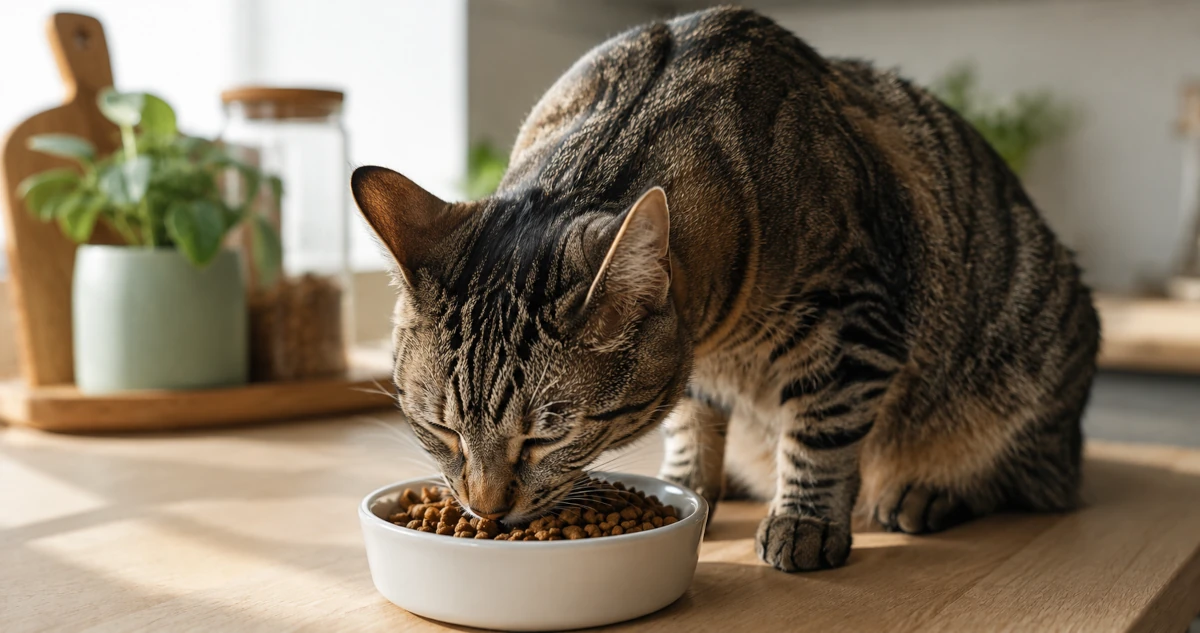
Cats are not small dogs. Their nutritional physiology is fundamentally different: they are obligate carnivores with unique protein requirements, a low thirst drive, and a metabolism that responds differently to overfeeding. Yet most cat owners either free-feed (leaving food out all day) or rely on vague bag instructions, both of which are leading contributors to the current feline obesity epidemic.
This guide walks you through the exact method veterinary nutritionists use to calculate how much to feed a cat, and how to turn that into practical daily portions.
Key takeaways
- Use RER × MER, not the vague chart on the bag, to find your cat's actual daily calorie need.
- Neutering cuts metabolic rate by roughly 24 to 33%, so neutered indoor cats need noticeably less than pre-neuter amounts.
- Wet food's higher moisture content supports hydration and lowers urinary and kidney disease risk, which is why many vets recommend prioritizing it over dry.
- Feed 2 to 3 measured meals a day rather than free-feeding, one of the biggest drivers of feline obesity.
- Kittens need about 2.5× RER, while seniors often need more protein density even as total calories drop.
Table of Contents
Quick answer: Use our free cat food calculator: enter your cat's weight, age, and indoor/outdoor status for an instant, personalized estimate.
The RER/MER Formula for Cats
The same formula used for dogs applies to cats, published by the National Research Council (NRC 2006):
Example: a typical 4.5 kg (10 lb) neutered indoor cat has an RER of 70 × 4.5^0.75 ≈ 218 kcal/day at rest.
Then multiply by the appropriate life-stage factor to get MER, your cat's actual daily caloric need:
| Life Stage / Status | Multiplier | Example (4.5 kg cat, RER = 218) |
|---|---|---|
| Kitten < 4 months | 2.5 | 545 kcal/day |
| Junior 4 mo – 1 yr | 2.0 | 436 kcal/day |
| Neutered indoor adult, sedentary | 1.0 | 218 kcal/day |
| Neutered adult, moderate activity | 1.2 | 262 kcal/day |
| Intact adult, moderate activity | 1.6 | 349 kcal/day |
| Senior neutered (10+ yr) | 1.1 | 240 kcal/day |
| Weight loss | 0.8 | 174 kcal/day |
| Lactating | 3.5 | 763 kcal/day |
Source: NRC 2006 and WSAVA Global Nutrition Guidelines.
⚠️ Spay/neuter effect: Neutering reduces a cat's metabolic rate by approximately 24–33%. This is one of the most significant adjustments in feline feeding: neutered indoor cats are extremely prone to weight gain if fed at pre-neuter amounts.
How Much Dry Food Per Day?
Divide your cat's MER by the kcal/cup listed on your dry food bag (under "Calorie Content").
| Cat Weight | MER (neutered, moderate) | Cups/Day @ 300 kcal/cup | Cups/Day @ 400 kcal/cup |
|---|---|---|---|
| 5 lbs (2.3 kg) | 155 kcal | 0.52 cups | 0.39 cups |
| 7 lbs (3.2 kg) | 200 kcal | 0.67 cups | 0.50 cups |
| 9 lbs (4.1 kg) | 241 kcal | 0.80 cups | 0.60 cups |
| 11 lbs (5.0 kg) | 281 kcal | 0.94 cups | 0.70 cups |
| 13 lbs (5.9 kg) | 318 kcal | 1.06 cups | 0.80 cups |
| 15 lbs (6.8 kg) | 354 kcal | 1.18 cups | 0.89 cups |
Neutered adult, moderate activity. Check your bag for actual kcal/cup.
How Much Wet Food Per Day?
Wet cat food is typically 70–80% moisture. A standard 3-oz (85 g) can contains roughly 70–100 kcal, while a 5.5-oz (156 g) can contains roughly 130–180 kcal (varies significantly by brand). Divide your cat's MER by the can's listed caloric content.
Example: a 10 lb neutered adult cat needs ~240 kcal/day. At 90 kcal per 3-oz can, that is approximately 2.7 cans per day. For preset can sizes, a custom kcal-per-can field, and coverage of every life stage, use the dedicated Wet Food Calculator for Cats.
Should I Feed Wet, Dry, or Both?
From a strictly nutritional standpoint, both complete-and-balanced wet and dry foods can meet your cat's needs, but many veterinary nutritionists recommend prioritizing wet food for cats because:
- Cats evolved to get most of their hydration from prey (which is ~70% water)
- Cats have a low natural thirst drive and often do not drink enough from a water bowl alone
- Chronic mild dehydration is a contributing factor in urinary tract disease and kidney disease, the leading causes of death in domestic cats
- Wet food is typically lower in carbohydrates, more closely mirroring a cat's natural prey diet
If cost or practicality limits wet food, a mix of both is better than dry alone. See the detailed guide: Wet vs. Dry Pet Food: How Much of Each?
How Many Times a Day Should You Feed a Cat?
Unlike dogs, cats naturally eat many small meals: feral cats hunt and eat 8–16 small prey items per day. For practical indoor feeding, 2–3 meals per day is a good target for most adult cats. Avoid free-feeding dry kibble as it makes calorie control nearly impossible and is strongly associated with obesity.
Puzzle feeders and slow feeder bowls can help replicate the hunting experience and slow down fast eaters, which aids digestion and enrichment.
Kitten Feeding
Kittens under 4 months need about 2.5× their RER, a significant amount relative to their tiny size. Feed kitten-specific food (higher protein and fat, with appropriate calcium:phosphorus ratios) at least 3–4 times per day. Transition kittens to adult food around 12 months. For a full breakdown of meal counts and calories by exact age and weight, use the dedicated Kitten Feeding Schedule Calculator.
Senior Cat Feeding (10+ Years)
Senior cats often become less active but may also experience muscle loss (sarcopenia), which can cause weight loss even when intake seems adequate. Senior cats often benefit from higher protein density foods to maintain muscle mass, even if total caloric intake decreases. Monitor body condition closely and adjust based on lean body mass instead of scale weight alone.
Get Your Cat's Exact Daily Portions
Personalized calories and cups in under 60 seconds. Free, no account needed.
🐾 Use the Free CalculatorFrequently Asked Questions
My cat is always begging for food. Is she hungry?
Not usually, if body condition is ideal. Cats are highly food-motivated and often beg out of habit or boredom rather than genuine hunger. Scheduled feedings (versus free feeding) with enrichment toys help break the begging cycle. If your cat loses weight or body condition despite adequate feeding, consult your vet. Hyperthyroidism is common in cats over 10.
How many calories does a cat need per day?
A typical 10 lb (4.5 kg) neutered indoor adult cat needs approximately 200–260 kcal/day. This varies significantly based on activity level and reproductive status. Use the calculator for a personalized number.
Can I leave dry food out all day?
Free-feeding dry kibble is one of the most common drivers of feline obesity. If your cat maintains a healthy weight with free feeding, it can work, but most cats will overeat. Scheduled meals with measured portions are the better approach for most cats.
Should I feed my cat wet food, dry food, or both?
Many veterinary nutritionists recommend prioritizing wet food for cats because cats have a low natural thirst drive and wet food (70–80% moisture) helps them meet daily hydration needs, reducing the risk of urinary tract disease and kidney disease. A mix of wet and dry is better than dry alone if cost is a factor.
This article is for general informational purposes and is not a substitute for individualized veterinary advice. Consult your veterinarian about your cat's specific nutritional needs.