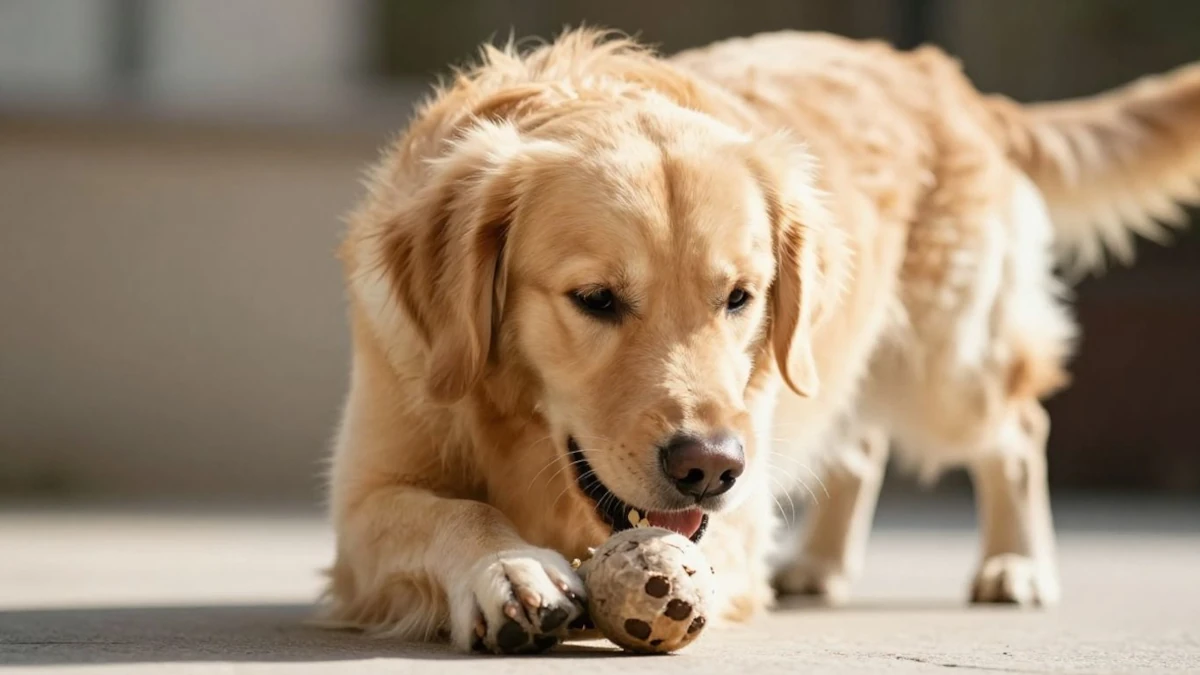
Is your dog a lefty or a righty? Most dogs favor one paw over the other, the same way most humans are right-handed. This trait, called pawedness or laterality, is linked to how each side of the brain controls behavior. Researchers have now developed the "Doginburgh Inventory": a 4-test tool that gives a more complete and reliable picture of your dog's paw preference than any single observation offers.
Key takeaways
- Dogs show paw preferences similar to human handedness, though the split is far more even than the roughly 90% right-hand dominance seen in people.
- The Doginburgh Inventory combines 2 manipulation tests (Kong toy, food-reaching) and 2 locomotion tests (stairs, curb) into one composite score.
- A dog's preferred paw can vary by task, which is why a single observation is not a reliable read on its own.
- Paw preference may correlate with emotional tendencies: left-pawed dogs sometimes show more pessimistic responses, and weak-preference dogs may react more strongly to stress.
- Run each test 10 times, and 7 or more uses on one side counts as a strong preference.
Table of Contents
Quick answer: Run the Kong test and the food-reaching test 10 times each and tally which paw your dog uses. A paw used 7 or more times out of 10 counts as a strong preference, and an even split means your dog is ambilateral. Enter your dog's details into the calculator for a feeding plan, or jump straight to how to test your dog at home below.
What Is Canine Pawedness?
Pawedness is a dog's consistent preference for using one paw over the other during specific tasks, and it stems from brain lateralization: the two hemispheres of the brain handle different functions, and which hemisphere dominates influences which limb a dog reaches with first. Researchers once considered handedness a uniquely human trait, but research over the past few decades shows many animals, dogs included, reliably favor one paw for specific activities.
Unlike humans, where roughly 90% are right-handed, dogs split far more evenly between left-pawed, right-pawed, and ambilateral (no strong preference). Some research finds a slight population-level lean toward right-paw preference, but the split is much closer to even.
The Doginburgh Inventory: How It Works
Researchers drew inspiration from the Edinburgh Handedness Inventory, a standard questionnaire used to assess human handedness, and adapted it for dogs. The result is the Doginburgh Inventory: a 4-test protocol combining 2 manipulation tests and 2 locomotion tests, giving a more accurate composite picture than any single measure provides. All 4 tests are designed to be replicable at home.
Manipulation Tests
- Kong Toy Test: Fill a Kong toy with treats and place it on the floor. Researchers record which paw the dog uses to hold the toy steady while working to get the treats out.
- Food-Reaching Test: Slide a treat out of reach under a low piece of furniture. Record the paw the dog extends to retrieve it.
Locomotion Tests
- Stair Test: The dog sits at the top of a staircase. Researchers note which paw moves first when the dog steps down.
- Walking Step Test: During a leashed walk, the dog encounters a single downward step or curb. Record the first paw to move.
By combining results across all 4 tasks, the inventory classifies dogs into one of 5 categories: strong left-pawed, weak left-pawed, ambilateral, weak right-pawed, or strong right-pawed.
Paw Preference Is Task-Dependent
One of the more notable findings from the research is that a dog's preferred paw is not always the same across activities. A dog might reach with its left paw to grab a treat from under furniture but use its right paw to steady a Kong toy. This task-dependence is exactly why the Doginburgh Inventory uses multiple tests: a single observation can mislead.
This mirrors findings in other species. Fish, birds, and primates all show limb preferences that can shift depending on what the animal is doing. Laterality appears to be a feature of how vertebrate brains divide cognitive labor, not a fixed switch.
Why Paw Preference Matters
Which paw a dog favors to steady a toy is only part of the picture. Paw preference also links to a dog's emotional temperament and stress response. Research cited by Scientific American and Smithsonian Magazine points to 3 behavioral patterns:
- Left-pawed dogs may show more pessimistic responses in ambiguous or novel situations
- Dogs with weaker or no paw preference may react more strongly to startling or stressful stimuli
- Researchers are exploring laterality assessments as a potential screening tool for working and service dog programs
As The Conversation notes, understanding a dog's cognitive and emotional tendencies through laterality helps owners and trainers tailor their approach. A more reactive dog might benefit from a calmer training environment, while a dog being screened for guide work might be assessed for the emotional stability that a strong paw preference sometimes correlates with.
🐾 Try it at home: Run the Kong test or the food-reaching test 10 times and track which paw your dog uses. The paw used 7 or more times out of 10 is likely dominant. Combine both tests for a more reliable result.
How to Test Your Dog at Home
Both manipulation tests from the Doginburgh Inventory are designed to be owner-replicable with no special equipment. Here is how to run them:
- Place a Kong or similar food-dispensing toy on a hard floor. Fill it with a high-value treat your dog can smell but not easily access.
- Let your dog approach and work at the toy. Record which paw contacts the toy first to stabilize it. Write L or R.
- Repeat 10 times across multiple short sessions for consistency.
- Run the food-reaching test: slide a small treat under the edge of a sofa or low shelf and note which paw your dog extends to retrieve it.
- Tally your results. 7 to 10 uses on one side = strong preference. 5 to 6 = weak preference. An even split = ambilateral.
For the most accurate picture per the Doginburgh research, also observe your dog on stairs and curbs to add the locomotion component. Tracking your dog's health at home is always more useful when you know how your individual dog thinks and responds.
Know Your Dog Inside and Out
Understanding your dog's behavior is one piece of the picture. Make sure their nutrition is dialed in too.
🐾 Calculate Your Dog's Daily Food NeedsFrequently Asked Questions
How can I tell if my dog is left-pawed or right-pawed?
Use the manipulation tests from the Doginburgh Inventory at home. Place a treat-filled Kong on the floor and record which paw your dog uses to stabilize it. Then slide a treat under low furniture and note which paw reaches for it. Run each test 10 times and tally the results. The paw used 7 or more times is likely dominant. For a fuller assessment, also observe which paw your dog places first when stepping down stairs or off a curb.
What does it mean if my dog uses both paws equally?
Dogs that show no clear preference are classified as ambilateral. Research suggests ambilateral dogs may respond more strongly to stressful stimuli compared to dogs with a strong paw preference. Individual variation is considerable, and a lack of paw preference alone does not indicate a problem.
Are most dogs right-pawed or left-pawed?
Studies show dogs split far more evenly between left-pawed, right-pawed, and ambilateral than humans do. Some research finds a slight population-level lean toward right-paw preference, but the distribution is nothing like the roughly 90% right-hand dominance seen in humans. Individual dogs vary considerably.
Does paw preference affect a dog's behavior or personality?
Research suggests links between laterality and emotional tendencies. Some studies indicate left-pawed dogs may show more pessimistic responses in ambiguous situations, while dogs with weaker paw preferences may be more reactive to startling stimuli. These are population-level patterns, not fixed rules for any individual dog. If you are working on training, see the guide on how activity level affects your dog's daily needs for another angle on understanding your pet.
Sources
How to tell if your dog is left-pawed or right-pawed, according to science, Scientific American. · Is your dog a lefty? New 'Doginburgh' test captures paw preference, Phys.org. · Dogs May Favor a Paw but Which One They Use May Depend on the Task, Discover Magazine. · Are dogs left- or right-handed? What the science says, The Conversation. · Is Your Dog Right-Pawed or Left-Pawed? Here's How to Figure It Out, Smithsonian Magazine.
This article is for general informational purposes and is not a substitute for individualized veterinary or behavioral advice. Consult your veterinarian if a sudden change in paw preference or coordination accompanies other signs of illness or injury.