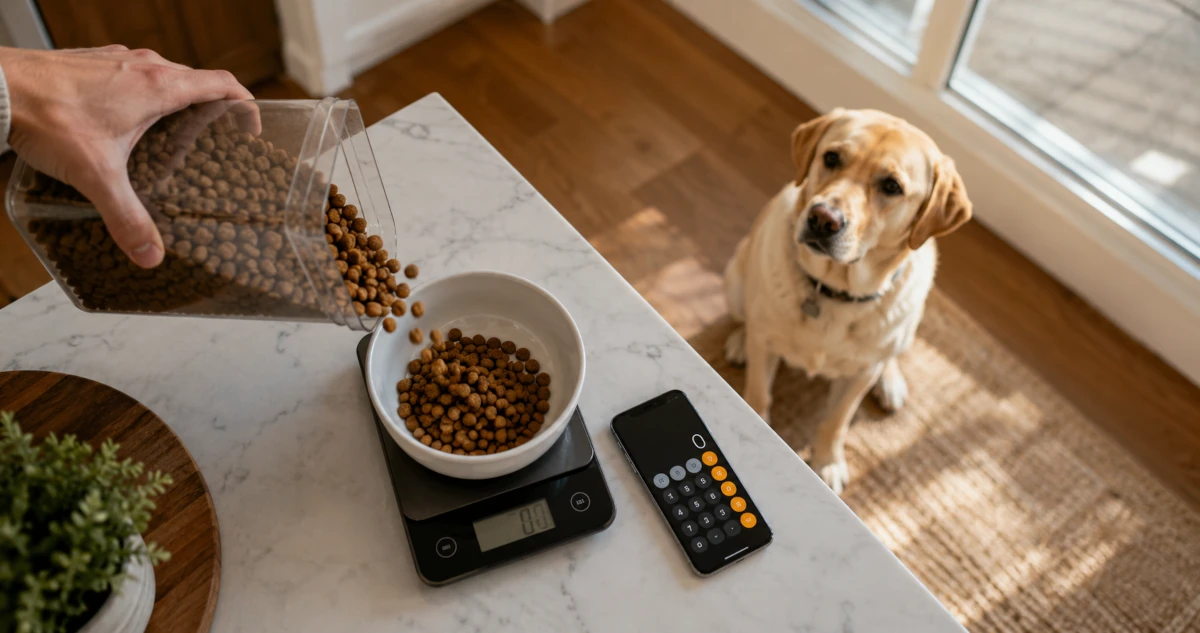
Most dry food bags print a feeding chart sorted by weight alone: "feed 1 to 1.5 cups per day." That is not a portion. It is a range wide enough to cover an intact 10-month-old puppy and a sedentary senior dog at the same number. A dry food calculator narrows that range down to a single, defensible portion, but only if it has the right information to work with.
Key takeaways
- Weight, spay/neuter status, and activity level are the 3 inputs that shift a calculator's output by 20% or more if entered wrong.
- Spayed and neutered dogs typically need 20 to 30% fewer calories than intact dogs at the same weight.
- Kcal per cup, not the bag's feeding chart, is the number that turns a calorie target into an actual cup measurement, and it varies significantly between formulas.
- Recheck body condition score two to four weeks after any portion change, and adjust by about 10% if needed.
- Individual dogs can run 20% above or below the calculated number, so treat the output as a starting point, not a fixed target.
Table of Contents
Quick answer: Open the free dry food calculator and enter your dog's weight, spay/neuter status, and activity level for an instant calorie and cups-per-day estimate. The sections below explain what each input changes and how to check the result against your dog's actual body condition.
What a Dry Food Calculator Needs From You
Every calculator built on veterinary formulas, including the Resting Energy Requirement (RER) and Maintenance Energy Requirement (MER) equations published by the National Research Council, runs on the same handful of inputs. Get one of them wrong and the output can shift by 20% or more.
Your Dog's Current Body Weight
Weight is the base of the equation: RER equals 70 times body weight in kilograms raised to the 0.75 power. A small error here compounds through every later step, so weigh your dog on a scale rather than estimating from memory or a vet visit several months back. For dogs too large for a kitchen scale, stand on a bathroom scale while holding your dog, then subtract your own weight.
Spay or Neuter Status
Reproductive status changes metabolic rate directly. Spayed and neutered dogs typically need roughly 20 to 30% fewer calories than intact dogs at the same weight and activity level, since the hormonal drivers behind higher energy turnover are no longer present. Confirm this input matches your dog's current status, especially soon after a spay or neuter procedure, when the old higher-calorie routine may still be in place.
Activity Level
Activity is the input owners most often misjudge, usually toward the high end. Use the categories below as a gut check before committing to a number:
| Activity Level | Typical Multiplier Range | What It Looks Like |
|---|---|---|
| Sedentary | 1.0 – 1.4 | Short leash walks, seniors, dogs recovering from illness or surgery |
| Moderate | 1.4 – 1.8 | Daily walks plus regular play, a typical companion dog |
| High / Working | 1.8 – 3.0 | Agility, hunting, herding, or sustained daily exercise |
These ranges are intentionally broad. For the exact multiplier tied to each life stage, see the complete RER/MER breakdown used throughout this site.
Calibrating the Result With Body Condition Score
A calculator gives you a starting number, not a verdict. Body Condition Score (BCS) is how you check whether that number is working for your dog after two to four weeks on the new portion.
The WSAVA 9-Point Scale
The World Small Animal Veterinary Association publishes a 9-point body condition scale used by vets worldwide, running from 1 (emaciated) to 9 (severely obese), with 4 to 5 considered ideal for most dogs. It gives you a consistent reference point that does not depend on the number on a scale, which matters because two dogs at the same weight can carry different amounts of body fat.
Checking by Sight and Touch
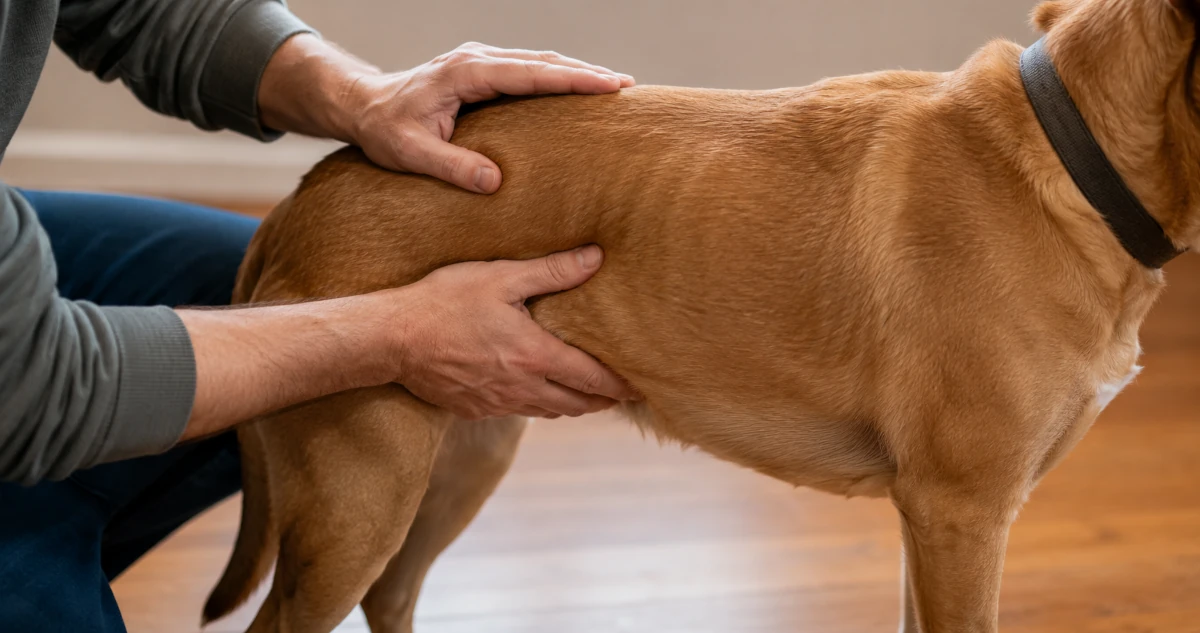
- Look from above: a healthy dog shows a visible waist tuck behind the ribs.
- Look from the side: the belly should slope upward from chest to hind legs, not hang level.
- Run your palms along the rib cage: ribs should be easy to feel with light pressure, similar to the back of your hand.
- Feel for a thin, even layer of fat over the ribs, not a firm pad you have to press through to find bone.
For a full walkthrough of every point on the scale, see How to Tell If Your Pet Is Overweight.
Finding the Number That Makes the Math Real: Kcal Per Cup
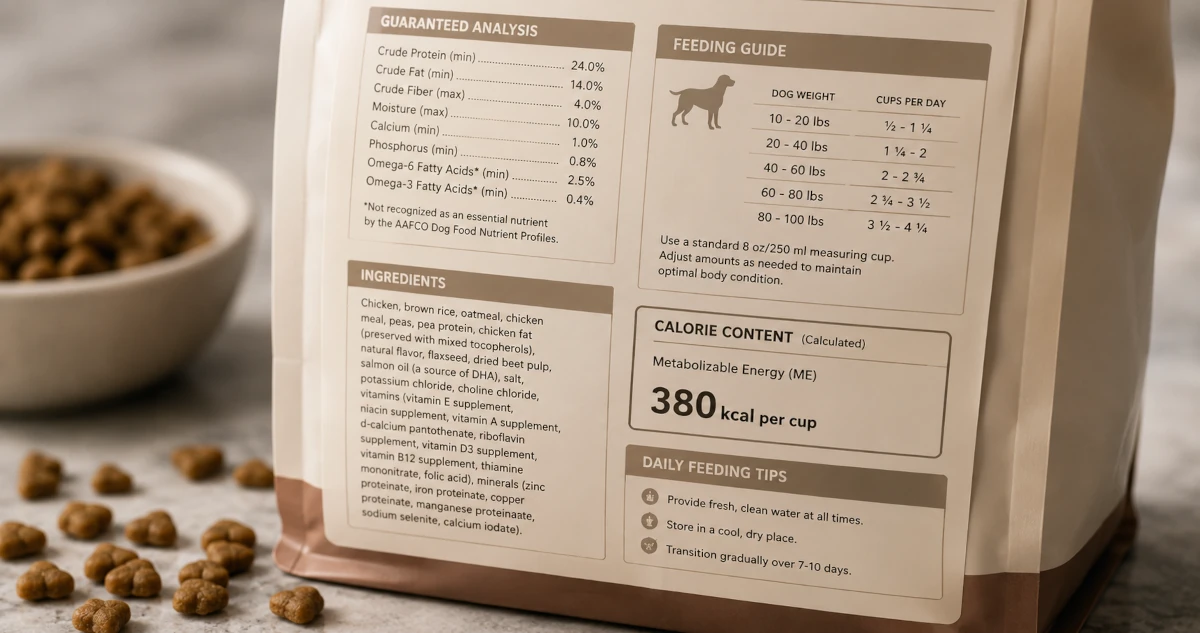
A calculator can hand you a calorie target, but you still eat cups, not calories. The conversion depends on one number most owners never look for: metabolizable energy, usually printed as kcal per cup.
Where to Find It on the Bag
The Association of American Feed Control Officials (AAFCO) requires dry dog food sold in the United States to disclose caloric content under its labeling standards. Look for a "Calorie Content" statement on the bag, typically near the guaranteed analysis panel, expressed as kcal per cup or kcal per kilogram. If it is missing from the bag, check the manufacturer's website. Most publish it in their product specifications.
Why a Cup From One Bag Is Not a Cup From Another
A cup measures volume, not energy. A dense, high-fat performance formula can pack 500 kcal into a single cup, while a fiber-heavy weight management formula might hold only 300 kcal in the same volume. Feeding "the same amount" by cup when switching foods can mean a 40% swing in actual calories, which explains a lot of unexplained weight change after a food switch. Weighing food in grams on a kitchen scale removes this variable entirely.
Adjusting for Life Stage and Health Status
Puppies, seniors, and dogs with medical conditions all need a second look at the calculator's baseline output, since growth, aging, and disease can each shift the true requirement well past what weight and activity level alone predict.
Puppies
Puppies run through a much higher multiplier since growth itself burns calories. A large-breed puppy fed like a large-breed adult will fall behind on what it needs during a developmental window that will not repeat, so use a puppy-specific formula and recheck the calculator monthly as weight climbs. For a worked example with a full age-by-age chart, see the Labrador puppy feeding guide.
Seniors
Metabolic rate slows with age, and activity often drops alongside it. Keeping a senior dog on an adult-era portion is one of the more common ways a healthy weight slips into overweight without an owner noticing, since the change happens gradually over months.
Medical Conditions
Thyroid disorders, arthritis, and some medications change how a dog's body uses energy independent of weight or activity. If your dog has a new diagnosis or medication, treat the calculator's output as a starting point to discuss with your veterinarian rather than a fixed target.
Recalculate After Any Change
Weight, activity, spay/neuter status, or a new bag of food: any of these shifts the right answer.
🐾 Use the Free CalculatorWhen the Calculator's Number Does Not Match Reality
Formulas estimate an average. Individual dogs can run 20% above or below the calculated number due to genetics, coat, and metabolism, so treat the calculator as a starting point you adjust against what you observe.
Signs You Are Underfeeding
Watch for a sudden drop in energy, ribs and hip bones becoming easy to see rather than feel, or a dog that seems to be searching for food constantly. Before assuming the calculator is wrong, confirm the weight and activity inputs are still current.
Signs You Are Overfeeding
Weight trending up over several consecutive weekly checks, a waist that disappears from the overhead view, or ribs that take firm pressure to locate all point toward too many calories. Treats and table scraps count toward this total and are the most commonly forgotten source of extra calories, according to the Association for Pet Obesity Prevention.
Making Changes Safely
Adjust the daily portion by about 10%, then hold that change for 2 weeks before judging the result. Weigh your dog weekly during any adjustment period. A single reading tells you little, but a trend over three or four weeks tells you whether the new portion is working. For guidance on splitting a portion between wet and dry food, see Wet vs. Dry Pet Food: How Much of Each?
Frequently Asked Questions
Can I use a human calorie calculator for my dog?
No. Canine metabolism does not scale the same way human metabolism does, so formulas built for people produce numbers with no real connection to a dog's energy needs. Use a calculator built on veterinary formulas such as RER and MER instead.
How often should I recalculate my dog's portion?
Recalculate any time your dog's weight, activity level, or reproductive status changes, and whenever you switch to a food with a different kcal-per-cup value. For a stable adult dog, a quarterly check alongside a body condition assessment is enough.
Should treats count toward the daily calorie total?
Yes. Treats, chews, and table scraps add calories the calculator does not include automatically. A common guideline is to keep treats under 10% of total daily calories and subtract that amount from the calculated food portion.
Why does the bag's feeding chart give a different number than the calculator?
Bag charts calibrate their numbers around a generic intact adult dog at moderate activity, which is rarely the dog eating from the bag. A calculator's inputs, weight, reproductive status, and activity level together, produce a more specific estimate for your individual dog.
How long before I see whether the new portion is working?
Give it two to four weeks before judging by scale weight, and check body condition at the same time. Weight changes gradually, so a single week's reading is not enough to tell whether an adjustment is correct.
What if my dog seems hungry at the calculated portion?
Many dogs act hungry regardless of how much they have eaten, so behavior alone is not a reliable signal. If your dog's body condition score is already in the ideal range, resist the urge to increase food and consider adding a low-calorie option like plain green beans for volume without added calories.
How many cups of dry kibble per day should I feed my 65 lb neutered Lab?
A 65 lb (29.5 kg) neutered Labrador at moderate activity has an RER of about 878 kcal (70 × 29.50.75), multiplied by the neutered-moderate factor of 1.6 for an MER near 1,405 kcal/day. At a typical large-breed kibble's 380-400 kcal per cup, that works out to roughly 3.5-3.7 cups a day, split into 2 meals. Check your specific bag's Calorie Content statement, since formulas range from 300-450 kcal per cup, or enter the exact value into the calculator for a precise cup measurement.
This article is for general informational purposes and is not a substitute for individualized veterinary advice. Consult your veterinarian about your dog's specific nutritional needs.