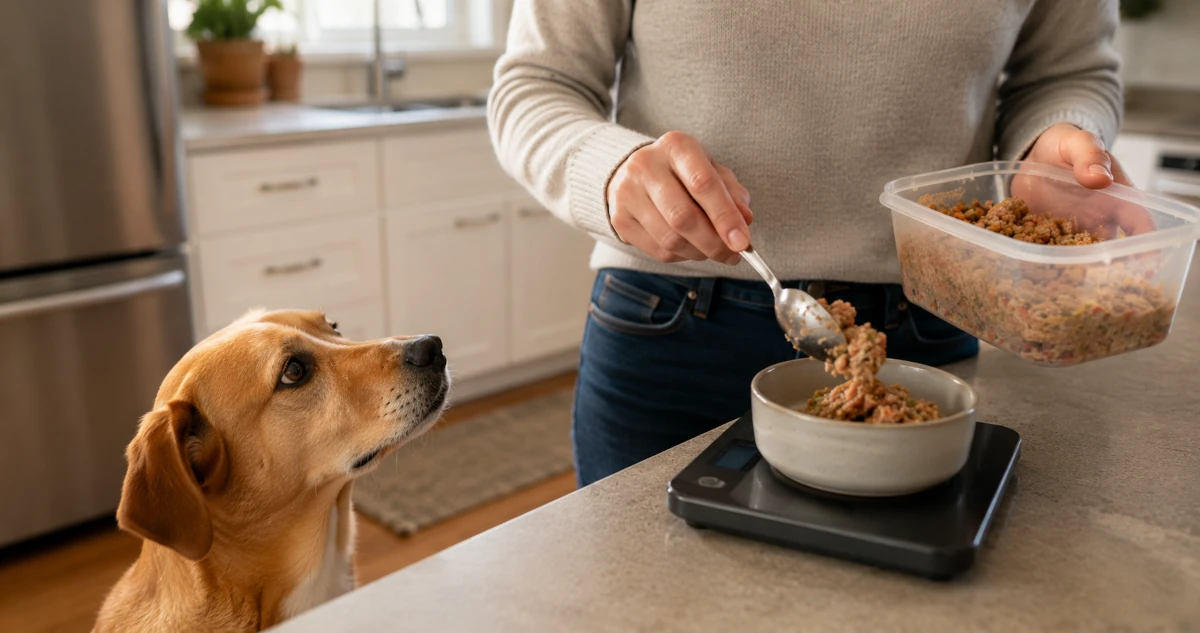
Fresh dog food does not come with a cup scoop, and it does not come with a feeding chart that accounts for your specific dog. Whether you are switching to a subscription service, cooking meals at home, or feeding a commercial raw diet, the standard "cups per day" math printed on a kibble bag does not apply. A fresh dog food calculator solves this, but only if you feed it the right numbers, starting with a caloric density measured in grams, not cups.
This guide covers what makes fresh food math different from kibble math, what to enter into a calculator to get an accurate result, and how to transition your dog onto a fresh diet without digestive upset.
Key takeaways
- Fresh food is measured in kcal per 100g, not kcal per cup, so kibble-style scoop measurements do not transfer.
- Start from RER × MER, the same formula used across every feeding guide on this site, then divide by the food's kcal per 100g and multiply by 100 to get a daily weight in grams.
- Recheck body condition score two to four weeks after switching, and adjust the daily portion by about 10% if needed.
- Transition over 7 to 10 days to avoid loose stool from the jump in moisture and fat content.
- Subtract calories from any kibble or treats fed alongside fresh food so the combined daily total still matches the target.
Table of Contents
- Why Fresh Food Breaks the Standard Kibble Math
- The RER/MER Formula Behind Every Fresh Food Portion
- What to Enter Into a Fresh Food Calculator
- Checking the Result Against Body Condition
- Transitioning to Fresh Food Without Stomach Upset
- Managing Mixed Feeding
- A Ready-Made Option: Just Food For Dogs
- When to Recalculate
- Frequently Asked Questions
Quick answer: Open the free fresh food calculator and enter your dog's weight, spay/neuter status, and activity level for a daily calorie target, already converted into an exact daily weight in grams from the food's kcal per 100g.
Why Fresh Food Breaks the Standard Kibble Math
Most feeding calculators and every bag of kibble are built around one unit: the cup. Fresh food does not fit that model, and treating it like kibble is the most common reason fresh-food portions end up wrong.
Kcal Per 100g, Not Kcal Per Cup
Fresh food is sold and portioned by weight, typically in pre-portioned patties, pouches, or containers measured in grams or ounces. Caloric density is listed the same way, as kcal per 100g, kcal per kg, or total kcal per pack, rather than kcal per cup. If you try to eyeball a fresh food portion using a dry measuring cup, you are guessing at a number the packaging was never designed to express that way.
Moisture Content Changes the Comparison
Fresh food typically runs 60 to 75% moisture, similar to canned food and far higher than dry kibble's roughly 10%. That means a gram of fresh food and a gram of kibble are not nutritionally equivalent, and switching between formats by weight alone, without recalculating calories, is a common way portions drift off target. For the full breakdown of comparing formats by moisture content, see Wet vs. Dry Pet Food: How Much of Each?
The RER/MER Formula Behind Every Fresh Food Portion
Regardless of format, the starting point is the same veterinary formula used throughout this site: Resting Energy Requirement (RER), scaled by a Maintenance Energy Requirement (MER) factor for activity and reproductive status.
A 20 kg (44 lb) neutered adult dog at moderate activity has an RER of roughly 662 kcal, scaled by a typical MER multiplier of about 1.4 to a daily target near 927 kcal. For the complete multiplier table across life stages and activity levels, see How Much Should I Feed My Dog?
What to Enter Into a Fresh Food Calculator
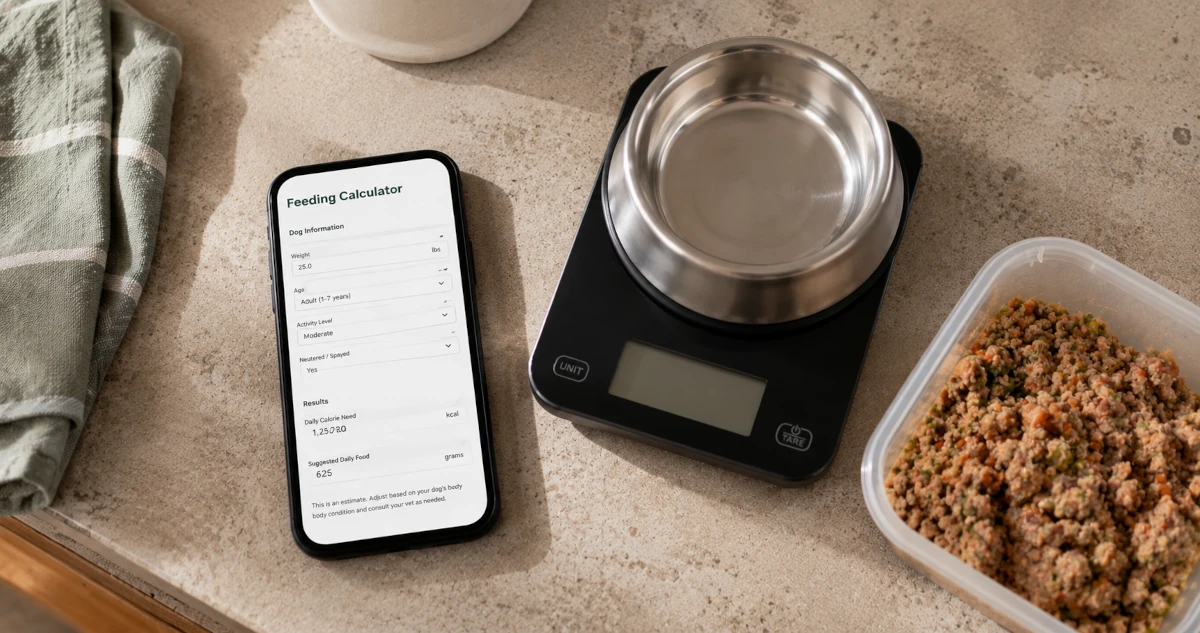
Once you have a daily calorie target, converting it into a daily weight of fresh food takes 4 pieces of information.
Current Body Weight
Weigh your dog on a scale rather than relying on a number from memory or a past vet visit. Since RER scales with weight raised to the 0.75 power, a stale number compounds into a meaningfully wrong daily target.
Spay or Neuter Status and Activity Level
These 2 inputs set the MER multiplier applied to RER. Spayed and neutered dogs typically need roughly 20 to 30% fewer calories than intact dogs at the same weight, and activity level shifts the multiplier further, from sedentary seniors to working or high-activity dogs. For a full reference table on activity multipliers, see How to Use a Dry Food Calculator, which covers the same inputs in more depth.
Caloric Density Per 100g
Fresh food brands typically publish this figure on the package label or on a nutrition specifications page for each recipe, usually as kcal per 100g, kcal per kg, or kcal per serving, since caloric density shifts meaningfully between a beef-based recipe and a leaner poultry or fish recipe. If the label uses kcal per kg, divide by 10. If it lists kcal per serving, divide by the serving's gram weight and multiply by 100. Divide your dog's daily calorie target by the kcal per 100g figure, then multiply by 100 to get the total daily weight in grams, and split that total across 2 or more meals.
Checking the Result Against Body Condition
Confirm the calculator's number against your dog's score on the WSAVA's 9-point body condition scale (BCS). The math is a starting point, not a verdict. The following weeks of BCS checks tell you whether that starting point is right for your dog.
The WSAVA 9-Point Scale
The World Small Animal Veterinary Association's 9-point body condition scale evaluates rib visibility, waist definition, and abdominal tuck to categorize a dog from underweight to obese, with 4 to 5 considered ideal for most dogs. Recheck your dog's score two to four weeks after starting a fresh diet and adjust the daily portion by about 10% if the trend is moving the wrong way. For the full walkthrough, see How to Tell If Your Pet Is Overweight.
Transitioning to Fresh Food Without Stomach Upset
Fresh food has a different fat content, fiber profile, and moisture level than most kibble, and an abrupt switch is the most common cause of loose stool during a transition. Spread the change over seven to ten days: start around 25% fresh food mixed with 75% of the old diet for the first few days, move to a 50/50 mix, then finish at 75% fresh before dropping the old food entirely. Watch for stool consistency at each stage and slow the pace if you see sensitivity.
Managing Mixed Feeding
Many owners feed fresh food alongside kibble or treats rather than switching entirely, which adds a layer of arithmetic that is easy to skip. Subtract the calories provided by kibble, treats, and any secondary food source from the calculated fresh food allotment so the combined daily total still matches your dog's target. Since fresh food's caloric density can run 2 to 3 times higher per 100g than kibble depending on the recipe, a rough by-volume split between the two formats tends to overshoot the total more often than it undershoots.
A Ready-Made Option: Just Food For Dogs
Affiliate disclosure: The buy links below are affiliate links. If you make a purchase through them, this site may earn a commission at no additional cost to you. It does not affect how this brand or any other is evaluated.
If cooking at home is not practical, Just Food For Dogs is a fresh food company founded in 2010 by a team that includes board-certified veterinary nutritionists. Recipes use USDA-inspected, human-grade ingredients, and the company has run feeding trials against AAFCO protocols rather than relying on formulation alone, a step most fresh food brands skip. Each recipe publishes a caloric density figure on its nutrition page, which converts to kcal per 100g using the formula above.
Get the Exact Daily Weight, Not a Guess
Enter your dog's details once and get a calorie target you can divide by any food's density.
🐾 Use the Free CalculatorWhen to Recalculate
Recalculate when your dog ages into a slower metabolism, takes on a working or high-activity role, or develops a medical condition, since each of those shifts the daily requirement enough to make the original number stale.
Senior Dogs
Metabolic rate and activity typically both decline with age, and a portion sized for a younger, more active dog will run too high without anyone noticing until the weight trend makes it obvious.
Working and High-Activity Dogs
Dogs with genuinely variable daily workloads, herding, hunting, or sustained exercise, often need a portion that flexes with the day rather than a single fixed number, since their energy expenditure swings more than a typical companion dog's.
Dogs With Medical Conditions
Calculators provide a solid baseline for healthy dogs, but they do not replace veterinary guidance for dogs in treatment or recovery. Chronic conditions and some medications change how the body uses energy in ways a formula built for healthy dogs will not capture.
Frequently Asked Questions
How often should I re-evaluate my dog's fresh food portion?
Re-evaluate at least quarterly, or immediately if you notice a change in body condition, weight, or activity level. Any switch to a different fresh food brand or recipe also calls for a recheck, since caloric density varies between them.
Can raw food provide enough nutrition compared to cooked fresh food?
Yes, provided the raw diet is formulated to be complete and balanced, covering essential vitamins and minerals in addition to protein and fat. Caloric density still needs to be calculated accurately regardless of whether the food is raw or cooked. If you're feeding a homemade raw diet rather than a commercial one, the Raw Feeding Ratio Calculator splits your dog's daily total into muscle meat, bone, and organ grams using the standard 80/10/10 ratio.
What should I do if my dog seems hungry after switching to fresh food?
Check body condition score before increasing the portion. Dogs often display food-seeking behavior that has little to do with actual hunger, especially during a food transition.
Does my dog's breed affect the fresh food calculator's result?
Yes. Breed size and build influence metabolic rate, which is why activity level and body weight both need to reflect your dog's actual size and lifestyle rather than a generic average.
Are treats included in the daily caloric total?
Yes. Treats should be counted toward the total and generally kept under 10% of daily calories, with the fresh food portion adjusted down to make room for them.
Is it safe to feed a mix of dry kibble and fresh food?
Mixed feeding is safe as long as you track and subtract the calories from both the kibble and the fresh food so the combined total still matches your dog's calculated daily need.
What's a free alternative to The Farmer's Dog calculator for figuring out fresh food portions?
This site's fresh food calculator runs on the same NRC RER/MER formula as every guide here, but it is not tied to one brand's own recipes: enter your dog's weight, spay/neuter status, and activity level for a daily calorie target, already converted into grams using the kcal-per-100g value printed on any fresh food's label, whether that is a subscription service, a commercial raw diet, or home-cooked meals. It is free, requires no account or subscription, and works the same way regardless of which fresh food brand you end up choosing.
This article is for general informational purposes and is not a substitute for individualized veterinary advice. Consult your veterinarian about your dog's specific nutritional needs, especially if switching to a fresh or home-cooked diet.