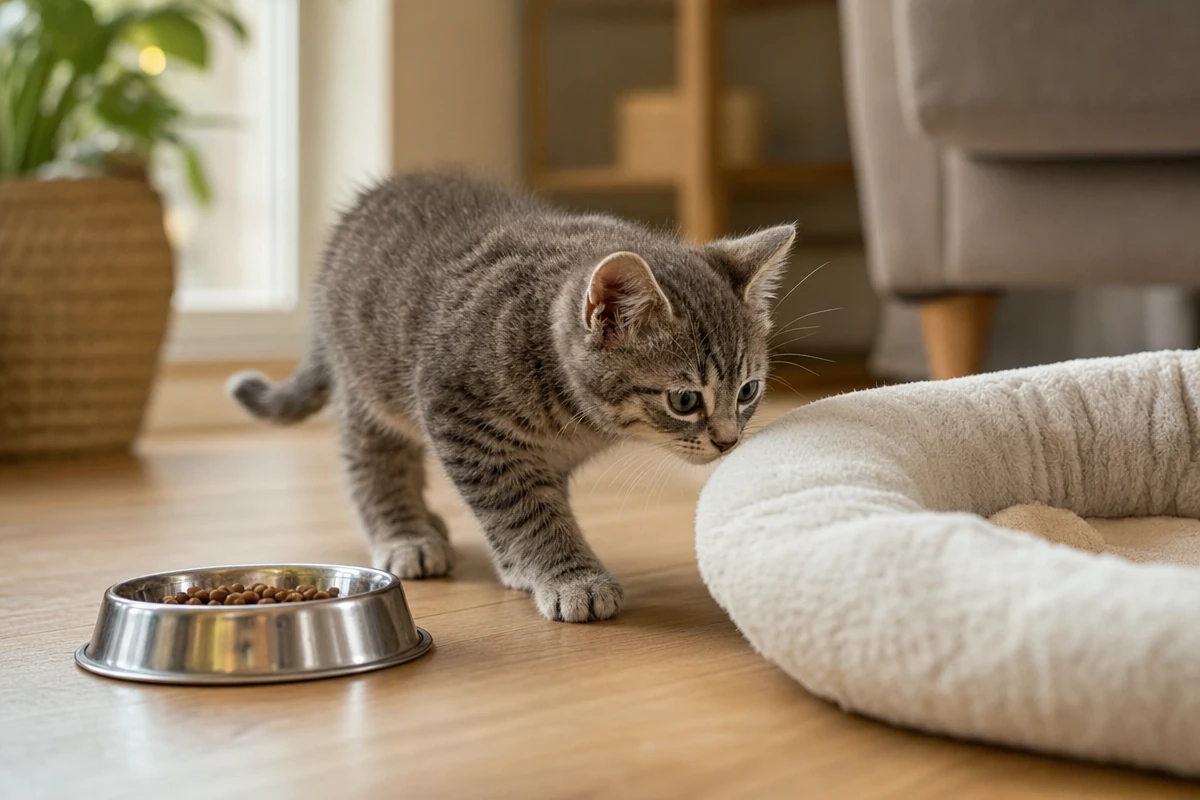
A new kitten needs more than food and a litter box in the first few weeks. Kitten care 101 covers supplies, litter training, home safety, feeding, socialization, and a vet and vaccine schedule that starts within your kitten's first week home. Skipping any one of these early on tends to turn into a harder problem later, from litter box avoidance to a cat who never fully relaxes around new people. This guide walks through what needs your attention first, in the order it usually comes up.
Key takeaways
- Before your kitten comes home, a right-sized litter box, kitten food, a carrier, and a scratching post matter more than toys.
- Litter training works best with a box about 1.5 times your kitten's length, one box per cat plus one extra, and consistent placement after meals and naps.
- The critical socialization window for kittens is 2 to 7 weeks old. After that, positive exposure still helps, but the easiest window for bonding is closing.
- Core vaccines start around 6 to 8 weeks old and continue every 3 to 4 weeks until 16 weeks, with spay or neuter typically scheduled by 5 months.
- Kittens under 4 months old need a same-day vet call for any diarrhea, since young kittens dehydrate and drop blood sugar fast relative to their size.
Table of Contents
- What Supplies Does a New Kitten Need First?
- How Do You Litter Train a Kitten?
- How Do You Kitten-Proof Your Home?
- How Much Should You Feed a Kitten?
- What Is the Kitten Socialization Window?
- What Vet Visits and Vaccines Does a Kitten Need?
- What Are the Warning Signs a Kitten Needs a Vet Right Away?
- Frequently Asked Questions
Quick answer: A new kitten needs a right-sized litter box, food measured to about 2.5 times its resting energy need under 4 months old, a first vet visit within the first week home, and consistent gentle handling during the 2 to 7 week socialization window. Use the Kitten Feeding Schedule Calculator for the exact calorie and meal-count math instead of guessing.
What Supplies Does a New Kitten Need First?
A new kitten needs six things before it ever sees your home: a kitten-sized litter box, kitten food, food and water bowls, a secure carrier, a scratching post, and basic bedding. Everything else can wait.
The litter box matters most, and it is the item new owners most often get wrong by buying an adult-sized box. A kitten's box should be about 1.5 times its body length, low-sided enough to step into easily, and filled with non-clumping litter if your kitten is under 8 to 10 weeks old, since very young kittens can ingest clumping litter while grooming. Choose a carrier that doubles as a bed or has a removable top, so it becomes familiar rather than a box that only appears before something unpleasant happens.
A scratching post belongs on the first-week list too. Kittens develop scratching habits early, and an acceptable surface from day one heads off furniture damage before it starts.
How Do You Litter Train a Kitten?
Most kittens litter train themselves with minimal help, as long as the box is easy to find and easy to use. Show your kitten where the box is as soon as it arrives, and place it gently inside after meals, naps, and play, the times a kitten is most likely to need to go.
Keep one litter box per cat, plus one extra, placed in separate, easy-to-reach locations rather than clustered in one room. Avoid corners or enclosed spots that can feel like a trap to a small animal exploring a new space, and scoop after every use during the first few weeks, since a kitten that finds a dirty box will often look elsewhere.
If accidents happen outside the box, resist the instinct to scold. Clean the spot with an enzymatic cleaner so no odor draws your kitten back, and reward box use with a treat right after your kitten leaves it. Litter training can begin as early as 4 weeks old, around when kittens start weaning, but most kittens adopted at 8 weeks or older pick up the habit within days of consistent placement.
How Do You Kitten-Proof Your Home?
Kittens investigate everything with their mouths and paws, turning ordinary household items into hazards an adult cat owner would not think twice about. Walk through each room at kitten height before bringing your kitten home, and remove or secure what you find.
Toxic plants are the biggest hidden risk. Lilies are especially dangerous to cats and can cause kidney failure from even minimal exposure, including pollen brushed onto fur during grooming. Check every houseplant against an ASPCA-verified toxic plant list before your kitten arrives, not after.
Beyond plants, secure blind and curtain cords so a curious kitten cannot get tangled, store medications and cleaning supplies behind closed doors, and check window screens for gaps a small kitten could push through. Loose cords, small chokable objects, and open toilet lids round out the list.
How Much Should You Feed a Kitten?
Kitten calorie needs run roughly double an adult cat's per pound of body weight, and the amount changes every few weeks as your kitten grows. Veterinary nutritionists calculate it as RER times a kitten-factor: resting energy requirement (70 × body weight in kg0.75) multiplied by 2.5 for kittens under 4 months old and 2.0 for kittens 4 to 12 months old, split across 3 to 4 meals a day at the youngest ages and tapering to 2 to 3 meals by 6 to 12 months.
Rather than work the math by hand, enter your kitten's weight and age into the Kitten Feeding Schedule Calculator for daily calories, meals per day, and an estimated cups-per-day amount matched to your kitten's exact age. For the general adult feeding formula once your kitten grows up, see How Much Should I Feed My Cat?.
What Is the Kitten Socialization Window?
The critical socialization window for kittens runs from about 2 to 7 weeks old, the period when a kitten's brain treats new experiences as interesting rather than frightening. Gentle exposure to handling, everyday sounds, and different people during these weeks shapes how confident and easygoing your cat is for the rest of its life.
If you are adopting from 8 weeks on, the technical window has already started closing, but the effort is not wasted. Continue short, positive handling sessions, introduce one new person or sound at a time, and let your kitten retreat if it shows fear rather than pushing through it. Treats and toys paired with each new experience build the association you want.

Include the rest of the household in this process early. Gentle handling by every family member, brief supervised time with a resident dog or cat, and calm exposure to a carrier and car rides all pay off later, especially if your kitten will need to travel or visit a vet.
What Vet Visits and Vaccines Does a Kitten Need in the First Year?
Schedule your kitten's first vet visit within the first week home, even if your kitten seems healthy. That first exam screens for parasites, checks for feline leukemia and feline immunodeficiency virus, looks for congenital issues like heart murmurs, and starts the core vaccine series.
Core kitten vaccines follow a set schedule tied to age, not a single shot. The first FVRCP dose, covering feline viral rhinotracheitis, calicivirus, and panleukopenia, typically starts at 6 to 8 weeks old, with boosters every 3 to 4 weeks until 16 weeks old, when rabies is also added. A booster round follows at 1 year, then annually.
| Age | Milestone |
|---|---|
| 2 – 7 weeks | Critical socialization window, with gentle handling and positive exposure |
| 6 – 8 weeks | First vet visit within first week home, plus first FVRCP vaccine dose |
| 8 – 10 weeks | Typical age for adoption or coming home |
| 10 – 12 weeks | FVRCP second dose plus first FeLV dose |
| 14 – 16 weeks | FVRCP third dose, rabies, and FeLV booster |
| 4 – 6 months | Spay or neuter window (Fix by Five: by 5 months) |
| 12 months | Transition to adult food, with annual vaccine boosters beginning |
Sources: AAHA New Kitten Checklist, PetMD kitten vaccination schedule, and the AVMA-endorsed Fix by Five spay/neuter initiative.
Spay or neuter timing has shifted earlier in recent years. The AVMA-endorsed Fix by Five initiative recommends spaying or neutering by 5 months old, since kittens can become pregnant as early as 4 months. Many vets now schedule the procedure between 4 and 6 months rather than the traditional 6-month mark.
For a printable growth chart to track weight by age alongside this vet visit timeline, see the Kitten Growth Chart & Vet Visit Checklist.
Want a Printable First-Year Tracker?
Kitten Care Planner: Your Complete First-Year System for a Confident, Healthy Cat by Kade Forth pairs a feeding and growth tracker with vet visit logs, milestones, and daily care pages in one printable planner.
Affiliate disclosure: This book is published by PetFeedCalculator.com under the pen name Kade Forth. The link below is an affiliate link, and purchases made through it may earn this site a commission at no extra cost to you.
What Are the Warning Signs a Kitten Needs a Vet Right Away?
Any diarrhea in a kitten under 4 months old is a same-day call to your vet, not a wait-and-see situation, because young kittens dehydrate fast relative to their small size. Add vomiting alongside diarrhea, blood in either, or signs of dehydration such as tacky gums and lethargy, and the same urgency applies regardless of age.
For kittens over 4 months old with diarrhea and no other symptoms, it is reasonable to monitor for 24 hours if your kitten is otherwise eating and acting normally, then call your vet if it has not resolved. Decreased interest in eating or unusual lethargy at any age deserves a same-day call.
Kittens under 3 months old can develop dangerously low blood sugar after going without food for several hours, since their bodies cannot yet regulate glucose like an adult cat's can. Watch for wobbliness, trembling, or unusual weakness, and treat those as an emergency rather than something to monitor overnight.
🐾 Next step: Once feeding and vaccines are on track, use the Dog & Cat Portion Calculator to keep portions accurate as your kitten grows into an adult cat.
Frequently Asked Questions
How many litter boxes does a kitten need?
One litter box per cat, plus one extra, placed in separate, easy-to-reach spots around the home. For a single kitten, that means at least 2 boxes.
What is the critical socialization window for kittens?
About 2 to 7 weeks old. Positive, gentle exposure to people, handling, and everyday sounds during this window shapes a kitten's lifelong confidence and comfort around people.
When should a kitten have its first vet visit?
Within the first week of coming home, even if your kitten looks and acts healthy. That visit screens for parasites, tests for feline leukemia and FIV, and starts the core vaccine series.
When should a kitten be spayed or neutered?
By 5 months old, per the AVMA-endorsed Fix by Five initiative. Kittens can become pregnant as early as 4 months old, so many vets now schedule the procedure between 4 and 6 months.
How much should I feed a kitten?
Use RER times a kitten-factor: about 2.5 times resting energy requirement for kittens under 4 months old, and 2.0 times for kittens 4 to 12 months old. Enter your kitten's weight and age into the Kitten Feeding Schedule Calculator for an exact daily amount.
What are signs my kitten needs a vet right away?
Any diarrhea in a kitten under 4 months old, vomiting combined with diarrhea, blood in either, tacky gums, lethargy, or wobbliness and trembling that could signal low blood sugar.
This article is for general informational purposes and is not a substitute for individualized veterinary advice. Consult your veterinarian about your kitten's specific health, vaccine, and feeding needs.