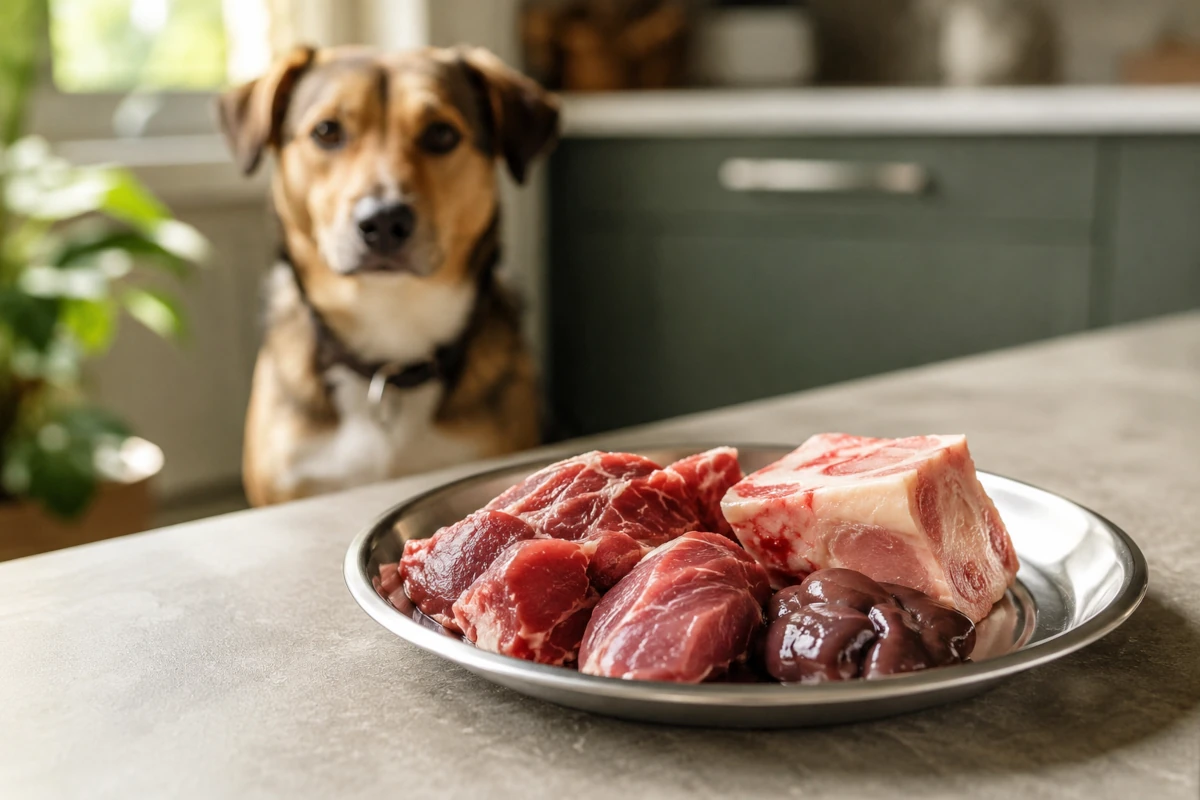
A calorie total alone does not tell a raw feeder what to put in the bowl. Raw diets are built from muscle meat, edible bone, and organ meat in specific proportions, and getting that ratio wrong causes real problems: too much bone leads to constipation and hard, chalky stool, too little leaves a calcium gap, and too much liver risks vitamin A toxicity over time. This raw feeding ratio calculator takes the same NRC calorie formula used across this site and splits the result into exact muscle meat, bone, and organ grams for your dog.
This page covers where the 80/10/10 ratio comes from, how to split your dog's daily total using the calculator's adjustable sliders, and what the ratio does and does not guarantee nutritionally.
Key takeaways
- The standard raw-feeding starting ratio is 80% muscle meat, 10% edible bone, and 10% organ meat by weight.
- Organ meat is typically split evenly: 5% liver, 5% another secreting organ like kidney or spleen.
- The daily total still starts from RER × MER, the same NRC formula used across every calculator on this site.
- 80/10/10 approximates whole-prey composition but does not guarantee AAFCO-complete micronutrients without variety or supplementation.
- Recheck body condition every few weeks and adjust the ratio or total amount if needed, especially for puppies and pregnant or lactating dogs.
Table of Contents
- Raw Feeding Ratio Calculator
- What Is the 80/10/10 Raw Feeding Ratio?
- The RER/MER Formula Behind Your Dog's Raw Portion
- Why the Organ Portion Is Split Between Liver and Other Organs
- Is 80/10/10 Nutritionally Complete and Balanced?
- Raw Feeding Food Safety
- When to Adjust the Ratio
- Frequently Asked Questions
Quick answer: Enter your dog's weight, life stage, and activity level in the calculator below for a daily raw food total, already split into muscle meat, bone, liver, and other organ grams using the standard 80/10/10 ratio, adjustable to your preference.
Calculate Your Dog's Raw Feeding Ratio
Enter your dog's details for an instant, personalized gram breakdown
What Is the 80/10/10 Raw Feeding Ratio?
Raw feeders commonly build a dog's diet around a starting ratio of 80% muscle meat, 10% edible bone, and 10% organ meat by weight, a rough approximation of what a dog would get eating whole prey. It's a structural starting point, not a nutrient-by-nutrient prescription, but it works reasonably well as a default because muscle meat supplies protein and fat, bone supplies calcium and phosphorus, and organ meat supplies concentrated vitamins and minerals that muscle meat alone runs short on.
| Component | Typical % | What It Provides |
|---|---|---|
| Muscle meat | 80% | Protein, fat, most B vitamins |
| Edible bone | 10% | Calcium, phosphorus |
| Liver | 5% | Vitamin A, copper, concentrated micronutrients |
| Other secreting organ | 5% | Additional micronutrients (kidney, spleen, pancreas) |
Quick answer: 80/10/10 means 80% muscle meat, 10% bone, and 10% organ meat by weight, with the organ portion usually split evenly between liver and one other secreting organ.
The RER/MER Formula Behind Your Dog's Raw Portion
Before any ratio math happens, the calculator needs a daily calorie target, using the same NRC (2006) formula as the rest of PetFeedCalculator.com:
MER = RER × life-stage multiplier
Worked example: a 45 lb (20.4 kg) neutered adult dog at moderate activity has an RER of 70 × 20.40.75 ≈ 671 kcal/day. MER = 671 × 1.6 ≈ 1,074 kcal/day. At a typical raw food density of 1.5 kcal/gram, that's 716 grams of raw food per day, split into roughly 573 g muscle meat, 72 g bone, 36 g liver, and 36 g other organ using the default 80/10/10 ratio.
Why the Organ Portion Is Split Between Liver and Other Organs
Liver is nutrient-dense, especially in vitamin A and copper, and that density cuts both ways. A small amount goes a long way toward closing the micronutrient gaps muscle meat leaves open, but feeding too much liver too often carries a real risk of vitamin A toxicity over time, which can affect bone and joint health. Splitting the 10% organ portion roughly evenly, about 5% liver and 5% another secreting organ like kidney, spleen, or pancreas, keeps liver intake in a safer range while still covering a wider spread of micronutrients than liver alone provides.
Non-secreting organs like tripe, heart, or tongue are sometimes fed in addition to this ratio, but they're closer to muscle meat nutritionally and don't count toward the 10% organ target the same way liver, kidney, spleen, and pancreas do.
Is 80/10/10 Nutritionally Complete and Balanced?
Not automatically. The ratio approximates the broad macronutrient and mineral composition of whole prey, but a single protein source fed at 80/10/10 will not reliably hit every vitamin and mineral target in an AAFCO complete-and-balanced profile. Nutrients that are commonly under-supplied on a narrow 80/10/10 rotation include vitamin E, zinc, manganese, and iodine.
Two approaches close that gap: rotating through multiple protein sources (beef, poultry, fish, and game each contribute a different micronutrient profile), and feeding whole prey with fur or feathers included when practical, since that adds nutrients the muscle/bone/organ ratio alone misses. For a homemade raw diet fed long-term, having a board-certified veterinary nutritionist review the recipe against AAFCO or NRC targets is the most reliable way to confirm it's complete.
🐾 Just need the calorie math, not the ratio? If you're feeding a commercial fresh or raw food with a printed kcal-per-gram value, the Fresh Dog Food Calculator guide covers the calorie side in more depth.
Raw Feeding Food Safety
Raw meat, bone, and organ can carry Salmonella, Listeria, and other bacteria that pose a risk to both pets and the people handling their food. Wash hands, cutting boards, bowls, and countertops with hot soapy water after every raw meal prep, keep raw food refrigerated or frozen until shortly before feeding, and thaw frozen portions in the refrigerator rather than at room temperature. Households with young children, elderly members, pregnant people, or anyone immunocompromised should take extra precautions or discuss raw feeding risk with a doctor and veterinarian first.
When to Adjust the Ratio
The 80/10/10 default is a starting point, not a fixed rule. A few situations call for a different split:
- Loose stool. Often means too little bone, or a transition happening too fast. Nudge the bone percentage up slightly and watch the next few days.
- Constipation or hard, chalky stool. Usually means too much bone. Nudge the bone percentage down.
- Puppies, pregnant, and lactating dogs. These life stages have tighter calcium-to-phosphorus and micronutrient requirements than a maintenance adult. Use the calculator's life-stage selector for the calorie total, but work with your veterinarian to check the ratio itself.
- Weight management. The ratio's percentages stay the same; the total daily amount changes instead. Select the weight-loss life stage above to reduce the calorie target while keeping the same meat/bone/organ split.
Frequently Asked Questions
What is the 80/10/10 raw feeding ratio?
It's the raw-feeding community's standard starting ratio: 80% muscle meat, 10% edible bone, and 10% organ meat by weight, with the organ portion usually split evenly between liver and another secreting organ like kidney or spleen. It approximates the rough composition of whole prey.
How much bone should a dog eat on a raw diet?
Around 10% of total daily food weight is the standard starting point. Too little bone can lead to a calcium deficiency over time, while too much can cause constipation or hard, chalky stool. Adjust in small increments and watch stool consistency.
How much organ meat is safe to feed a dog?
About 10% of total daily food weight, split roughly evenly between liver and another secreting organ. Liver is very high in vitamin A, so feeding too much of it, too often, carries a real risk of vitamin A toxicity over time. Keep liver to about 5% of the total diet.
Is raw feeding nutritionally complete without supplements?
Not automatically. The 80/10/10 ratio approximates the broad macronutrient and mineral profile of whole prey, but it does not guarantee every vitamin and mineral an AAFCO complete-and-balanced diet requires. Rotating protein sources, feeding whole prey when possible, or working with a board-certified veterinary nutritionist closes that gap.
Can I adjust the ratio for a puppy or pregnant dog?
The calculator lets you select puppy, pregnant, and lactating life stages, which raises the MER multiplier and daily food amount, but growing and reproducing dogs have tighter calcium-to-phosphorus and micronutrient requirements than a maintenance adult. Work with your veterinarian to formulate or check any raw diet for a puppy, pregnant, or lactating dog.
How much raw food should I feed my dog per day?
Use RER × life-stage multiplier to get a daily calorie target, then divide by your raw food's kcal-per-gram density to get total grams per day. The calculator above does this automatically and also splits that total into muscle meat, bone, and organ grams based on your dog's weight, life stage, and activity level.
This article is for general informational purposes and is not a substitute for individualized veterinary advice. Consult your veterinarian before starting a raw diet, especially for puppies, seniors, pregnant or lactating dogs, or dogs with existing health conditions.