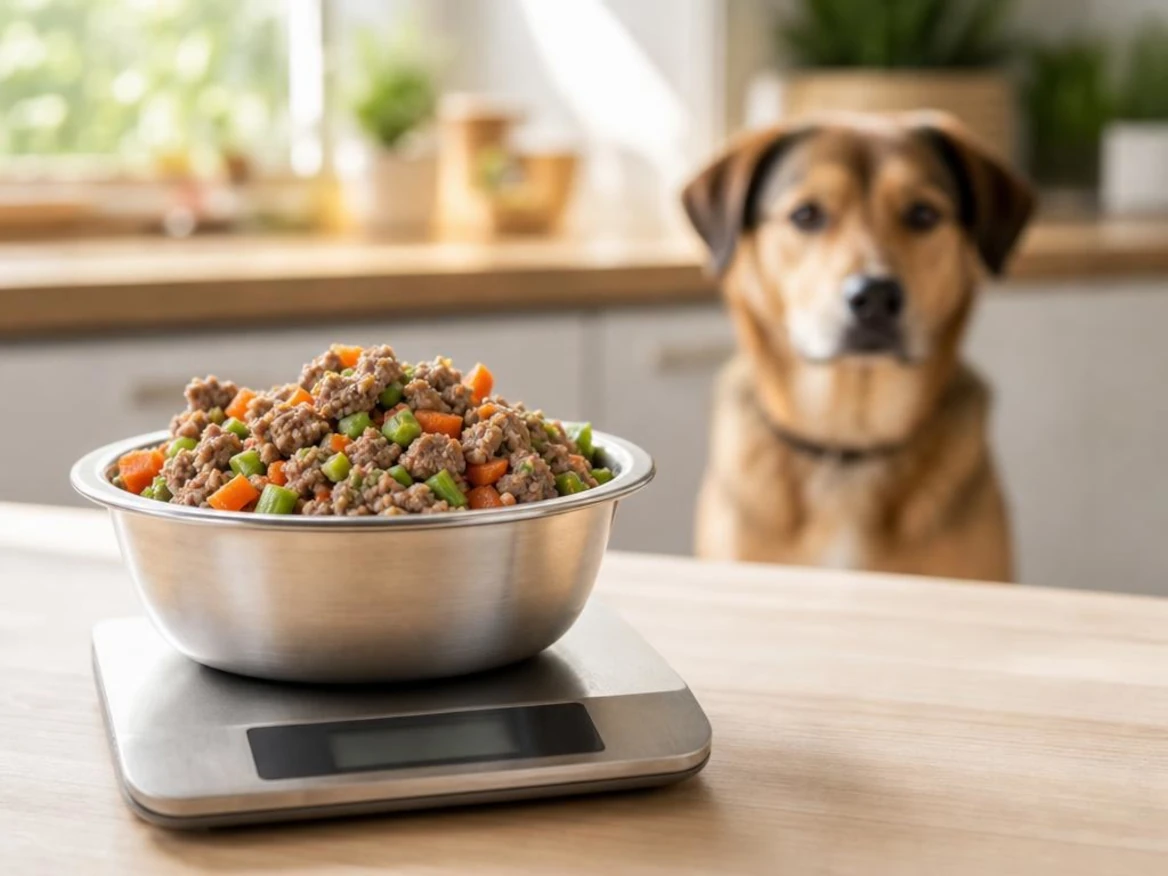
Fresh dog food does not come with a cup measurement that means anything. A scoop of loose kibble and a scoop of dense, moisture-rich fresh food can carry completely different calorie counts, so the cup-based feeding guides printed on kibble bags simply do not transfer. Fresh, pre-portioned, and home-cooked diets are measured by weight instead, and getting that number right starts with the same calorie math used everywhere else on this site, converted into grams.
This page explains the formula, shows you where to find your food's calorie density, and covers the transition, storage, and nutritional-completeness questions that come up most for owners switching to fresh food.
Key takeaways
- Fresh food is measured in grams, not cups, because its calorie density per volume varies far more than dry kibble.
- Daily grams come from DER (RER × life-stage multiplier) divided by the food's kcal per 100g, multiplied by 100.
- Fresh food typically runs 120-200 kcal per 100g; check your specific product's label rather than relying on a default.
- Transition to fresh food gradually over 7-10 days to avoid stomach upset.
- Homemade fresh diets need to be checked against AAFCO nutrient profiles to be truly complete and balanced.
Table of Contents
- Fresh Dog Food Calculator
- Why Fresh Food Is Measured in Grams, Not Cups
- The RER/DER Formula Behind Your Dog's Fresh Food Portion
- Finding Your Food's Calorie Density (Kcal per 100g)
- Transitioning to Fresh Food Without Stomach Upset
- Is Homemade Fresh Food Nutritionally Complete?
- Frequently Asked Questions
Calculate Your Dog's Fresh Food Portion
Enter your dog's details for an instant, personalized gram amount
Why Fresh Food Is Measured in Grams, Not Cups
A cup measures volume. Calories come from mass and calorie density, not the space something takes up in a scoop. Dry kibble is fairly consistent in density from bag to bag, which is why cup-based feeding charts work well enough for it. Fresh, pre-portioned, and home-cooked foods do not share that consistency: moisture content, ingredient mix, and recipe all shift the calories packed into a given volume, sometimes significantly between brands or even between batches of a homemade recipe.
A kitchen scale removes that variability. Weighing the portion in grams ties the amount you feed directly to your dog's actual calorie target, regardless of how dense or airy that particular food happens to be.
Quick answer: Enter your dog's weight, life stage, and food's kcal per 100g in the calculator above for a daily gram amount, split into grams per meal and, if your food comes in pre-portioned packs, packs per day.
The RER/DER Formula Behind Your Dog's Fresh Food Portion
The calculator uses the same NRC (2006) two-step formula as the rest of PetFeedCalculator.com, with the result converted from calories into grams using the food's density:
DER = RER × life-stage multiplier
Grams per day = (DER ÷ kcal per 100g) × 100
Worked example: a 35 lb (15.9 kg) spayed adult dog at moderate activity has an RER of 70 × 15.90.75 ≈ 570 kcal/day. DER = 570 × 1.6 ≈ 912 kcal/day. At a food density of 160 kcal per 100g, that comes to (912 ÷ 160) × 100 ≈ 570 grams per day, split evenly across the number of meals you choose.
| Life Stage | Neutered Multiplier | Intact Multiplier |
|---|---|---|
| Puppy (under 4 months) | 3.0 | |
| Junior (4 months – 1 year) | 2.0 | |
| Adult, sedentary | 1.2 | 1.8 |
| Adult, moderate | 1.6 | 1.8 |
| Adult, active | 2.0 | 2.5 |
| Senior, moderate | 1.4 | 1.6 |
| Weight loss | 1.0 (at current weight) | |
Source: National Research Council (NRC) 2006 nutrient requirements, cross-referenced against WSAVA global nutrition guidelines. This is the same multiplier table used by every calculator on this site.
Finding Your Food's Calorie Density (Kcal per 100g)
Every commercial fresh food brand lists calorie content on the packaging or the product page, usually as kcal per 100g, kcal per kg, or kcal per serving. If your label uses a different unit, convert it to kcal per 100g before entering it above: divide kcal per kg by 10, or divide kcal per serving by the serving's gram weight and multiply by 100.
Fresh food density typically runs 120 to 200 kcal per 100g, lower than dry kibble's roughly 300 to 400 kcal per 100g because of the much higher moisture content. If you're cooking a homemade recipe without a label, a recipe-nutrition calculator or your veterinary nutritionist can estimate the density from the ingredient list.
🐾 Feeding a raw diet instead of a cooked fresh diet? Use the Raw Feeding Ratio Calculator for a daily amount already split into muscle meat, bone, and organ grams.
Transitioning to Fresh Food Without Stomach Upset
Switching a dog's diet too quickly is one of the most common causes of loose stool and vomiting during a food change, fresh food included. A gradual transition over 7 to 10 days gives the gut microbiome time to adjust:
- Days 1-3: About 25% fresh food mixed with 75% of the current diet.
- Days 4-6: Roughly 50/50.
- Days 7-9: About 75% fresh food, 25% current diet.
- Day 10 onward: Fully fresh food, at the gram amount from the calculator above.
Watch stool consistency throughout. If it loosens noticeably, hold at the current ratio for a few extra days before increasing the fresh food share, and check with your veterinarian if vomiting, diarrhea, or appetite loss persists.
Is Homemade Fresh Food Nutritionally Complete?
Not automatically. Commercial fresh food brands that label a product "complete and balanced" have formulated it against AAFCO nutrient profiles and typically back that claim with feeding trials or nutrient analysis. A homemade recipe carries no such guarantee on its own, even when it looks nutritionally reasonable.
The most common gaps in homemade diets are calcium, certain trace minerals, and specific vitamins that do not naturally balance out without a formulated recipe. If you are cooking for your dog long-term rather than occasionally, have the recipe reviewed or built by a board-certified veterinary nutritionist, for example through a service like balanceit.com or a veterinary nutrition referral, rather than relying on a recipe found online without professional review.
🐾 Feeding a senior dog fresh food? The life-stage multipliers above already account for age-related metabolic changes, or use the dedicated Senior Dog Food Calculator for additional joint and kidney health guidance.
Frequently Asked Questions
How much fresh food should I feed my dog per day?
Use DER divided by your food's calorie density. DER = 70 × (body weight in kg)0.75 × a life-stage multiplier, then divide by the food's kcal per 100g and multiply by 100 to get grams per day. Use the calculator above for a number personalized to your dog.
Why is fresh dog food measured in grams instead of cups?
A cup measures volume, not calories, and fresh, pre-portioned, and home-cooked foods vary far more in density than dry kibble. Weighing the portion in grams on a kitchen scale is the only accurate way to match the amount you feed to your dog's actual calorie needs.
What is a typical calorie density for fresh dog food?
Most fresh dog foods run roughly 120 to 200 kcal per 100g, noticeably lower than dry kibble because of the higher moisture content. 160 kcal per 100g is a reasonable default if you can't find the exact number, but always check the product label or brand website for accuracy.
Can I mix fresh food with kibble?
Yes. Calculate each food's share of your dog's total daily calories separately, then convert the fresh portion to grams using its kcal per 100g and the kibble portion to cups using its kcal per cup. The two calorie amounts should add up to your dog's full DER, not exceed it.
How do I switch my dog to fresh food without stomach upset?
Transition gradually over seven to ten days, mixing increasing amounts of fresh food into the current diet rather than switching all at once. A common schedule is roughly 25% fresh food for the first two to three days, 50% for the next two to three days, 75% for two to three more, then fully fresh, watching stool consistency along the way.
Is homemade fresh dog food nutritionally complete?
Not automatically. A homemade recipe needs to be formulated, or checked, against AAFCO nutrient profiles to guarantee complete and balanced nutrition, since gaps in calcium, trace minerals, or vitamins are common in home-cooked diets that were not professionally reviewed. Commercial fresh food brands that state "complete and balanced" on the label have already done this.
How many meals a day should fresh food be split into?
Two meals a day is standard for most adult dogs, though puppies typically need three to four smaller meals and some owners split fresh food into more, smaller portions to make refrigerated storage and thawing easier. The calculator above splits your dog's daily total evenly across the number of meals you choose.
This calculator gives a starting point, not a prescription. Fresh food formulations vary by brand and recipe, always confirm the exact kcal per 100g on your food's label. For pets with a medical condition, follow your veterinarian's guidance over this estimate.