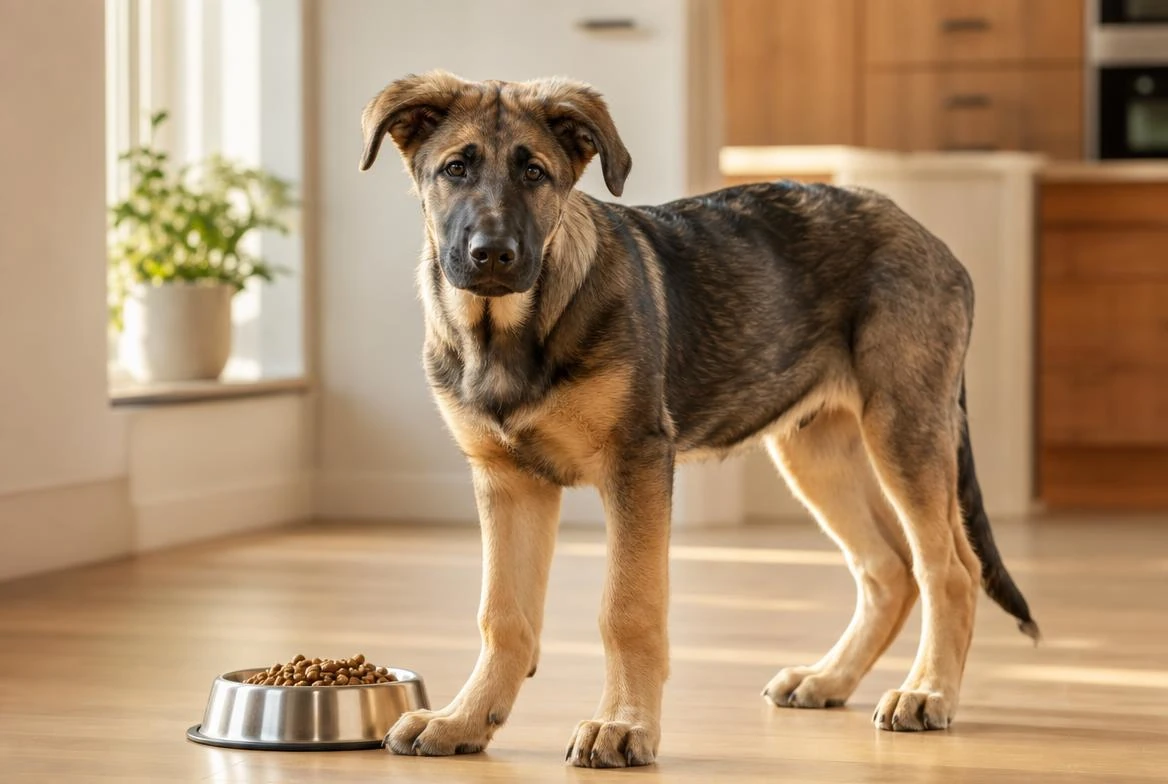
Large and giant breed puppies don't just eat more than small dogs — they grow on a longer timeline, typically finishing skeletal growth between 12 and 18 months instead of the roughly 12 months it takes small and medium breeds. That means a large-breed puppy's calorie needs, meal frequency, and even the point where it should switch to adult food all run on a different schedule. This page gives you the exact veterinary formula and a free calculator that turns your puppy's weight, age, and estimated adult size into a personalized feeding schedule.
Key takeaways
- Large-breed puppy daily calories = RER × growth multiplier: 3.0× under 4 months, 2.0× from 4-12 months, and roughly 1.8× from 12-18 months for large and giant breeds specifically.
- Meal frequency drops as puppies age: 3-4 meals/day under 4 months, 2-3 meals/day at 4-12 months, and 2 meals/day from 12 months on.
- "Large breed" generally means an estimated adult weight of 50-90 lbs; "giant breed" means over 90 lbs. Both need controlled calcium and a longer growth timeline than smaller dogs.
- Small and medium breeds (under 50 lb adult weight) typically finish growth by 12 months — the extended 12-18 month growth stage doesn't apply to them.
- These are general, evidence-informed guidelines — always confirm with your veterinarian, especially for unusually fast- or slow-growing puppies.
Table of Contents
Calculate Your Puppy's Growth Schedule
Enter your puppy's weight, age, and estimated adult size for an instant, personalized result
Large-Breed Puppy Feeding Chart by Age and Weight
Large-breed puppies pass through five broad feeding stages, the last of which — the 12-18 month extended growth window — only applies if your puppy's estimated adult weight is 50 lbs or more. This calculator uses the same age brackets and calorie multipliers as the site's main Dog & Cat Portion Calculator, extended with the large-breed-specific growth stage:
| Age | Calorie Multiplier | Meals per Day | Notes |
|---|---|---|---|
| Under 8 weeks | — | — | Nursing / weaning; breeder or vet-guided plan needed |
| 8 weeks – 4 months | 3.0 × RER | 3–4 | Peak growth phase; large-breed formula with controlled calcium essential |
| 4 – 12 months | 2.0 × RER | 2–3 | Steady growth continues for all breed sizes |
| 12 – 18 months | 1.8 × RER | 2 | Large/giant breeds only — smaller breeds move to adult formula here |
| 18+ months (adult) | Adult formula | 2 | Switch to adult maintenance over 7–10 days |
Multipliers follow NRC 2006 and WSAVA growth guidance. The 12-18 month stage is a transitional estimate — individual puppies and breeds vary more here than in the earlier stages.
Quick answer: Feed a large-breed puppy 3-4 times a day until 4 months old, 2-3 times a day from 4-12 months, and 2 times a day from 12 months through adulthood. Use the calculator above for your puppy's exact numbers.
The RER/MER Formula for Large-Breed Puppies
Veterinary nutritionists calculate calorie needs with a two-step formula published by the National Research Council (NRC 2006) — the same formula used throughout PetFeedCalculator.com:
MER = RER × growth-stage multiplier
RER (Resting Energy Requirement) is the calories your puppy's body burns at rest. MER (Maintenance Energy Requirement) — the number you actually feed to — multiplies RER by a growth-stage factor that stays elevated for longer in large and giant breeds than in smaller dogs:
| Growth Stage | Multiplier | Example (15 kg / 33 lb puppy, RER ≈ 583) |
|---|---|---|
| Under 4 months | 3.0 | ≈ 1,749 kcal/day |
| 4 – 12 months | 2.0 | ≈ 1,166 kcal/day |
| 12 – 18 months (large/giant only) | 1.8 | ≈ 1,049 kcal/day |
| Adult, neutered, moderate activity | 1.6 | ≈ 933 kcal/day (for comparison) |
Worked example: a 15 kg (33 lb) puppy has an RER of 70 × 150.75 ≈ 583 kcal. If that puppy is 3 months old, MER comes to roughly 1,749 kcal per day. If it's instead 14 months old with an estimated 75 lb adult weight, it falls in the large-breed 12-18 month stage at 1.8× RER, or about 1,049 kcal/day — notably higher than the 933 kcal/day an adult dog of the same weight would need. Divide the daily total by the kcal-per-cup figure printed under "Calorie Content" on the food bag to get the daily cup amount, then split it across 2-4 meals depending on age.
How Many Times a Day Should You Feed a Large-Breed Puppy?
Meal frequency matters as much as total calories for growing puppies, and it matters even more for large and giant breeds, which are prone to bloat (gastric dilatation-volvulus) — a life-threatening condition linked partly to eating large meals quickly. Feed 3-4 meals a day up to 12 weeks old, 2-3 meals a day from 3 months to a year, and settle into 2 meals a day from around a year onward. Splitting the daily total into multiple measured meals supports steady digestion and reduces bloat risk compared to one or two large feedings.
When to Switch to Adult Dog Food
Most large-breed dogs can transition between 12 and 18 months old, once growth has slowed and the puppy is close to its adult weight — later than the roughly 12-month mark for small and medium breeds. Switching earlier risks cutting off the controlled calcium and calorie profile that supports proper skeletal development. When you do switch, transition over 7-10 days by gradually mixing in more adult food to avoid digestive upset, then use the site's main Dog & Cat Portion Calculator for ongoing adult portions.
🐾 Next step: Once your large-breed dog reaches adulthood, head to the Dog & Cat Portion Calculator for adult, senior, and activity-adjusted feeding amounts.
Frequently Asked Questions
How much should I feed my large-breed puppy?
It depends on current weight, age, and how large your puppy will be as an adult. Use RER × growth-stage multiplier: RER = 70 × (body weight in kg)0.75, multiplied by 3.0 for puppies under 4 months, 2.0 for 4-12 months, and roughly 1.8 for large and giant breeds continuing to grow from 12-18 months. Use the calculator above for a number personalized to your puppy's exact weight, age, and estimated adult size.
What counts as a large-breed puppy?
Most pet food manufacturers and veterinary nutritionists classify dogs expected to reach 50 to 90 pounds as adults as large breed, and dogs expected to exceed 90 pounds as giant breed. Large and giant breed puppies need a formula with controlled calcium and phosphorus to slow bone growth to a joint-safe rate, and they continue on an elevated growth-calorie curve for longer than small and medium breeds.
Why do large-breed puppies need a feeding chart by weight and age instead of just a portion calculator?
Because a large-breed puppy's calorie needs and meal frequency change every few weeks as it grows, and it stays on an elevated growth-calorie curve well past the 12-month mark that ends the growth phase for smaller dogs. A single portion number goes stale within weeks, so a chart or calculator that re-derives the numbers from current weight and age — and accounts for the puppy's eventual adult size — is more useful than a one-time calculation.
When do large-breed puppies switch to adult dog food?
Most large-breed puppies are ready to transition between 12 and 18 months old, once growth has slowed and they are close to their adult weight, compared to about 12 months for small and medium breeds. Switching too early risks cutting off the controlled calcium and calorie profile that supports safe skeletal development. Transition gradually over 7-10 days by mixing in increasing amounts of adult food.
How many meals a day should a large-breed puppy eat?
Feed 3-4 meals a day up to 4 months old, 2-3 meals a day from 4-12 months, and 2 meals a day from 12 months onward. Splitting the daily total into multiple meals supports steady digestion and helps reduce the risk of bloat (gastric dilatation-volvulus), which deep-chested large breeds are more prone to.