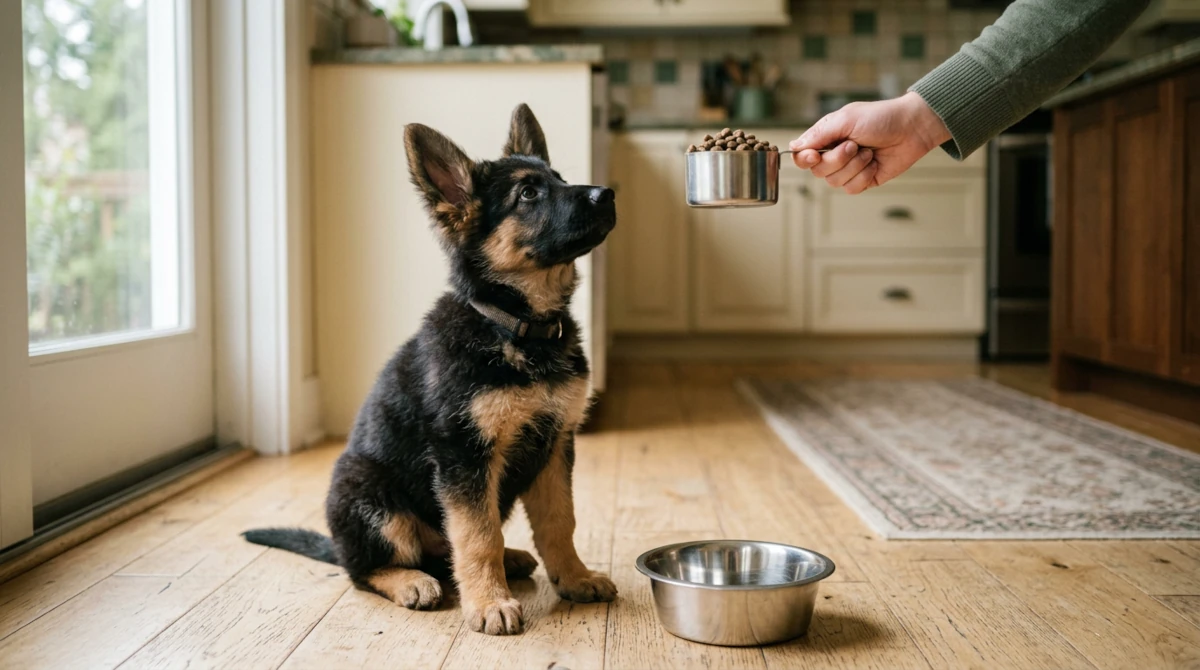
A German Shepherd puppy is headed toward an adult body of roughly 49 to 88 lb, and the right portion changes at every stage along the way. A typical German Shepherd puppy feeding chart lists a cup range by age and stops there. This one shows the calories behind each age, the 3 points where the portion changes, and the breed-specific checks that matter for a shepherd.
The numbers use the same veterinary formula and growth stages as the large-breed puppy feeding calculator, so the chart and the calculator give the same answer for the same puppy.
Key takeaways
- German Shepherd puppies need about 3 × RER from 8 weeks to 4 months, 2 × RER from 4 to 12 months, and 1.8 × RER from 12 to 18 months, based on current weight.
- A 25 lb puppy at 12 weeks needs about 1,298 kcal a day, or 3.46 cups of a 375 kcal/cup large-breed puppy food.
- German Shepherds keep growing past their first birthday, so they stay on puppy-level calories longer than small and medium breeds.
- Most males finish above 70 lb, so choose a food labeled for growth of large size dogs.
- A shepherd puppy that eats well but stays thin, with pale, bulky stools, needs a vet visit to rule out exocrine pancreatic insufficiency (EPI).
Table of Contents
- How Much Should a German Shepherd Puppy Eat?
- German Shepherd Puppy Feeding Chart by Weight and Age
- How Calories Change From 8 Weeks to 18 Months
- How Many Meals a Day for a German Shepherd Puppy
- Choosing a Food for a Large-Breed Shepherd Puppy
- Breed-Specific Signs Your Puppy's Feeding Plan Needs a Vet
- Frequently Asked Questions
Quick answer: Enter your puppy's current weight, age, and expected adult weight in the large-breed puppy feeding calculator. It returns daily calories, cups per day, and meals per day for your shepherd's growth stage.
How Much Should a German Shepherd Puppy Eat?
A German Shepherd puppy needs about 3 times its Resting Energy Requirement (RER) each day from 8 weeks to 4 months, 2 times RER from 4 to 12 months, and 1.8 times RER from 12 to 18 months. The calculation uses the puppy's current weight, not the adult weight you expect.
8 weeks to 4 months: daily kcal = RER × 3
4 to 12 months: daily kcal = RER × 2
12 to 18 months: daily kcal = RER × 1.8
The RER formula comes from the National Research Council (NRC). The third stage is what sets a shepherd apart from a smaller dog. The 2021 AAHA Nutrition and Weight Management Guidelines note that some large and giant breeds do not reach skeletal maturity until about 15 to 16 months, and they call for a lean body condition and no excess calcium during that time.
Worked Example: A 25 lb Puppy at 12 Weeks
A 25 lb puppy weighs 11.3 kg. RER is 70 × 11.30.75, or about 433 kcal. At 12 weeks, multiply by 3 for about 1,298 kcal a day. With a large-breed puppy food at 375 kcal per cup, that is about 3.46 cups a day, or a little under 7/8 cup at each of 4 meals.
German Shepherd Puppy Feeding Chart by Weight and Age
Find your puppy's current weight, then read across to the column for its age. The chart assumes a large-breed puppy food at 375 kcal per cup, so check the kcal per cup on your bag and adjust.
 PetFeedCalculator
petfeedcalculator.com
| Current weight | 8 wk to 4 mo (3 ×) | 4 to 12 mo (2 ×) | 12 to 18 mo (1.8 ×) |
|---|---|---|---|
| 10 lb | 653 kcal · 1.74 cups | 435 kcal · 1.16 cups | 392 kcal · 1.04 cups |
| 20 lb | 1,098 kcal · 2.93 cups | 732 kcal · 1.95 cups | 659 kcal · 1.76 cups |
| 30 lb | 1,488 kcal · 3.97 cups | 992 kcal · 2.65 cups | 893 kcal · 2.38 cups |
| 40 lb | 1,846 kcal · 4.92 cups | 1,231 kcal · 3.28 cups | 1,108 kcal · 2.95 cups |
| 50 lb | 2,182 kcal · 5.82 cups | 1,455 kcal · 3.88 cups | 1,309 kcal · 3.49 cups |
| 60 lb | 2,502 kcal · 6.67 cups | 1,668 kcal · 4.45 cups | 1,501 kcal · 4.00 cups |
| 70 lb | 2,809 kcal · 7.49 cups | 1,873 kcal · 4.99 cups | 1,685 kcal · 4.49 cups |
| 80 lb | 3,105 kcal · 8.28 cups | 2,070 kcal · 5.52 cups | 1,863 kcal · 4.97 cups |
Find the row for your puppy's current weight and recheck every 2 weeks. Get your puppy's exact portion at petfeedcalculator.com
Some cells will not match a real puppy, such as an 80 lb shepherd under 4 months. Use the row and column that match your puppy today, and recheck every 2 weeks as both change.
Get Your Shepherd's Exact Daily Portion
Enter current weight, age, and expected adult weight for calories, cups, and meals per day.
🐾 Use the Large-Breed Puppy CalculatorHow Calories Change From 8 Weeks to 18 Months
Daily calories climb fast for the first 4 months, dip when the multiplier drops from 3 to 2, climb again through the first year, then step down twice more before adulthood. The chart follows an illustrative male growing to 80 lb. Your puppy's weights at each age will differ.
Calories peak near 12 months. At its first birthday, a shepherd still needs more calories than it will as an adult.
The steps in the chart are steps in the formula. Your puppy's metabolism changes more gradually, so taper the portion over two to three weeks around 4 months and again around 12 months. The puppy feeding guide covers the 4-month dip in more detail for all breed sizes.
How Many Meals a Day for a German Shepherd Puppy
Feed 3 to 4 meals a day from 8 weeks to 4 months, 2 to 3 meals from 4 to 12 months, and 2 meals from 12 months on. Split the daily amount evenly across meals.
Keeping 3 smaller meals past 6 months is a reasonable choice for a large, deep-chested dog. The Cornell Richard P. Riney Canine Health Center lists eating too fast, being fed once a day, and exercising soon after eating among the risk factors for gastric dilatation-volvulus (GDV), or bloat, a life-threatening emergency in large dogs. Measured meals, a calm hour after eating, and a slower pace at the bowl all address those factors. For meal timing after the first year, see the dog feeding schedule guide.
Choosing a Food for a Large-Breed Shepherd Puppy
Feed a puppy food whose AAFCO statement covers growth of large size dogs. That wording tells you the food meets the calcium cap for puppies expected to reach 70 lb or more as adults.
Under AAFCO's nutrient profiles, a growth food can carry the phrase "including growth of large size dogs (70 lb or more as an adult)" only if its calcium stays at or below 1.8% on a dry-matter basis, according to Petfood Industry's summary of the AAFCO profiles. Foods labeled "except for growth of large size dogs" do not meet that limit.
This matters for shepherds. The FCI breed standard lists adult males at 30 to 40 kg (66 to 88 lb) and females at 22 to 32 kg (49 to 71 lb), so most males and some females cross the 70 lb line. When you enter an expected adult weight in the calculator, use the range for your puppy's sex. A small female near the bottom of the range may fall under the calculator's 50 lb large-breed threshold, which ends her growth stages at 12 months instead of 18.
Breed-Specific Signs Your Puppy's Feeding Plan Needs a Vet
Weigh your puppy every 2 weeks and check body condition. If the numbers do not match what you see, German Shepherds have one digestive condition worth knowing by name.
Body Condition
Aim for a lean puppy with ribs you can feel easily under a thin layer of fat and a visible waist from above. On the 9-point body condition score (BCS) scale, that is a 4 to 5. The body condition score guide shows the hands-on check. Adjust the daily amount by about 10% if your puppy trends heavy or thin, then recheck in 2 weeks.
Exocrine Pancreatic Insufficiency (EPI)
VCA Animal Hospitals lists German Shepherds first among the breeds that develop EPI more often, a condition in which the pancreas stops producing enough digestive enzymes, and notes it is suspected to be inherited in the breed. Signs include weight loss despite a normal or increased appetite and large volumes of pale, fatty stool. It often appears in young adult dogs. If your shepherd eats its full portion and still loses weight or condition, see your veterinarian before increasing food. More calories will not fix a dog that cannot digest them.
Large-breed puppy feeding follows the same rules across breeds. The Labrador puppy feeding guide applies them to another popular large breed.
Frequently Asked Questions
How much should a German Shepherd puppy eat per day?
Multiply your puppy's RER by 3 from 8 weeks to 4 months, by 2 from 4 to 12 months, and by 1.8 from 12 to 18 months. A 25 lb puppy at 12 weeks needs about 1,298 kcal a day, or 3.46 cups of a 375 kcal/cup large-breed puppy food.
How many cups should an 8-week-old German Shepherd puppy eat?
It depends on weight. A 16 lb puppy at 8 weeks needs about 929 kcal a day, which is about 2.48 cups of a 375 kcal/cup food, split across 4 meals.
When should a German Shepherd switch to adult food?
Plan the switch around 18 months, when the calculator's growth stages end. Confirm the timing with your veterinarian, since shepherds vary in when they finish growing. Transition over 7 to 10 days and recalculate the portion for the new food.
Do German Shepherd puppies need large-breed puppy food?
Yes for most. Choose a growth food whose AAFCO statement includes growth of large size dogs (70 lb or more as an adult), which limits calcium to 1.8% on a dry-matter basis.
Why is my German Shepherd puppy always hungry?
Most puppies act hungry at every meal, so check body condition first. If your puppy eats its full portion, stays thin, and has pale, bulky stools, ask your veterinarian about EPI.
This article is for general informational purposes and is not a substitute for individualized veterinary advice. Ask your veterinarian to check your puppy's growth and body condition at each puppy visit, and consult them before changing the diet of a puppy with a medical condition.