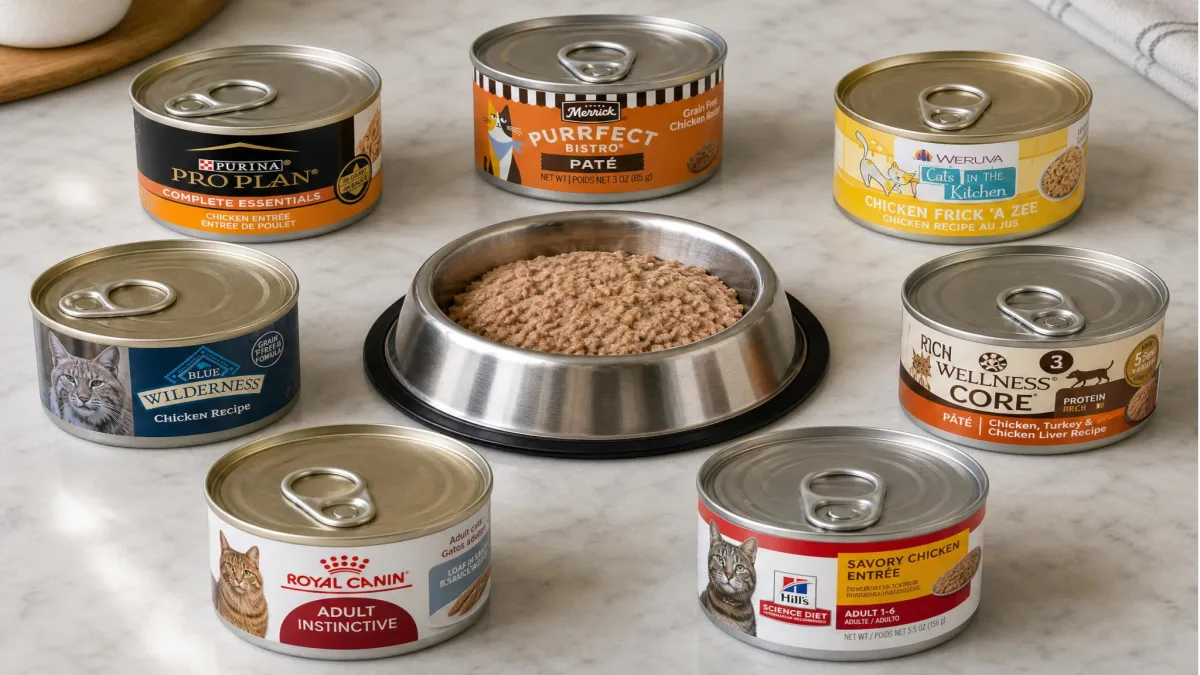
Walk into any pet store and the canned cat food aisle looks the same from one brand to the next: "real meat," "natural ingredients," "premium nutrition." None of those phrases are regulated, and none of them tell you whether the food is right for an obligate carnivore that depends on animal protein to survive.
This guide ranks 7 canned cat foods on the criteria that matter: the AAFCO nutritional adequacy statement, the quality and transparency of protein sources, moisture content, and calorie density per can. Each pick includes what you need to calculate the correct daily portion for your specific cat.
Key takeaways
- Look for an AAFCO "complete and balanced" statement matched to your cat's life stage, since anything labeled "for intermittent or supplemental feeding only" cannot be a primary diet.
- A named animal protein (chicken, turkey, salmon) should be the first ingredient, and the label should confirm added taurine, since cats cannot synthesize enough on their own.
- Canned food runs 75 to 82% moisture, so a 5.5-oz can typically delivers only 150 to 220 kcal, far less than an equivalent volume of dry kibble.
- Always calculate portions from the can's listed kcal content, never by volume or weight alone.
- Protein content varies more than the front of the can suggests. Comparing formulas on a dry matter basis, not the as-fed percentage, is the only fair way to rank them.
Affiliate disclosure: Some links in this guide go to retailers including Chewy, Amazon, and Petco. If you purchase through them, this site may earn a small commission at no extra cost to you. It does not affect which brands are recommended or how they are ranked.
Formulas change. Manufacturers reformulate lines and update ingredients without public notice. Last reviewed: September 2026. Before purchasing, verify the current AAFCO statement and ingredient list on the product label.
Table of Contents
Quick answer: Use our free wet food calculator for cats to find your cat's daily calorie target, then check the "Calorie Content" on the can's label to see how many cans per day that adds up to.
What Separates a Good Canned Cat Food from a Poor One
A good canned cat food carries an AAFCO "complete and balanced" statement, lists a named animal protein first, and confirms added taurine. Here's what to check on the label before you buy.
The AAFCO Statement
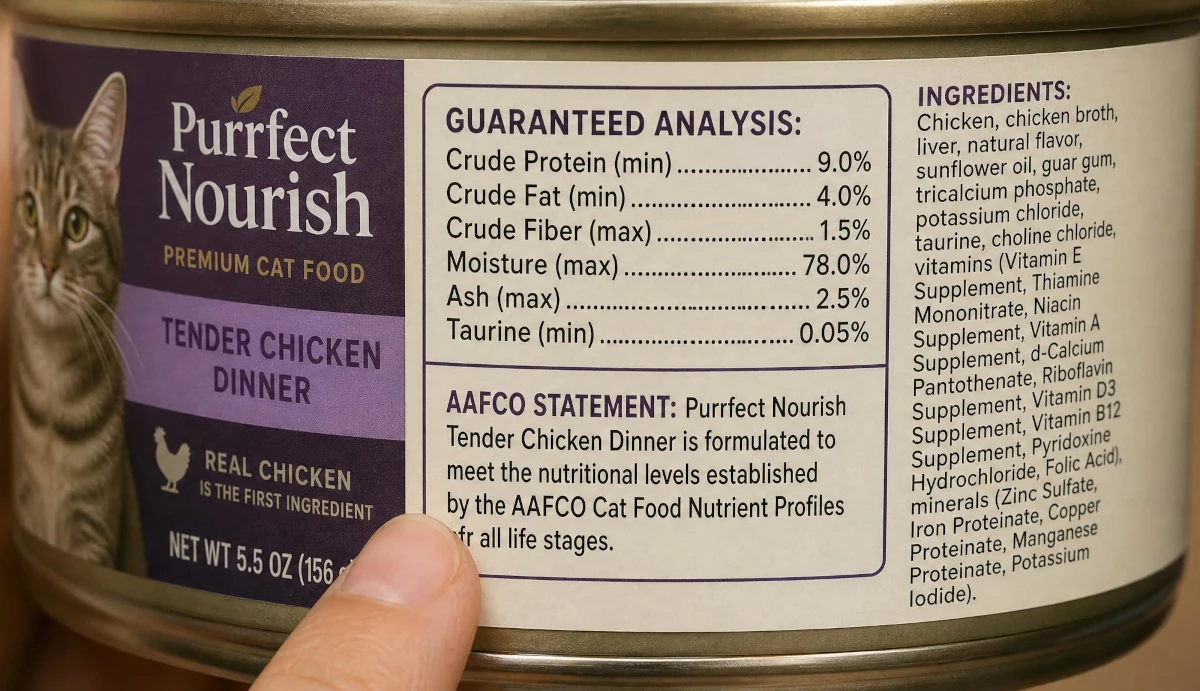
Every nutritionally complete cat food sold in the United States must carry an AAFCO (Association of American Feed Control Officials) nutritional adequacy statement. The phrase to look for is "complete and balanced." Any product labeled "for intermittent or supplemental feeding only" is not suitable as a primary diet, no matter what the front of the can says.
The statement also tells you which life stage the food covers. "For adult maintenance" is not appropriate for kittens. "For all life stages" covers growth and adults both, which is why it is often recommended for multi-cat households. For the full breakdown of how life stage changes a cat's nutrient needs, see How to Choose the Best Cat Food.
The First Ingredient, and Why Taurine Matters More for Cats
Named animal proteins (chicken, turkey, salmon, beef) should appear as the first ingredient. Cats are obligate carnivores, and unlike dogs, they cannot synthesize enough taurine on their own. A taurine deficiency causes a form of heart failure called dilated cardiomyopathy, a link researchers identified in cats during the 1970s and 1980s, which is why commercial cat food has carried a mandatory taurine minimum since the late 1980s. Every food ranked below meets that minimum, but confirming taurine on the label is still worth the ten seconds it takes.
Thickeners and Additives
Virtually all canned cat foods use some form of thickener to hold texture. Carrageenan, derived from red seaweed, is the most debated. The approved food-grade form remains legal in the United States, and reviewers who have examined the research note there isn't much hard data on cats specifically, since cats cannot report digestive discomfort the way a human research subject can. A small share of approved carrageenan may still degrade into a more inflammatory form during digestion, which is reason enough for owners of cats with sensitive digestion to consider a carrageenan-free option. Gums such as xanthan, guar, and locust bean are less debated but signal more processing. Neither type disqualifies a food outright. A shorter ingredient list is generally the better sign.
Moisture Content and Calorie Density
Canned food is typically 75–82% moisture, far less calorie-dense per gram than dry kibble. A standard 5.5-oz can delivers roughly 150–220 kcal depending on the formula. A single cup of dry food, by comparison, provides 300–450 kcal. Never estimate wet food portions by weight or volume. Always use the kcal content printed on the can under "Calorie Content," then calculate your cat's daily amount from there.
For the math on blending wet and dry food in the same meal, see Wet vs. Dry Pet Food: How Much of Each?
The 7 Best Canned Cat Foods for 2026
Quick comparison before the full breakdown:
| Food | Protein (dry matter basis) | Price | AAFCO life stage |
|---|---|---|---|
| 1. Purina Pro Plan | 50.0–54.5% | $ (~$0.47/oz) | All life stages |
| 2. Hill's Science Diet | 7.5%* | $$ (~$0.48/oz) | Adult maintenance |
| 3. Royal Canin | 40.6–56.8% | $$$ (~$0.55–0.80/oz) | Adult maintenance |
| 4. Wellness CORE Pate | 54.5% | $$$ (~$0.61/oz) | All life stages |
| 5. Merrick Purrfect Bistro | 45.5% | $$ (~$0.53/oz) | Adult maintenance |
| 6. Blue Buffalo Wilderness | 45.5% | $ (~$0.33/oz) | Adult maintenance |
| 7. Weruva Cats in the Kitchen | 60.0% | $$ (~$0.41/oz) | Adult maintenance |
Protein is shown on a dry matter basis (as-fed protein divided by the dry matter remaining after moisture) so formulas with different moisture content are comparable. *Hill's publishes only an as-fed minimum on this label without a moisture percentage, so it is shown as-fed rather than estimated. Prices are per-ounce estimates from current case pricing at major retailers and fluctuate; use them for relative comparison, not as quoted totals.
1. Purina Pro Plan: Best Overall
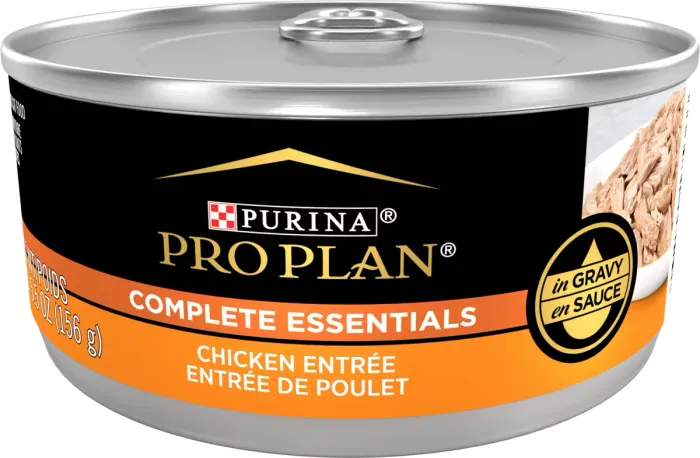
Purina Pro Plan is the most research-backed mainstream brand available without a prescription. Purina employs veterinary nutritionists and runs feeding trials across many of its formulas, meaning they back their nutritional adequacy statements with real-world data rather than nutrient profile calculations alone.
The All Life Stages Classic Entrée line uses named protein as the first ingredient and is complete and balanced for kittens, adults, and seniors alike, which makes it a practical default for multi-cat households spanning different ages. For cats with diagnosed conditions, the Pro Plan Veterinary Diets range (available through veterinarians) covers kidney disease, GI disorders, and weight management with clinical-grade precision.
If you are unsure where to start with canned food and your cat has no specific health issues, Pro Plan is the safest default for most healthy adult cats.
Pros: Feeding trials back the nutritional adequacy statements with real-world data rather than nutrient calculations alone, the All Life Stages Classic Entrée covers kittens through seniors in one formula, and the Veterinary Diets range addresses diagnosed conditions like kidney disease and GI disorders.
Cons: Veterinary Diets formulas require purchase through a vet, and at roughly $0.47/oz it's priced closer to the middle of this list than the cheapest option.
2. Hill's Science Diet: Best for Specific Health Needs
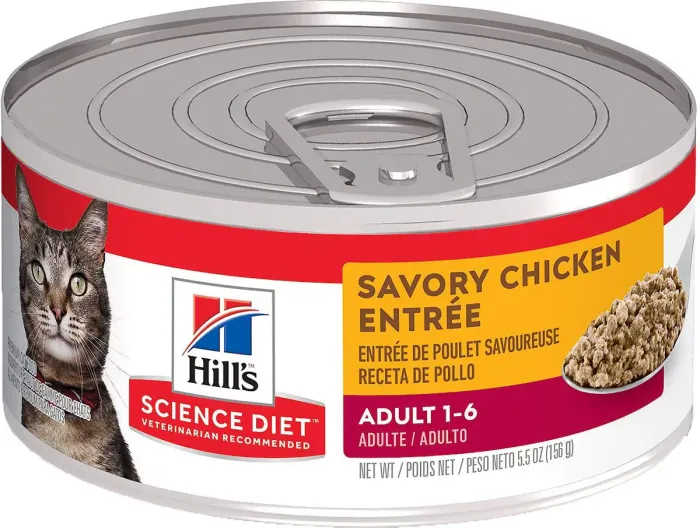
Hill's has been producing veterinary-recommended pet food since 1939. The Science Diet line is their over-the-counter range. Hill's Prescription Diet offers feline formulas your veterinarian can prescribe for conditions including kidney disease, urinary issues, and GI disorders.
The Adult Savory Chicken Entrée is one of their most recommended mainstream options: named meat, well-tolerated by most healthy adult cats. The label lists a 7.5% minimum crude protein and 5.0% minimum fat, on the lower end of this list's as-fed numbers, though canned formulas at this moisture level are still calorie-appropriate when portioned from the can's kcal count rather than a generic feeding chart.
Hill's over-the-counter formulas are aimed at adult maintenance. If your cat has a diagnosed condition, ask your veterinarian whether a Prescription Diet formula is a better fit than the standard Science Diet line.
Pros: Veterinary-recommended since 1939, a wide Prescription Diet range for diagnosed conditions like kidney disease and urinary issues, and a well-tolerated Adult Savory Chicken Entrée for sensitive cats.
Cons: The 7.5% as-fed minimum crude protein is the lowest labeled figure of the 7 picks, and it's tied for the priciest mainstream option at roughly $0.48/oz.
3. Royal Canin: Best for Breed-Specific and Condition-Specific Nutrition
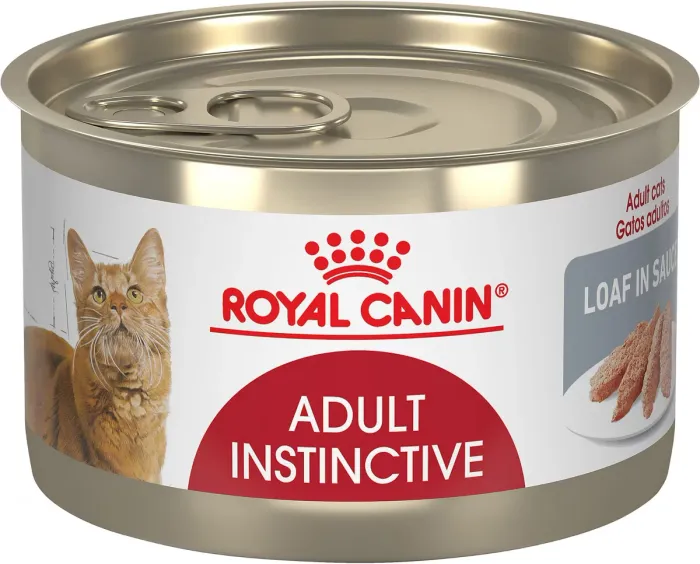
No mainstream brand matches Royal Canin's specificity. The company sells over 100 different varieties of cat food, including recipes built around specific breeds (Persians, Maine Coons) and specific medical conditions, rather than a generic adult profile.
Their standard Feline Health Nutrition wet line is complete and reliable for everyday feeding. Where Royal Canin earns its place is in the veterinary formula range, which covers urinary health, digestive care, renal support, and weight management. If your veterinarian has recommended Royal Canin for a specific condition, that recommendation is almost always grounded in formulation research and clinical trials, not marketing.
Pros: Over 100 varieties including breed-specific and condition-specific formulas, and the veterinary range is grounded in clinical trial data for urinary, digestive, and renal support.
Cons: The most expensive pick on this list (roughly $0.55–0.80/oz), and the standard Feline Health Nutrition line is less differentiated than the vet-specific formulas.
4. Wellness CORE Pate: Best High-Protein Option
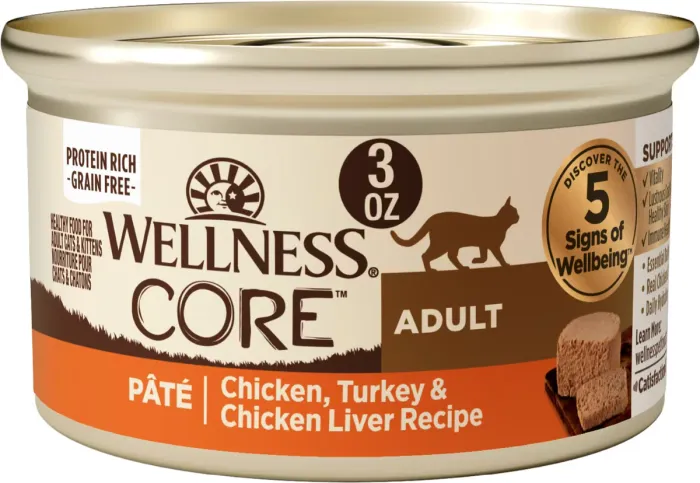
Wellness CORE's grain-free Pate line lists a 12.0% minimum crude protein against a 78.0% moisture maximum, which works out to roughly 54.5% protein on a dry matter basis, the highest as-labeled figure among the mainstream picks on this list. No artificial preservatives, colors, or flavors, and the AAFCO statement covers all life stages.
Because protein and calorie density are both higher than average for canned food, run your cat's daily target through the wet food calculator to avoid unintentional overfeeding.
One consideration: like any grain-free formula, Wellness CORE falls within the ongoing research into diet-associated dilated cardiomyopathy. The evidence in cats is much thinner than in dogs (the FDA had logged fewer than 20 suspected feline cases by mid-2020, against over 1,100 in dogs), and the mandatory taurine minimum already addresses the mechanism researchers suspect matters most. Discuss any heart-health history with your veterinarian before choosing a grain-free diet.
Pros: Highest labeled protein of the mainstream picks (roughly 54.5% dry matter), no artificial preservatives, colors, or flavors, and an AAFCO statement covering all life stages.
Cons: Higher protein and calorie density mean portion math matters more to avoid overfeeding, and like all grain-free formulas it falls within the FDA's ongoing DCM research, though the feline evidence is far thinner than in dogs.
5. Merrick Purrfect Bistro Grain-Free Pate: Best Clean-Label Option
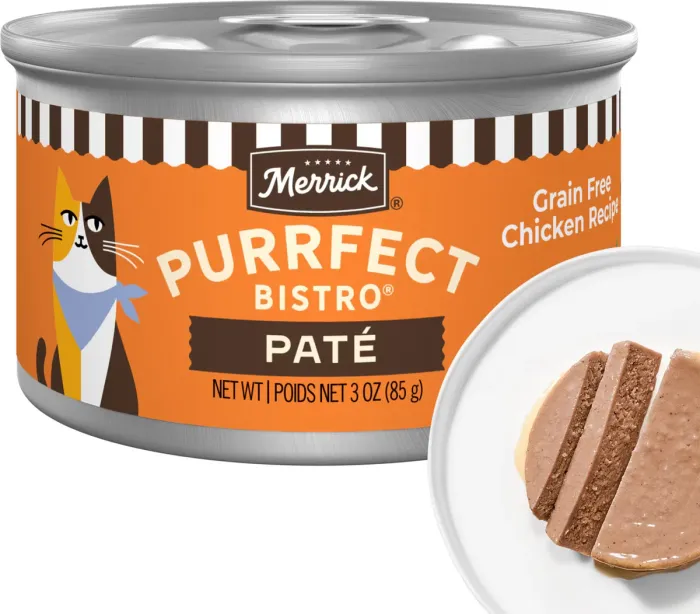
Merrick leads with deboned chicken, chicken liver, and chicken broth as its first three ingredients, a short and recognizable list. The Grain-Free Pate line works out to roughly 45.5% protein on a dry matter basis, and the recipe carries no artificial preservatives.
One label detail worth knowing: this formula is AAFCO-certified for adult maintenance only, not growth. It is not a fit for kittens. A piece of context some buyers factor into their decisions: Nestlé Purina acquired Merrick in 2015. The recipes have remained largely consistent post-acquisition, and manufacturing continues to meet AAFCO standards.
Pros: Deboned chicken, chicken liver, and chicken broth lead the ingredient list, no artificial preservatives, and roughly 45.5% protein on a dry matter basis.
Cons: AAFCO-certified for adult maintenance only, not a fit for kittens, and it's been owned by Nestlé Purina since 2015, though recipes have stayed largely consistent post-acquisition.
6. Blue Buffalo Wilderness High Protein Pate: Best Widely Available Pick
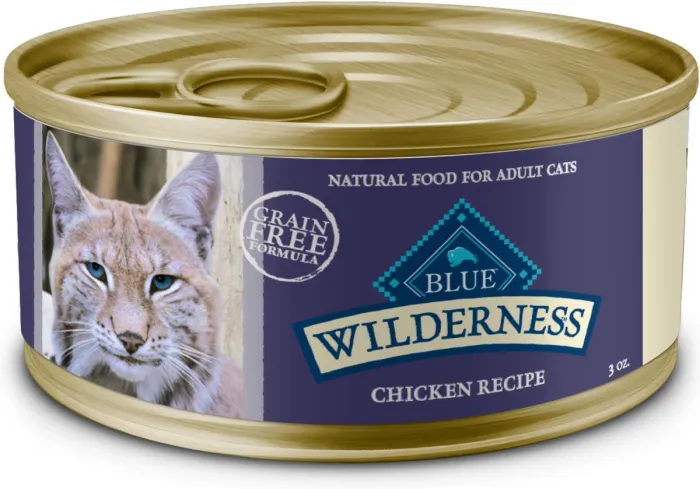
Blue Buffalo's Wilderness line leads with chicken, chicken broth, and chicken liver, contains no meat or poultry by-products, and works out to roughly 45.5% protein on a dry matter basis. Most major grocery stores and big-box pet retailers stock it, which matters when you run out of food on a Sunday evening and cannot wait for a delivery.
It is also the least expensive pick on this list at roughly $0.33 per ounce in current case pricing, which makes it a reasonable everyday option for owners feeding multiple cats. Check the kcal per can before assuming portion size, since calorie counts vary by variety.
Pros: Widely stocked at grocery and big-box retailers, the least expensive pick on this list (roughly $0.33/oz), and no meat or poultry by-products.
Cons: Calorie counts vary by variety, so portions can't be assumed from one recipe to the next, and 45.5% protein is mid-pack rather than class-leading.
7. Weruva Cats in the Kitchen: Best for Lean, High-Protein Broths
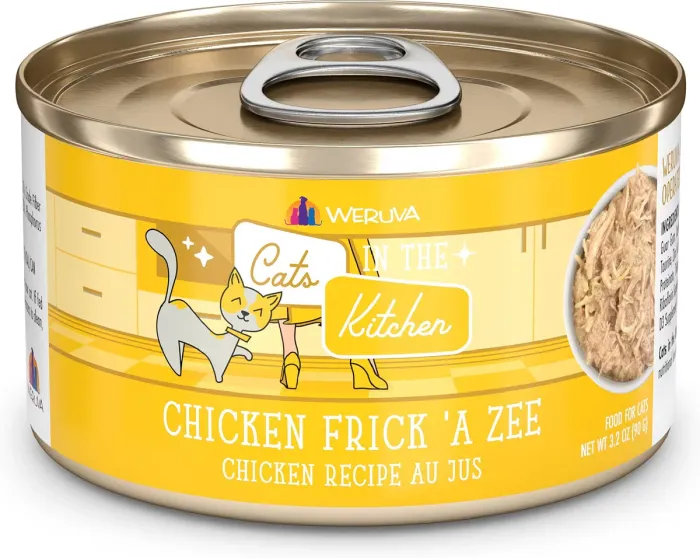
Weruva built its brand on recognizable, human-quality ingredients: land and sea proteins like boneless chicken breast, lamb, and fish loins, served in broths rather than formed into a dense pate. The Cats in the Kitchen line works out to roughly 60% protein on a dry matter basis, the highest of the 7 picks, paired with a comparatively low fat content.
That combination (lean protein, high moisture, lower fat) makes it a good fit for cats that need protein without excess calories, including less active adults prone to weight gain or seniors preserving muscle mass while controlling overall intake. Because calorie density per can runs on the lower side, check the kcal per can for the specific recipe and calculate from there using the wet food calculator.
Weruva runs a bit higher per ounce than Blue Buffalo. Factor that into the comparison alongside your cat's specific nutritional needs.
Pros: Highest protein of any pick by a wide margin (60% dry matter), whole recognizable land-and-sea proteins in broth rather than pate, and low fat for weight-conscious or senior cats.
Cons: Runs a bit higher per ounce than Blue Buffalo (roughly $0.41/oz), and lower calorie density per can means more volume is needed to hit daily targets for larger cats.
How to Calculate the Right Portion for Any Canned Food
Wet food portions trip people up because moisture content skews the weight-to-calorie ratio dramatically. A cup of dry food might contain 350 kcal. The equivalent weight of wet food might contain 80–100 kcal. Volume and weight are not reliable guides. Only calories are.
The correct method has 3 steps:
- Find your cat's daily calorie target using the free wet food calculator for cats. Enter your cat's weight, age, and activity level. The result is based on the RER/MER veterinary formula, the same method used by veterinary nutritionists. For more on how the formula works, see How Much Should I Feed My Cat?
- Find the kcal per can (or per 100g) listed under "Calorie Content" on the product label.
- Divide your cat's daily calorie target by the calories per can to get the number of cans per day. Split that amount into 2 meals for adult cats, 3 to 4 for kittens.
If you are combining wet and dry food in the same day, calculate the calories from each source separately and confirm they sum to your cat's daily target. The full blended-diet formula is in Wet vs. Dry Pet Food: How Much of Each?
Canned Food for Weight Management, Seniors, and Kittens
Canned cat food serves 3 specific situations especially well: cutting calories for an overweight cat, supporting a senior with a smaller appetite, and feeding a kitten that needs calorie-dense, easy-to-eat meals during growth. The right approach differs for each.
Weight Management
According to the Association for Pet Obesity Prevention's 2022 survey, 61% of cats in the United States are classified as overweight or obese. Wet food's high moisture content helps here: cats get more volume per calorie, which can reduce food-seeking behavior without cutting portion size drastically.
Rather than trimming a flat percentage off maintenance calories, start from an estimated target weight. Each body condition score point above the ideal of 5 corresponds to roughly 10 to 15% excess body weight. Calculate calories at that target weight, and hold the pace to 0.5 to 1% of body weight lost per week to avoid the risk of hepatic lipidosis, a liver disease specific to cats that lose weight too quickly. The full method, including the calorie formula, is in Cat Weight Loss Plan: A Safe, Vet-Guided Approach. Use the body condition score guide to check your cat's starting point.
Senior Cats
Most cats reach senior status around age 10 to 11. Seniors often deal with reduced kidney filtration and some muscle loss at the same time, which calls for a food that manages phosphorus while still supplying enough high-quality protein to maintain muscle mass. A food labeled "for adult maintenance" is appropriate for most healthy seniors unless your veterinarian recommends a specialized formula. Watch body condition closely during this stage, since weight loss can signal both underfeeding and an underlying medical issue.
Kittens
Kittens require food labeled "for growth" or "for all life stages." Adult maintenance formulas, including several of the picks above, do not meet the higher demands of growth, particularly for calcium, phosphorus, and protein. Wet food works well for kittens (for palatability, hydration, and ease of eating) whether as the sole diet or alongside an appropriate kibble, provided the formula carries an AAFCO statement for growth. See Kitten Care 101 for a full first-year feeding and care breakdown. Kitten calorie needs can run 2 to 3 times those of an adult cat at the same weight.
Get Your Cat's Exact Daily Portion
Enter your cat's weight, age, and activity level for a calorie estimate based on vet-standard formulas. Free, no account needed.
🐾 Use the Free CalculatorFrequently Asked Questions
How long does an opened can of cat food last in the refrigerator?
Three to four days, covered, at or below 40°F (4°C). Discard any wet food that has been at room temperature for more than 2 hours.
Can I mix canned and dry cat food?
Yes. Both foods should carry AAFCO "complete and balanced" statements for your cat's life stage. Calculate the calories from each source separately and confirm they sum to your cat's daily target. The full blended-diet calculation is covered in Wet vs. Dry Pet Food: How Much of Each?
Is grain-free canned cat food safe?
Diet-associated dilated cardiomyopathy (DCM) has been studied far more in dogs than in cats. By mid-2020 the FDA had logged fewer than 20 suspected feline cases against more than 1,100 in dogs, and the mandatory taurine minimum already added to commercial cat food addresses the mechanism researchers suspect matters most. Grain-free formulas are not inherently risky for cats, but confirm a complete AAFCO statement and adequate taurine, and raise any heart-health history with your veterinarian.
What does the AAFCO statement on a cat food label mean?
It confirms that the food meets the minimum nutrient profiles published by the Association of American Feed Control Officials for a specific life stage. "Complete and balanced" means the food can serve as a cat's entire diet. "For intermittent or supplemental use only" means it cannot. The life stage modifier (growth, adult maintenance, all life stages) tells you which cats the formula was designed for.
What is the difference between pate and shreds or chunks in gravy?
Pate is a smooth, uniform texture formed from finely ground meat. Shreds, chunks, or morsels in gravy contain identifiable pieces of meat in a thin sauce. Both formats can be nutritionally complete. The difference is texture and palatability. Pate is generally easier for kittens, seniors with dental problems, or cats that struggle to chew. Many cats show a clear preference for one or the other, and switching formats can sometimes resolve a picky eating problem.
What is the most nutritious wet cat food for adult cats?
The most nutritious wet cat food for adult cats carries an AAFCO "complete and balanced for adult maintenance" statement, lists a named animal protein (chicken, turkey, salmon) as the first ingredient, and confirms added taurine, since cats cannot synthesize enough on their own. Because canned food runs 75 to 82% moisture, portions should always be calculated from the kcal per can, not volume or weight. Purina Pro Plan stands out for research-backed, feeding-trial-tested formulas, Wellness CORE Pate for its high named-meat protein content, and Weruva Cats in the Kitchen for lean, high-protein recipes with minimal processing.
What are the best canned wet cat food brands and how much should I feed per meal?
Purina Pro Plan, Hill's Science Diet, and Royal Canin lead for research-backed, AAFCO-tested formulas, with Wellness CORE and Weruva Cats in the Kitchen standing out for higher-protein, less-processed options. To find the per-meal amount, take your cat's daily calorie target from the free wet food calculator, divide by the calories per can listed on the label, then split that number of cans across 2 meals a day.
This article is for general informational purposes and is not a substitute for individualized veterinary advice. Consult your veterinarian about your cat's specific nutritional needs before switching foods.