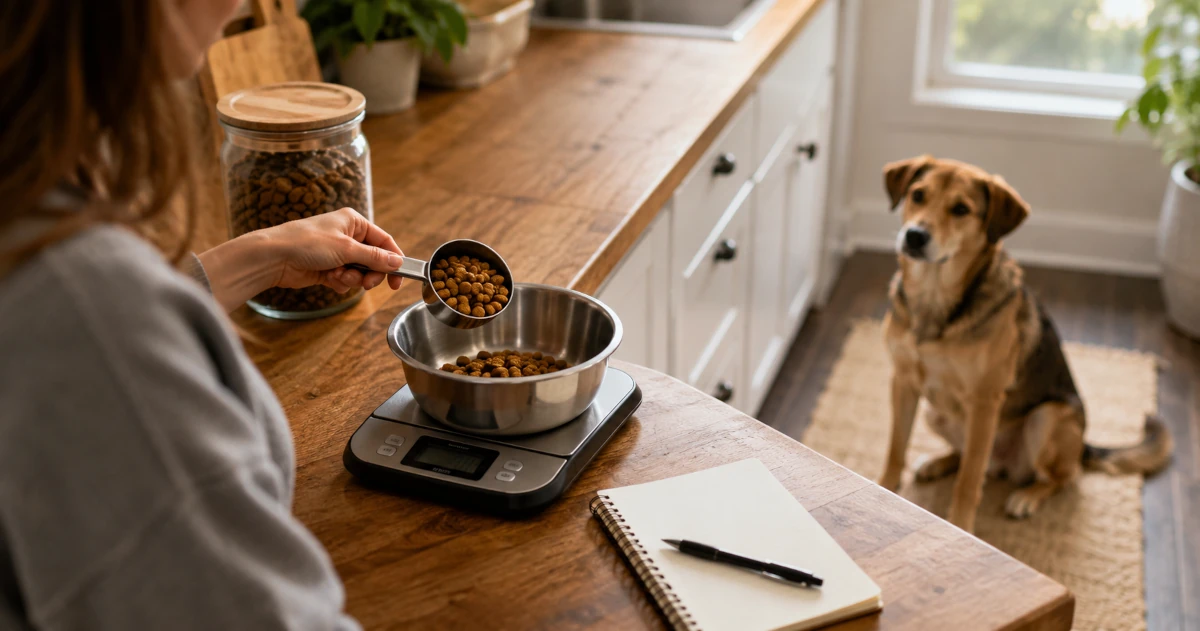
Most dog owners feed by eye: a scoop that looks about right, topped off if the bowl empties fast. That works fine until the extra weight has already crept on. A dog calorie counter replaces the guess with an actual number, using the same energy-requirement math veterinary nutritionists rely on, built from body weight rather than cup size.
This guide covers the formula behind the count, how to convert it into food you can measure, and the details, like treats and mixed diets, that throw most owners' math off without them realizing it.
Key takeaways
- Counting calories starts with the RER/MER formula, not a cup measurement, since the bag's feeding chart is only a rough estimate for one generic dog.
- Weighing food in grams against its kcal-per-gram value is more accurate than scooping, since kibble density varies significantly between brands.
- Treats, chews, and scraps should stay under about 10% of total daily calories and get subtracted from the count, not added on top of it.
- Body Condition Score, not the number on a scale, is the real check on whether a calorie count is correct.
- Recount after any change in weight, activity level, spay/neuter status, or food brand.
Table of Contents
- Why a Calorie Count Beats a Cup Measurement
- The Formula Behind the Count: RER and MER
- Turning the Count Into an Actual Portion
- Counting Treats, Scraps, and Supplements
- Where Dog Owners' Calorie Counts Go Wrong
- Checking Your Count Against Body Condition
- Building a Routine You Will Keep Up
- Frequently Asked Questions
Quick answer: Open the free dog food calculator and enter your dog's weight, spay/neuter status, and activity level for an instant daily calorie target. The sections below explain how that number is built and how to turn it into an actual portion.
Why a Calorie Count Beats a Cup Measurement
A cup is a unit of volume. A calorie is a unit of energy, and it is the number that determines whether your dog gains, loses, or holds weight. The two are only loosely related, because kibble density varies enough between brands that a level cup can differ by 100 calories or more from one bag to the next.
Bag feeding charts compound the problem. They calibrate their numbers around a generic intact adult dog at moderate activity, a profile that describes relatively few pets. Roughly 59% of dogs in the United States are overweight or obese, according to the Association for Pet Obesity Prevention, and inaccurate portioning is one of the most common, and most fixable, contributors.
Counting Is Ongoing, Not a One-Time Calculation
A single calculation gives you a starting point. Counting is what happens after: weighing food, logging treats, and rechecking the number whenever something about your dog's life changes. Owners who calculate once and never revisit the figure are the ones most likely to end up feeding a 5-year-old number to a dog that has since been neutered, aged, or changed activity levels entirely.
The Formula Behind the Count: RER and MER
Every credible dog calorie counter runs on the same two-step formula published by the National Research Council's Nutrient Requirements of Dogs and Cats. The first step is the Resting Energy Requirement (RER), the energy your dog burns at complete rest to keep organs running:
RER = 70 × (body weight in kg)0.75
The second step multiplies RER by a life-stage factor to reach the Maintenance Energy Requirement (MER), the actual daily calorie target:
| Life Stage / Status | Multiplier | Example (10 kg dog, RER = 394) |
|---|---|---|
| Puppy under 4 months | × 3.0 | 1,182 kcal/day |
| Puppy 4 months to 1 year | × 2.0 | 788 kcal/day |
| Neutered adult, moderate activity | × 1.6 | 630 kcal/day |
| Intact adult, moderate activity | × 1.8 | 709 kcal/day |
| Senior, neutered | × 1.4 | 552 kcal/day |
| Weight loss | × 1.0 | 394 kcal/day |
For the full multiplier table, including activity-level variations, see the complete RER/MER breakdown used throughout this site.
Turning the Count Into an Actual Portion
Find the "Calorie Content" statement on your dog's food label first. That kcal-per-cup or kcal-per-kilogram figure is what turns your MER target into an actual scoop or weighed portion, and it varies across foods, even across formulas from the same brand.
Finding Kcal Per Cup or Per Gram
Dog food sold in the United States must disclose caloric content under labeling standards from the Association of American Feed Control Officials (AAFCO). Look for a "Calorie Content" statement near the guaranteed analysis panel, usually listed as kcal per cup or kcal per kilogram. If it is missing from the bag, most manufacturers publish it on their website.
Dry Food vs. Wet Food Density
Wet food runs 70 to 80% moisture, so it holds far fewer calories per gram than dry kibble. A 3 oz cup or tray of wet dog food typically provides only 70 to 100 kcal, compared with 300 to 500 kcal in a single cup of dry kibble. A 13 oz can usually lists about 350 to 450 kcal, and How Much Wet Food to Feed Your Dog turns that into cans per day. The table below is illustrative. Always check the specific label for the food in front of you.
| Food Type | Typical Kcal Range |
|---|---|
| Standard dry kibble, per cup | 350 – 450 kcal |
| Weight-management dry kibble, per cup | 250 – 320 kcal |
| Wet food, per 3 oz cup or tray | 70 – 100 kcal |
| Wet food, per 13 oz can | 350 – 450 kcal |
Weighing Beats Scooping
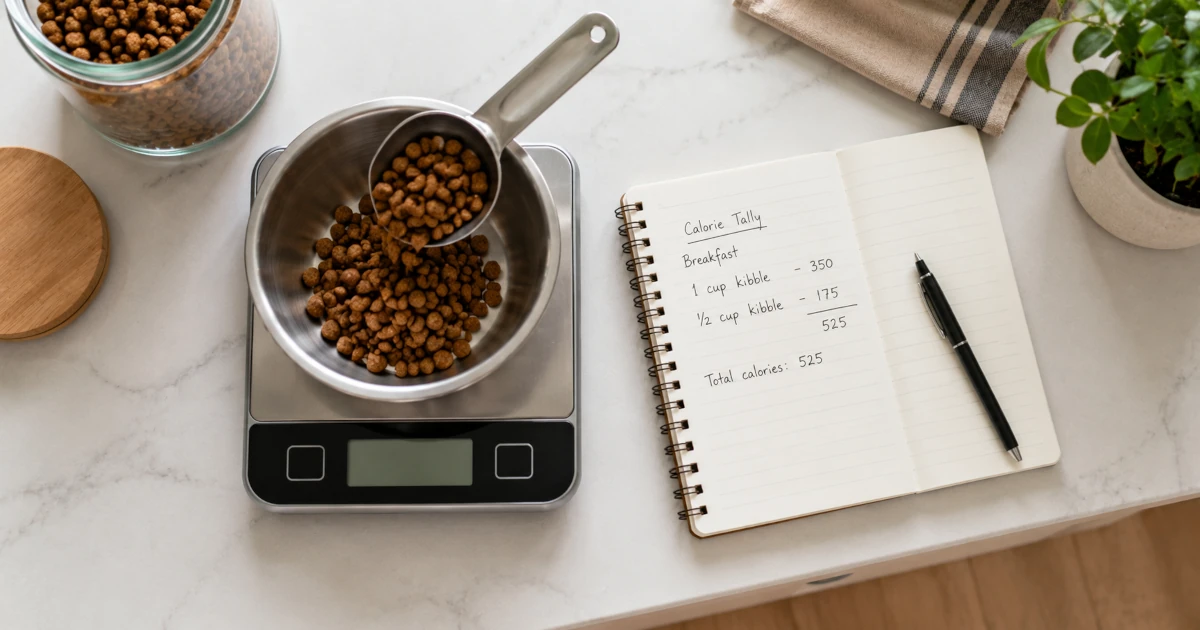
A digital kitchen scale removes the density problem entirely, since it measures mass instead of volume. Weigh the daily portion in grams rather than scooping cups, especially if you switch between formulas or brands. For a full walkthrough of mixing wet and dry in the same count, see Wet vs. Dry Pet Food: How Much of Each?
Counting Treats, Scraps, and Supplements
Treats, dental chews, and table scraps are the calories owners most often leave out of the count, and they add up faster than they look. A guideline used widely in veterinary nutrition is to keep treats and extras under roughly 10% of total daily calories, then subtract that amount from the day's food portion rather than layering it on top.
Peanut butter in a puzzle toy, a corner of a dental chew, or a spoonful of plain rice from dinner all count. None of them are large on their own, but a dog getting several small extras a day can easily exceed 10% of its total budget without the owner noticing.
🩺 Vet tip: If your dog's weight is trending up despite a food portion that matches the count, treats are the first place to check before assuming the formula is wrong.
Where Dog Owners' Calorie Counts Go Wrong
A count is only as good as the assumptions behind it. These are the most common ways it drifts away from reality:
- Treating a short neighborhood walk as high activity, when only sustained aerobic exercise justifies a higher multiplier.
- Not recalculating after a spay or neuter procedure, which typically lowers energy needs by 20 to 30%.
- Keeping an adult-level count for a senior dog whose metabolic rate and activity have both declined.
- Leaving treats, chews, and scraps out of the daily total entirely.
- Using a kcal value from an old bag after switching to a different formula or brand.

Checking Your Count Against Body Condition
A calorie count is a starting hypothesis, not a verdict. Body Condition Score (BCS) is how you confirm it is working. The WSAVA Global Nutrition Guidelines use a 9-point scale, with 4 to 5 considered ideal for most dogs: ribs easily felt under a thin layer of fat, and a visible waist tuck when viewed from above.
Check body condition every two to four weeks after starting or changing a count. If the waist disappears or ribs get harder to feel, cut the daily total by about 10% and recheck in two weeks. If ribs or spine feel sharp, add the same margin back. A full walkthrough of the scale is in Is My Dog Overweight?
Get Your Dog's Exact Daily Calorie Target
Enter their weight, spay/neuter status, and activity level for an instant, vet-standard estimate. Free, no account needed.
🐾 Use the Free CalculatorBuilding a Routine You Will Keep Up
The formula gets you close on day one. Consistency is what makes a calorie count useful over months and years. Weigh your dog on the same scale at the same time of day, since inconsistent weighing produces noise that masks real trends.
When you do change the daily amount, phase it in over several days rather than all at once, to keep appetite and digestion stable. If your dog holds a static weight despite a count that matches its actual food and treats, that's a signal for a veterinary check rather than a bigger portion cut. Underlying conditions like hypothyroidism can bypass standard calorie math entirely.
Frequently Asked Questions
How often should I recheck my dog's calorie count?
Recheck it whenever weight, activity level, or spay/neuter status changes, and any time you switch foods with a different kcal value. For a stable adult dog, a quarterly review alongside a body condition check is enough.
Can I count human food toward my dog's daily calories?
Yes, provided it is a safe, low-calorie option like plain green beans or a small piece of carrot. Estimate the calorie content and subtract it from the day's food portion the same way you would a commercial treat.
Why does the bag suggest more food than my calorie count?
Bag charts build their numbers around a generic intact adult dog at moderate activity, a profile that fits relatively few pets. A count based on your dog's actual weight, reproductive status, and activity level will usually land lower.
Is it normal for my dog to act hungry after I lower the count?
It is common if the previous amount was above what your dog needed. Adding volume without calories, such as plain, unsalted green beans, can ease the adjustment without changing the daily total.
What if my dog won't eat the counted portion?
First confirm the kcal value used in the count is current, since formulas change. If the math checks out and the dog still leaves food behind, rule out dental pain or other health issues with your veterinarian.
Does a senior dog's calorie count work the same way?
The formula is the same, but the multiplier usually needs to come down as metabolic rate and activity decline with age. Recalculating every few months catches this drift before it shows up as extra weight. Use the dedicated Senior Dog Food Calculator for age-, size-, and neuter-adjusted numbers.
My vet says my dog needs to lose weight. How many calories should he eat per day?
Recalculate using the weight-loss multiplier (RER × 1.0) instead of your dog's current maintenance multiplier, which typically cuts the daily target by 15-25% below a standard adult count. Reassess Body Condition Score every two weeks and reduce the total by another 10% if the waist is not tightening. Use the free calculator's weight-loss setting for a personalized number, and confirm the target with your vet before starting, especially for dogs with existing health conditions.
This article is for general informational purposes and is not a substitute for individualized veterinary advice. Consult your veterinarian before starting a weight-loss plan, especially for dogs with existing health conditions.