
The feeding chart on the back of a dog food bag looks precise. It lists exact weight ranges next to exact cup measurements, formatted like a table a nutritionist built for your dog specifically. It was not. That chart targets one reference dog, and the odds that your dog matches it are lower than the confident formatting suggests.
This matters because the gap runs in a predictable direction. Most dogs eating strictly to the bag chart end up overfed, not underfed, and overfeeding is the more common and more preventable driver of the weight gain vets see every day. This guide breaks down exactly who the chart is calibrated for, how far off that leaves most real dogs, and the formula that closes the gap.
Key takeaways
- Bag feeding charts calibrate their numbers around an intact adult dog at moderate activity, a profile that describes a minority of pet dogs.
- A neutered dog needs roughly 20 to 30% fewer calories than the intact profile the chart assumes, before activity level is even considered.
- Even owners trying to follow the chart correctly often cannot: one study found only 43% of dog owners correctly estimated how much dry food to feed from the label.
- The RER/MER formula veterinarians use converts your dog's actual weight, activity, and reproductive status into a personalized number instead of a generic one.
- The chart is closest to accurate for one specific dog profile, so for every other dog, treat it as a rough ceiling, not a target.
Table of Contents
Quick answer: Skip the chart and use the free dog food calculator instead. Enter your dog's weight, spay/neuter status, and activity level for a personalized daily calorie and portion estimate built on the same formula veterinarians use.
Why Feeding Charts Are Built for a Dog That Is Not Yours
A feeding chart has to work for every dog of a given weight using a single column of numbers, so manufacturers pick one reference profile and calibrate the whole chart around it. That reference is typically an intact adult dog at moderate activity, the same baseline used in the veterinary MER multiplier tables. That single reference profile feeds every dog that is not intact, is not an adult, or is not moderately active a number calculated for someone else.
Spay and neuter status alone moves the target substantially. Removing reproductive hormones lowers a dog's resting metabolic rate, and neutered dogs typically need roughly 20 to 30% fewer calories than intact dogs at the same weight and activity level. Most pet dogs in the United States are spayed or neutered, which means most dogs reading a standard chart are reading a number that was never built for them.
How Much a Feeding Chart Typically Overshoots By
For a neutered dog at moderate activity, a generic chart overshoots the accurate target by roughly 12% from the reproductive-status mismatch alone, and by 20 to 30% once a lower activity level is factored in too, since most pet dogs are less active than the "moderate" baseline assumes.
Take a 65 lb neutered dog at moderate activity as an example. The RER/MER formula puts that dog's daily need at roughly 1,416 kcal. A chart calibrated for an intact dog at the same weight and activity level implies closer to 1,593 kcal, about 177 kcal a day more than the dog needs. Held over months, that gap is exactly the kind of steady surplus that turns into the extra weight the Association for Pet Obesity Prevention tracks in the roughly 59% of U.S. dogs it classifies as overweight or obese.
Why Even Reading the Chart Correctly Is Hard
The calibration problem is only half the issue. A 2017 study in Veterinary Sciences by Yam and colleagues found that only 43% of dog owners correctly estimated how much dry food to feed after being shown a pet food label, and only 23% got it right for wet food. Fewer than half correctly estimated their own dog's body weight in the first place.
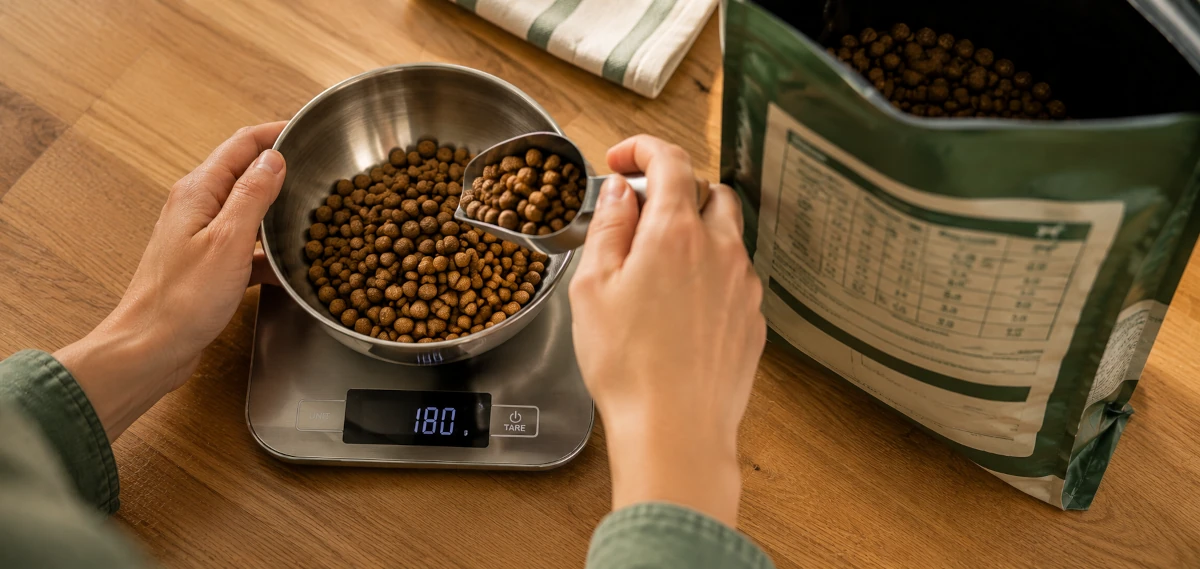
That is not a knock on pet owners. Chart ranges are printed in wide weight bands, kcal-per-cup values vary between formulas, and cup measurements themselves are notoriously imprecise. A digital kitchen scale weighed against the food's actual calorie content removes most of this error, but only once you know the number you're weighing toward.
The Vet-Standard Alternative: RER and MER
Replace the chart with a two-step formula published by the National Research Council and used in American Animal Hospital Association clinical guidance: Resting Energy Requirement (RER), scaled by a life-stage multiplier into Maintenance Energy Requirement (MER), the actual daily target.
MER = RER × life-stage multiplier
The multiplier is what a generic chart cannot provide, since it changes based on facts about your specific dog rather than the bag in front of you:
| Life Stage / Status | Multiplier |
|---|---|
| Neutered adult, moderate activity | × 1.6 |
| Intact adult, moderate activity (the chart's default) | × 1.8 |
| Neutered adult, sedentary | × 1.2 |
| Weight loss | × 1.0 |
| Puppy under 4 months | × 3.0 |
For the full multiplier table across every life stage, see the complete RER/MER breakdown.
Get the Number Built for Your Dog
Enter your dog's weight, spay/neuter status, and activity level for an instant, personalized calorie and portion target. Free, no account needed.
🐾 Use the Free CalculatorWhen the Bag Chart Is Still a Reasonable Starting Point
The chart is not wrong for every dog. An intact adult dog at genuinely moderate activity, the exact profile most charts are calibrated around, will land close to the chart's number using the RER/MER formula too. The chart also is not useless as a rough sanity check: if a calculated portion comes out wildly different from the chart's range, double-check the inputs before assuming the formula is wrong.
What the chart cannot do is adjust for the details that separate one dog from another. Treats, table scraps, and mixed feeding also sit outside what any printed chart accounts for, and they compound the same direction as the calibration gap if left uncounted.
Frequently Asked Questions
Is the feeding chart on my dog food bag ever accurate?
It comes closest for an intact adult dog at moderate activity, since that is the profile most bag charts are calibrated around. For a spayed or neutered dog, a sedentary dog, a puppy, or a senior, the chart number usually needs to be adjusted down or up rather than used as printed.
Why do different brands give different amounts for the same dog?
Each food has its own caloric density, so a cup of one brand's kibble can carry 100 or more calories than a cup of another. The chart uses that specific formula's kcal-per-cup value, not a universal standard, which is why switching foods without recalculating the portion is a common source of drift.
Should I feed less than what the chart says?
A blanket cut without a target number risks underfeeding as easily as overfeeding. Calculate a personalized amount from your dog's weight, spay or neuter status, and activity level instead, then check body condition after a few weeks and adjust by about 10% if needed.
Do prescription or weight-management foods have the same problem?
Their charts work the same way, around a reference dog profile rather than your specific one, so the same gap can apply. A calorie target based on your dog's actual details is still worth calculating even on a therapeutic diet, alongside your veterinarian's guidance.
How often should I recalculate instead of relying on the chart?
Recalculate whenever your dog's weight, activity level, or reproductive status changes, and any time you switch to a food with a different kcal-per-cup value. For a stable adult dog, checking in every few months alongside a body condition assessment is a reasonable routine. If a recalculated plan still is not producing the expected result, troubleshoot the tracking before assuming the formula is off.
This article is for general informational purposes and is not a substitute for individualized veterinary advice. Consult your veterinarian about your dog's specific nutritional needs, especially if your dog has a diagnosed medical condition.