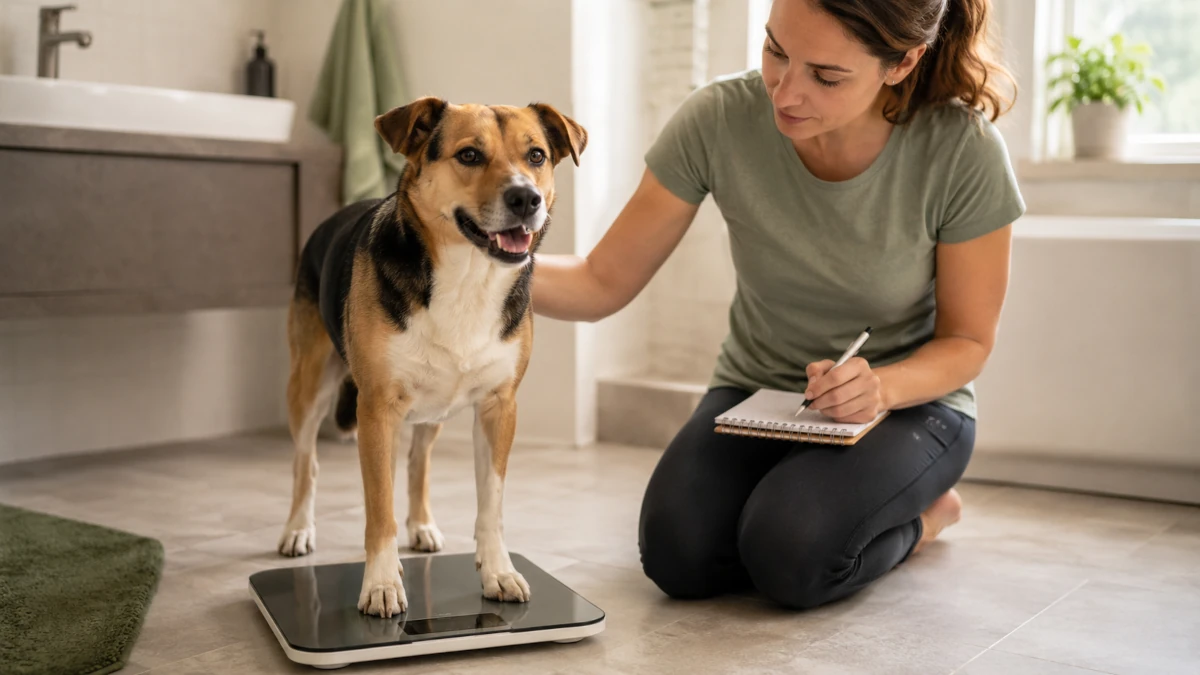
A calorie target is a starting hypothesis, not a guarantee. It comes from formulas that describe an average dog at a given weight and activity level, and your dog is not an average dog. If your dog's weight is not changing despite following the feeding plan, that does not mean the math was wrong. It means the time has come to look at the data you have collected and adjust the plan from there.
This guide covers how to track progress in a way that shows a real trend instead of daily noise, and what to check first when weight is not moving in the expected direction.
Key takeaways
- A calorie target is a starting point to test, not a fixed answer, since you should expect to adjust it based on real results.
- Weigh weekly, at the same time and on the same scale, rather than daily, since daily weight mostly reflects noise.
- Body condition score matters as much as the number on the scale, since it reflects fat and muscle, not mass alone.
- If weight is not moving as expected, check treats and measurement accuracy before assuming the calorie target itself is wrong.
- A plateau lasting more than a few weeks despite accurate tracking is a reasonable point to involve your veterinarian.
Table of Contents
- Why a Calculated Plan Still Needs Tracking
- Setting Your Baseline: Weight and Body Condition Score
- How to Log Progress Without Overreacting to Daily Noise
- What to Check If Weight Is Not Moving as Expected
- What to Do About Unexpected Weight Loss
- When It Is a Plateau vs. When It Is Time to See a Vet
- Life Changes That Call for a New Baseline
- Frequently Asked Questions
Quick answer: Weigh your dog weekly under the same conditions, and track body condition score alongside weight. If weight is not moving as expected after 2 to 4 weeks, check for uncounted treats and confirm you are measuring food by weight, not by scoop, before adjusting the calorie target itself. Start with an accurate baseline from the free calculator.
Why a Calculated Plan Still Needs Tracking
The RER/MER formula behind a calorie target is a well-tested starting point, not a guarantee specific to your dog. 2 dogs of the same breed, weight, and age can have resting energy needs that differ by 20 to 30% due to individual metabolism, activity, and body composition, so the only way to know whether a target is right is to track how your dog responds to it over time. For the formula itself, see the dog calorie counter guide.
Treat the initial number as a hypothesis to test, not a fixed answer. Tracking is what turns that hypothesis into a plan that is correct for your dog.
Setting Your Baseline: Weight and Body Condition Score
Before adjusting anything, establish where your dog currently stands. Record starting weight and a body condition score together, since weight alone does not distinguish fat from muscle. For the full scoring method, see how to tell if your pet is overweight.
These two numbers together give you a real baseline. Weight shows the trend, and body condition score confirms what that trend means physically.
How to Log Progress Without Overreacting to Daily Noise
Weigh your dog weekly, at the same time of day and on the same scale, rather than daily. Day-to-day weight shifts from water retention, digestion, and normal variation, and reacting to a single reading tends to produce changes that are not needed.
| Check-in | Weight | Body Condition Score | Adjustment |
|---|---|---|---|
| Week 1 (baseline) | 45.0 lbs | 5/9 | None |
| Week 4 | 45.2 lbs | 5/9 | None, within normal range |
| Week 8 | 44.6 lbs | 4/9 | Increase slightly, trending lean |
Look at the trend across several check-ins rather than any single one. An unchanged reading at week 4 alone is not a plateau. A consistent pattern across 3 or more check-ins is.
What to Check If Weight Is Not Moving as Expected
Before assuming the calorie target itself is wrong, check the inputs that most commonly throw off an otherwise correct plan.
Uncounted treats. Treats and table scraps are the most common source of hidden calories, and they are frequently left out of the math entirely. Keep treats under 10% of total daily calories, counted, not estimated.
Measurement accuracy. A calculated target only works if the portion delivered matches it. Weigh food on a kitchen scale against the bag's stated calorie density rather than scooping by volume, since scooping introduces error that weighing does not.
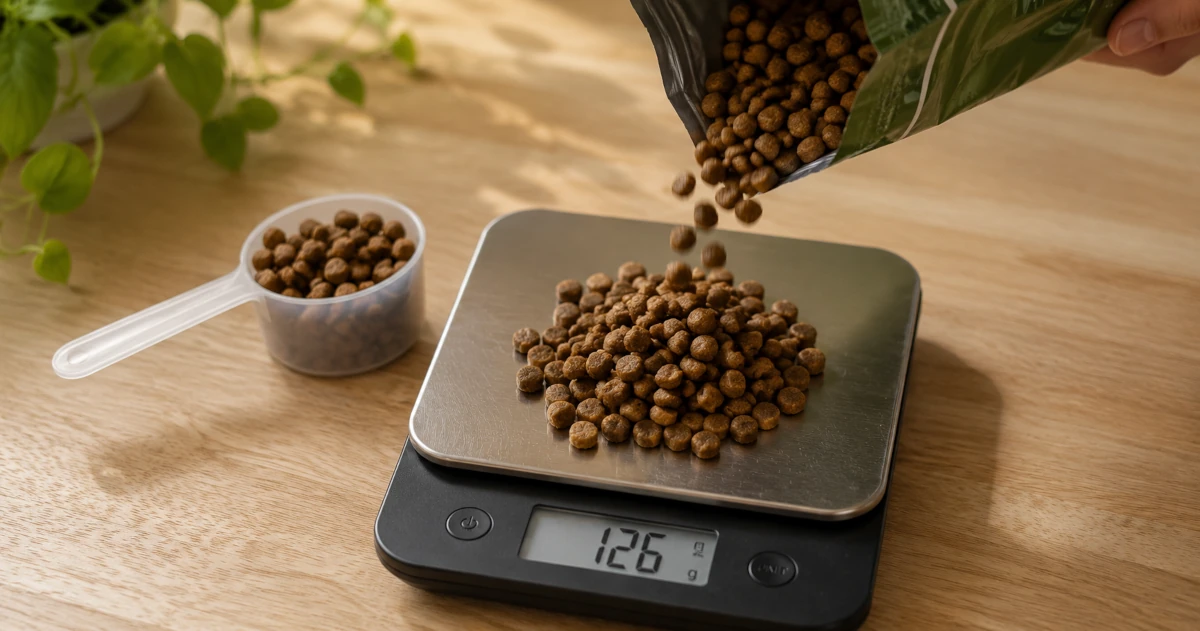
Caloric density assumptions. If you recently switched food, the new formula's actual label density may not match what the plan assumed. Recheck the label rather than assuming it is unchanged.
What to Do About Unexpected Weight Loss
Unexpected weight loss deserves faster attention than a slow plateau. First, confirm your dog is eating the full intended portion rather than leaving food behind. Next, verify the food has not recently undergone a formula change that altered its caloric density.
If both check out and weight continues dropping, involve your veterinarian rather than continuing to adjust the plan alone. Unexplained weight loss can point to issues, like parasites or malabsorption, that portion size alone will not fix.
When It Is a Plateau vs. When It Is Time to See a Vet
A plateau after a correctly measured, consistently tracked plan is common and usually means the target needs a modest adjustment, typically a 10% shift up or down, followed by another few weeks of tracking. That is a normal part of dialing in the right number.
A vet visit becomes the right move when weight keeps moving the wrong direction for more than a few weeks despite accurate tracking and measurement, or when a dog has a diagnosed condition like diabetes, where feeding needs medical coordination rather than a generic calculation. See feeding a diabetic dog or cat for that specific case.
Life Changes That Call for a New Baseline
Certain events mean the old target no longer applies, regardless of how well it was working before:
Spay or neuter surgery. Metabolic rate typically drops afterward, so the pre-surgery portion often leads to gradual weight gain if left unchanged.
A significant activity change. A dog that moves to a more or less active routine needs a recalculated target, not a carryover from the old lifestyle.
Moving into a new life stage. The shift from puppy to adult, or adult to senior, changes metabolic needs enough to warrant resetting the baseline rather than adjusting the old number incrementally.
Recheck Your Baseline Target
If your dog's weight, activity, or life stage has changed, recalculate before adjusting anything else.
🐾 Use the Free CalculatorFrequently Asked Questions
How long should I wait before deciding a feeding plan is not working?
Give it 2 to 4 weeks before making a change. Week-to-week weight can shift from water retention, digestion, and normal daily variation, so a single flat weigh-in does not mean the plan has failed.
Should I weigh my dog every day?
Weekly is usually enough, at the same time of day and on the same scale. Daily weigh-ins mostly capture noise rather than a real trend, and can lead to overreacting to normal fluctuation.
My dog is eating the calculated portion but not losing weight. What's wrong?
Check treats and table scraps first, since these are commonly left out of the calculation entirely. Next, verify you are measuring the food by weight against the label's actual caloric density rather than estimating it by scoop. If both check out and weight still is not moving after several weeks, a veterinary check can rule out a metabolic cause.
Do I need to recalculate after my dog is spayed or neutered?
Yes. Spaying or neutering typically lowers metabolic rate, so the same portion that maintained weight before the procedure can lead to gradual weight gain afterward. Recalculate and re-establish a new baseline once your dog has recovered.
When should I stop adjusting on my own and call the vet?
If weight keeps moving in the wrong direction for more than a few weeks despite an accurate, consistently measured portion, or if weight loss is unexplained and rapid, involve your veterinarian rather than continuing to adjust the plan alone.
I'm feeding my dog exactly what the bag says but he keeps gaining weight. What should I do?
Bag charts calibrate their numbers around a generic intact adult dog at moderate activity, so following them exactly overfeeds most spayed/neutered or less active dogs. Recalculate a target using your dog's actual weight, reproductive status, and activity level with the free calculator, weigh food on a kitchen scale instead of scooping, and count any treats toward the total. Track weight weekly for 3-4 weeks before judging whether the new number is working.
This article is for general informational purposes and is not a substitute for individualized veterinary advice. Consult your veterinarian if your dog's weight keeps moving in the wrong direction despite an accurate, consistently measured feeding plan.