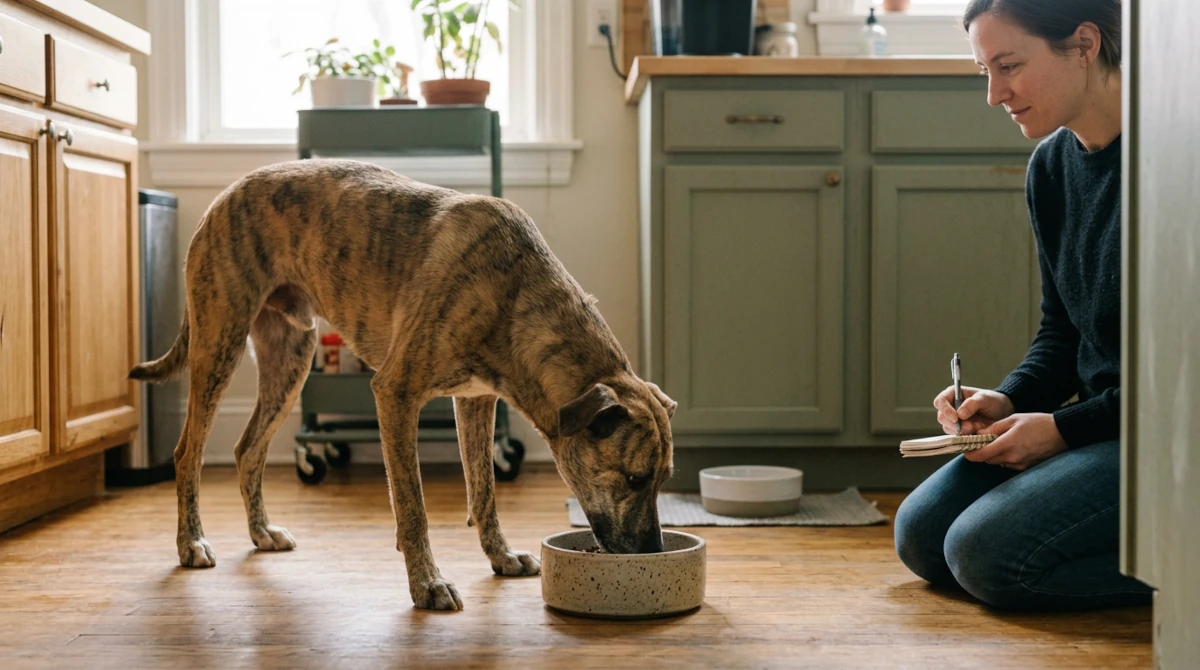
To help a dog gain weight, start with a number: the calories your dog needs at the weight it should be. Compare that with what your dog eats now, then close the difference in measured steps and weigh your dog every two weeks to check progress.
Before you change the amount in the bowl, confirm that your dog is underweight and rule out a medical cause for the weight loss.
Key takeaways
- A body condition score (BCS) of 1 to 3 on the 9-point scale means underweight. Check muscle condition too, since a dog can lose muscle without looking thin.
- See a vet before adding food if your dog lost weight without a clear cause, and sooner if the loss passes the 10% of body weight VCA Animal Hospitals considers clinically significant.
- Feed for your dog's target weight, not its current weight. A neutered 40 lb dog with a 45 lb target needs about 1,076 kcal a day instead of 985.
- If weight does not move after two weeks, raise calories by about 10% and recheck.
- Severely thin dogs (BCS 1 to 2) need a vet-guided refeeding plan that starts below their full calorie need.
Table of Contents
Quick answer: Ask your vet for a target weight, then enter that target weight in the free dog food calculator to get daily calories and cups. Weigh your dog every 2 weeks and raise the amount by about 10% if the scale does not move.
How to Tell If Your Dog Is Underweight
Your dog is underweight if it scores 1 to 3 on the 9-point body condition score (BCS) scale: ribs, spine, and hip bones easy to see or feel with little fat over them. A score of 4 to 5 is ideal.
The body condition score guide walks through the rib, waist, and tummy checks. Add one more check for weight gain. The WSAVA muscle condition score chart, developed at Tufts University, grades muscle separately from fat by feeling the muscles along the spine, skull, shoulder blades, and hips. It notes that a dog can have a low BCS with little muscle loss, or a normal-looking body with significant muscle loss. Muscle loss usually shows first along the spine.
When Weight Loss Needs a Vet Before More Food
See your veterinarian first if your dog has lost weight without a change in food or activity, or if it eats well and still loses weight. Feeding more will not fix weight loss caused by illness.
VCA Animal Hospitals considers weight loss clinically significant when a dog loses more than 10% of its normal body weight, and notes that faster loss is more concerning. The causes VCA lists include intestinal parasites, diabetes mellitus, Addison's disease, cancer, and digestive disorders such as exocrine pancreatic insufficiency (EPI), a condition the German Shepherd puppy feeding guide covers in more detail. Stress and changes at home, such as a new pet, can also cause weight loss.
This calorie plan fits a dog that has always been lean, eats eagerly, and has a clean vet check. A rescue dog, a dog recovering from illness, or a senior losing muscle should start with a vet visit.
How Many Calories an Underweight Dog Needs
Feed the calories your dog needs at its target weight, not its current weight. Ask your vet for the target, then calculate the daily need for that weight.
Daily kcal = RER × 1.6 (spayed or neutered adult) or × 1.8 (intact adult)
The Resting Energy Requirement (RER) formula comes from the National Research Council (NRC). It is the same formula behind every guide on this site, including How Much Should I Feed My Dog?
Worked Example: A 40 lb Dog With a 45 lb Target
A neutered adult that weighs 40 lb needs about 985 kcal a day to hold that weight. At a 45 lb target, RER is about 672 kcal, and the daily need is about 1,076 kcal. That is 91 kcal more a day, or about 3.07 cups of a 350 kcal/cup food instead of 2.81 cups. If weight has not moved after two weeks, raise the total by about 10%.
Start at the target-weight number. Move to the next bar only if the scale has not moved after two weeks.
 PetFeedCalculator
petfeedcalculator.com
| Weight now → target | Now | Start | Step-up (+10%) |
|---|---|---|---|
| 20 → 23 lb | 585 kcal · 1.67 cups | 650 kcal · 1.86 cups | 715 kcal · 2.04 cups |
| 40 → 45 lb | 985 kcal · 2.81 cups | 1,076 kcal · 3.07 cups | 1,184 kcal · 3.38 cups |
| 60 → 68 lb | 1,335 kcal · 3.81 cups | 1,466 kcal · 4.19 cups | 1,613 kcal · 4.61 cups |
Use your vet's target weight. Weigh every 2 weeks and step up only if weight has not moved. Get your dog's exact numbers at petfeedcalculator.com
Underweight Puppies Use Puppy Multipliers
The adult multipliers above do not apply to a growing puppy. A puppy under 4 months needs about 3 times its RER each day, and a puppy from 4 months to adult size needs about 2 times RER, based on its current weight. The puppy feeding guide walks through the full calculation by age.
A puppy's weight changes every week, so ask your vet whether your puppy is on track for its age instead of setting a target weight. Recalculate every 2 weeks as it grows. A puppy that stays thin on a full puppy portion needs a vet check before more food, since VCA lists intestinal parasites among the causes of weight loss.
Get Your Dog's Target-Weight Calories
Enter your vet's target weight, age, and activity for daily calories and cups of your food.
🐾 Use the Free CalculatorWhy Severely Underweight Dogs Need a Slower Start
A dog at BCS 1 or 2 should not jump straight to full calories. Sudden large meals after a long period of underfeeding can trigger refeeding syndrome, a dangerous shift in blood electrolytes, so these dogs need a plan that starts low and builds over days with a veterinarian monitoring them.
The ASPCA's feeding protocol for emaciated dogs, a guide for shelter veterinary teams, starts at 1/3 of RER on the first day, reaches full RER by the third day, and holds there for at least a week before moving toward the dog's full daily need. It tracks blood potassium, phosphorus, and magnesium along the way, which is why this phase belongs with your vet. If you have taken in a dog whose ribs, spine, and hips are all clearly visible, book that visit before changing the food.
How to Add Calories Without Doubling the Bowl
A food with more calories per cup adds calories without adding volume. Feeding more of the current food works too, but a dog that fills up quickly may leave part of a larger meal.
Switch to a Higher-Calorie Food
Compare the kcal per cup on the "Calorie Content" line of each label. Moving from a 350 kcal/cup food to a 450 kcal/cup food delivers the same calories in about 22% less volume. Choose a food whose AAFCO statement covers adult maintenance or all life stages, and switch over seven to ten days using the food transition guide.
Add Wet Food or an Extra Meal
Adding a measured portion of wet food on top of kibble raises calories. Count its kcal per can toward the daily total, as the wet food portion guide shows. Splitting the day's food into 3 meals instead of 2 can help a dog that fills up quickly.
Keep Treats Within Limits
The 2021 AAHA Nutrition and Weight Management Guidelines recommend keeping treats and extras at or below 10% of daily calories so they do not unbalance the main diet. That limit applies to underweight dogs too. Table scraps add calories you cannot measure and nutrients the main food was not built around.
How to Track Weight Gain and Know When to Stop
Weigh your dog every two weeks on the same scale at the same time of day, and score body condition at each weigh-in. Stop increasing food once your dog reaches BCS 4 to 5 or the target weight.
Once your dog reaches the target, the target-weight calories become its new maintenance amount. If you stepped above that to get there, drop back to the target-weight number so the gain does not keep going. If weight stalls or drops while your dog eats the full portion, go back to your vet. The feeding plan tracking guide covers how to log progress without overreacting to day-to-day swings.
Frequently Asked Questions
How much should I feed an underweight dog?
Feed the daily calories for your dog's target weight. A neutered 40 lb dog with a 45 lb target needs about 1,076 kcal a day, or 3.07 cups of a 350 kcal/cup food. Raise it by about 10% if weight has not moved after two weeks.
What can I add to my dog's food to help it gain weight?
Switch to a food with more kcal per cup, add a measured portion of wet food, or add a third meal. Keep treats under 10% of daily calories and count every addition toward the daily total.
Why is my dog eating a lot but still skinny?
A dog that eats well and stays thin may have a medical cause. VCA lists intestinal parasites, diabetes, and digestive disorders such as exocrine pancreatic insufficiency among the causes of weight loss. See your veterinarian before increasing food.
How often should I weigh an underweight dog?
Every two weeks for a dog gaining weight at home, using the same scale and time of day. Severely underweight dogs on a refeeding plan need closer monitoring set by your veterinarian.
How do I help an underweight puppy gain weight?
Feed about 3 times RER under 4 months and about 2 times RER from 4 months to adult size, based on current weight, and recalculate every 2 weeks. A puppy that stays thin on a full puppy portion needs a vet check for parasites or other medical causes.
Should I free-feed an underweight dog?
Measured meals work better, because you need to know how much your dog eats to adjust the plan. Feed 2 to 3 measured meals a day and pick up what is left after the meal.
This article is for general informational purposes and is not a substitute for individualized veterinary advice. Unexplained or rapid weight loss, and any dog with ribs, spine, and hip bones clearly visible, needs a veterinary exam before changes to diet.