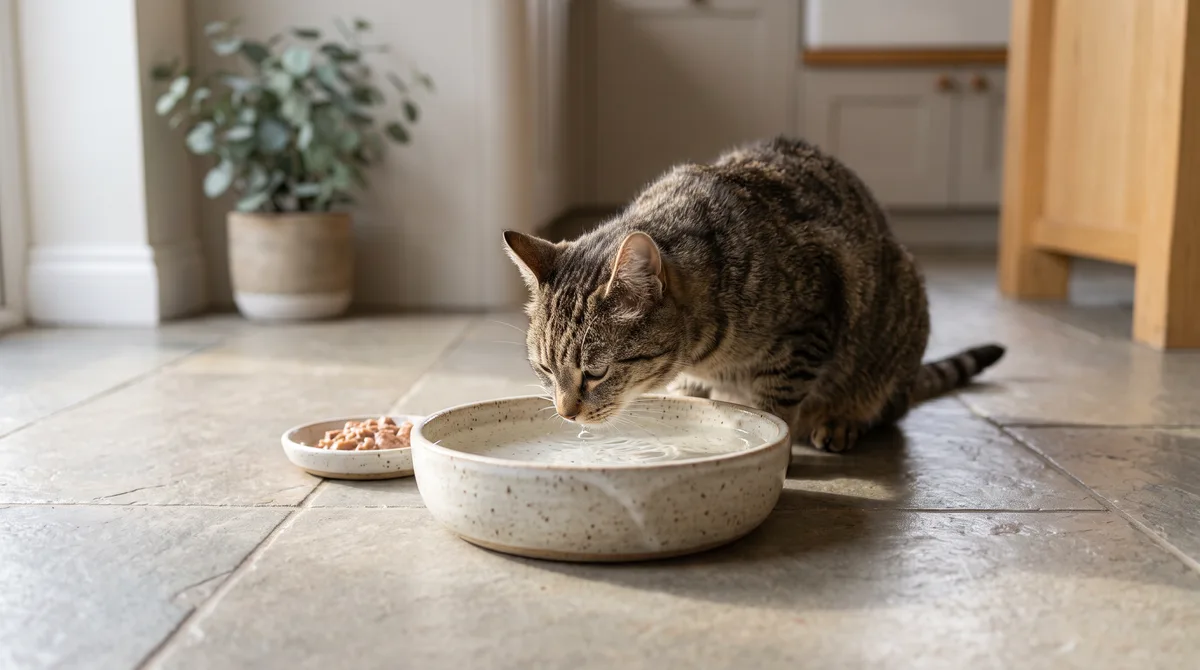
How much water should a cat drink a day? A healthy cat needs about 4 ounces of water for every 5 pounds of lean body weight, so a 10 lb cat needs about 1 cup (237 mL) a day. That total counts the water in her food. A cat on wet food gets most of it from her meals and may barely touch the bowl, while a cat on dry food has to drink nearly all of it.
This guide shows how much water your cat needs by weight, how much her diet already supplies, the signs of dehydration, and the level of thirst that calls for a vet visit.
Key takeaways
- Cats need about 4 oz of water per 5 lb of lean body weight a day, roughly 1 mL for every calorie they eat.
- Wet food is at least 75% water, so a cat on an all-wet diet gets about 80% of her daily water from food.
- Dry food is only 6 to 10% water. A dry-fed cat must drink nearly her full daily amount from the bowl.
- In a controlled study, cats on a dry diet drank about 6 times as much but still took in about 30% less total water than on a high-moisture diet.
- Total intake above 100 mL per kg a day, or a clear rise in drinking, is a reason to see your vet.
Table of Contents
Quick answer: Multiply your cat's lean weight in pounds by 0.8 to get her daily water in ounces. A 10 lb cat needs about 8 oz (1 cup). Subtract what her food supplies: about 6.5 oz on an all-wet diet, almost nothing on an all-dry diet. What is left is what she should drink.
How Much Water a Cat Needs by Weight
A cat needs about 4 oz (118 mL) of water a day for every 5 lb of lean body weight. That works out to about 0.8 oz per pound, or roughly 1 mL of water for each calorie she eats.
The Cornell Feline Health Center puts the need at 4 oz per 5 lb of lean body weight per day. The National Research Council (NRC) reaches nearly the same number from calories, at 1 mL of water per kcal, as summarized in The Veterinary Nurse. A 10 lb neutered cat eats about 261 kcal a day, so both methods land near 240 to 260 mL. Use her lean weight, not her current weight, if she is carrying extra pounds. The body condition score guide helps you estimate it.
 PetFeedCalculator
petfeedcalculator.com
| Lean weight | Daily water need | From all-wet diet | Left to drink (wet) | Left to drink (dry) |
|---|---|---|---|---|
| 6 lb (2.7 kg) | 4.8 oz · 142 mL | 133 mL | 9 mL | 138 mL |
| 8 lb (3.6 kg) | 6.4 oz · 189 mL | 166 mL | 24 mL | 185 mL |
| 10 lb (4.5 kg) | 8.0 oz · 237 mL | 196 mL | 41 mL | 232 mL |
| 12 lb (5.4 kg) | 9.6 oz · 284 mL | 225 mL | 59 mL | 278 mL |
| 14 lb (6.4 kg) | 11.2 oz · 331 mL | 252 mL | 79 mL | 325 mL |
Need: 4 oz per 5 lb lean weight (Cornell). Food water assumes a neutered adult at 1.2 × RER, wet food at 75% moisture and about 1 kcal per gram, dry food at 8% moisture and 4 kcal per gram. Get your cat's numbers at petfeedcalculator.com
Food water assumes a neutered adult with moderate activity (1.2 × RER), wet food at 75% moisture and about 85 kcal per 3 oz can, and dry food at 8% moisture and about 4,000 kcal per kg. An all-dry diet supplies only 4 to 7 mL a day. 1 cup = 8 oz = about 237 mL.
How Wet and Dry Food Change Bowl Drinking
Diet decides how much of that daily water your cat has to drink. On an all-wet diet, food covers about 80% of her need. On an all-dry diet, food covers about 2%.
Cornell's feeding guide lists canned food at a moisture content of at least 75% and dry food at 6 to 10%. Dry food also packs more calories into each gram. The veterinary text Canine and Feline Nutrition puts most dry foods at 3,000 to 4,500 kcal per kg, and notes that dry cat foods often sit at the higher end. A 10 lb cat eating about 3 cans of 3 oz wet food a day takes in close to 200 mL of water with her meals. The same calories from kibble weigh about 65 g and carry about 5 mL of water.
Based on a 10 lb neutered adult eating 261 kcal a day and needing 237 mL of water (Cornell guideline). Half and half splits calories evenly between wet and dry food. Moisture and calorie assumptions match the table above.
So a wet-fed cat who rarely drinks is usually not a worry, and a dry-fed cat who drinks a cup a day is doing what she should. To plan a wet or mixed diet by calories, the wet vs. dry food guide shows how to split the two.
See How Much Wet Food Your Cat Needs
Enter her weight and can size to get daily cans. More wet food means more of her water comes from meals.
🐾 Use the Wet Food CalculatorDo Dry-Fed Cats Drink Enough?
Often not quite. Cats on dry food drink more from the bowl, but research shows they do not fully make up for the missing water in their food.
A study in the British Journal of Nutrition (Buckley and colleagues, 2011) fed 6 cats the same dry diet at 6.3% moisture and with water added to reach 25.4%, 53.2%, and 73.3%. On the driest version the cats drank about 6 times as much as on the wettest, yet their total water intake was still about 30% lower: about 103 mL a day against 145 mL at 73.3%. Their urine was also more concentrated, and its calcium oxalate supersaturation, a measure of crystal and stone risk, was about double. The study was small and used soaked kibble rather than canned food, but it fits a long-held view that cats have a low thirst drive and lean on food for water. The authors also note that dry-fed cats may need less total water to dilute their urine, so lower intake alone does not mean a cat is dehydrated.
Healthy dry-fed cats can do well, as long as fresh water is always within reach. Adding some wet food is the most direct way to raise total intake. The canned cat food guide covers what to look for on the label.
Signs of Dehydration in Cats
A dehydrated cat is often lethargic and weak, eats poorly, and has dry gums or sunken eyes. These signs usually show up alongside an illness that is pulling water out of her body.
Cornell lists these signs of dehydration:
- Lethargy or weakness
- Poor appetite
- Dry mucous membranes, such as tacky gums
- Sunken eyes
Cornell also names the common causes of water loss: chronic kidney disease, diabetes, vomiting, diarrhea, hyperthyroidism, and diuretic medicines. A cat who stops eating wet food also loses a large share of her water at once. If your cat shows these signs, call your vet the same day rather than waiting to see if she drinks more.
When Drinking Too Much Means a Vet Visit
See your vet if your cat's total water intake tops about 100 mL per kg a day, or if she starts drinking noticeably more than her normal. For a 10 lb cat, that line is about 450 mL, or almost 2 cups.
A 2023 review in Today's Veterinary Practice defines excessive drinking (polydipsia) as water intake that exceeds 100 mL/kg per day, and lists chronic kidney disease, diabetes mellitus, and hyperthyroidism as the most common causes in cats. Cornell notes that hyperthyroid cats often show increased thirst and urination, mostly in middle-aged and older cats. A change matters more than a single number: bigger clumps in the litter box, a bowl that empties faster, or a cat who now drinks from the sink. If she has diabetes, the diabetic cat feeding guide covers the diet side.
Keep the diet in mind here too. A cat switched from wet to dry food will drink much more from the bowl without drinking too much overall.
How to Measure Your Cat's Water Intake
Measure what goes into the bowl and what is left 24 hours later. Then add the water from her food to get her total.
- Fill her bowl with a measured amount, such as 2 cups (473 mL).
- Set a second bowl with the same amount where she cannot reach it, to account for evaporation.
- After 24 hours, measure what is left in both bowls. Her bowl loss minus the evaporation loss is what she drank.
- Add about 0.75 mL for every calorie of wet food she ate that day.
- Repeat for 2 or 3 days and average the results, since daily intake varies.
In a home with more than one cat, this gives a household total. With a water fountain, skip the second bowl: fill it to a marked line and record how much you add to bring it back to that line each day. Track the trend over a few weeks and share it with your vet if it climbs.
How to Get a Cat to Drink More Water
The most reliable way to raise your cat's water intake is to feed more wet food or add water to her meals. Better bowl access helps too.
Cornell suggests keeping fresh water easy to reach, trying a pet water fountain, feeding canned food or adding water to her food, and flavoring water with tuna water or low-sodium broth. Place bowls in more than one spot and clean them daily. If you move some of her calories from dry to wet food, cut the dry portion to match so her total calories stay the same. The cat feeding guide shows how to set her daily calories.
Frequently Asked Questions
How much water should a cat drink a day?
About 4 oz per 5 lb of lean body weight, so a 10 lb cat needs about 8 oz (1 cup) a day. That includes the water in her food. A cat on wet food may drink only 1 to 2 oz from the bowl.
How much water should a cat drink if she eats dry food?
Nearly her full daily amount, since dry food is only 6 to 10% water. A 10 lb cat on an all-dry diet should drink close to 1 cup (about 230 mL) a day.
Is it normal for my cat to never drink water?
It can be, if she eats mostly wet food. An all-wet diet supplies about 80% of her daily water, so she may drink little. A dry-fed cat who rarely drinks, or any cat with signs of dehydration, should see a vet.
How much water is too much for a cat?
Total water intake above 100 mL per kg a day counts as excessive drinking. For a 10 lb cat that is about 450 mL, almost 2 cups. Kidney disease, diabetes, and hyperthyroidism are the most common causes.
Does wet food count as water intake for cats?
Yes. Wet food is at least 75% water, and that water counts toward her daily total. About 3 cans of 3 oz wet food supply close to 200 mL, most of what a 10 lb cat needs.
This article is for general informational purposes and is not a substitute for individualized veterinary advice. Water needs change with illness, heat, activity, and medication. Call your veterinarian if your cat's drinking changes suddenly or she shows signs of dehydration.