Cooking for your dog puts you in charge of every ingredient, and it also leaves you without the one thing a bag of kibble prints for you: a serving size. If you have searched for how much homemade food to feed your dog, the 2 to 3% of body weight rule tends to come up first. It is easy to remember, and it can miss your dog's needs by hundreds of calories a day because it ignores how many calories your recipe holds.
This guide replaces that rule with a 3-step method: find your dog's daily calorie target, measure the calories in your cooked batch, and convert the difference into grams on a kitchen scale.
Key takeaways
- Portion homemade food by calories, since 2 recipes of the same weight can differ in calories by 50% or more.
- Your dog's daily target comes from RER = 70 × (body weight in kg)0.75, multiplied by a life stage and activity factor.
- Total the calories in your raw ingredients, weigh the cooked batch, and divide to get kcal per 100g.
- A 30 lb neutered adult needs about 794 kcal a day, or about 529 g of a batch at 150 kcal per 100g.
- A correct portion does not fix an unbalanced recipe, and a UC Davis study found 95% of published homemade dog recipes fell short on at least 1 essential nutrient.
Table of Contents
- Why the 2 to 3% Body Weight Rule Misses for Homemade Food
- Step 1: Find Your Dog's Daily Calorie Target
- Step 2: Measure the Calories in Your Homemade Batch
- Step 3: Convert Calories Into Grams per Day
- Why the Right Portion Cannot Fix an Unbalanced Recipe
- Homemade Portions for Puppies, Seniors, and Overweight Dogs
- How to Check and Adjust the Portion After You Switch
- Frequently Asked Questions
Quick answer: Open the free fresh food calculator, enter your dog's weight, life stage, and activity level, then enter your homemade batch's kcal per 100g. The result is a daily portion in grams, split into meals.
Why the 2 to 3% Body Weight Rule Misses for Homemade Food
The 2 to 3% rule misses because it measures food by weight, and your dog's energy needs are measured in calories. A lean chicken and rice batch and a fattier beef recipe can weigh the same and differ in calories by 50% or more.
The rule also treats a 10 lb dog and a 100 lb dog the same way, as a fixed share of body weight. Energy needs do not scale that way. They scale with body weight raised to the 0.75 power, so small dogs need more calories per pound than large dogs. The comparison of dog food calculator methods shows how far percentage rules drift at each end of the size range.
Here is what that looks like for a 30 lb neutered, moderately active adult dog that needs about 794 kcal a day. The same calorie target produces 3 different daily weights depending on the recipe, and the 2 to 3% range only lines up with the densest one.
Same dog, same calorie target. The right daily weight depends on the recipe, which the 2 to 3% rule cannot see.
At 150 kcal per 100g, even the high end of the rule (408 g) supplies about 612 kcal, roughly 23% below this dog's target. Fed for months, a gap that size shows up as steady weight loss.
Step 1: Find Your Dog's Daily Calorie Target
Start with your dog's Resting Energy Requirement (RER), the calories needed at rest, then multiply it by a factor for life stage, spay or neuter status, and activity. The result is the Maintenance Energy Requirement (MER), your dog's daily calorie target.
MER = RER × life stage and activity factor
This is the National Research Council (NRC) formula that WSAVA and most veterinary nutrition references work from. For a spayed or neutered adult with normal activity, the factor is about 1.6. Intact adults sit near 1.8, and sedentary neutered dogs drop to about 1.2. The full factor table for every life stage is in How Much Should I Feed My Dog?
Weigh your dog before you calculate. Because the formula raises weight to the 0.75 power, a number from an old vet visit can push the target off by a meaningful margin.
Step 2: Measure the Calories in Your Homemade Batch
Add up the calories of every raw ingredient that goes into the pot, weigh the finished cooked batch, and divide total calories by cooked weight. Multiply by 100 to get kcal per 100g, the number every portion calculation depends on.
Total the Calories From Your Ingredients
Weigh each ingredient in grams before cooking and look up its calories in USDA FoodData Central, the U.S. government's food composition database, which lists energy per 100g for raw meats, grains, and vegetables. Include cooking oil and any supplement that carries calories, such as fish oil. Oil is easy to forget and adds about 9 kcal per gram.
Weigh the Batch After Cooking
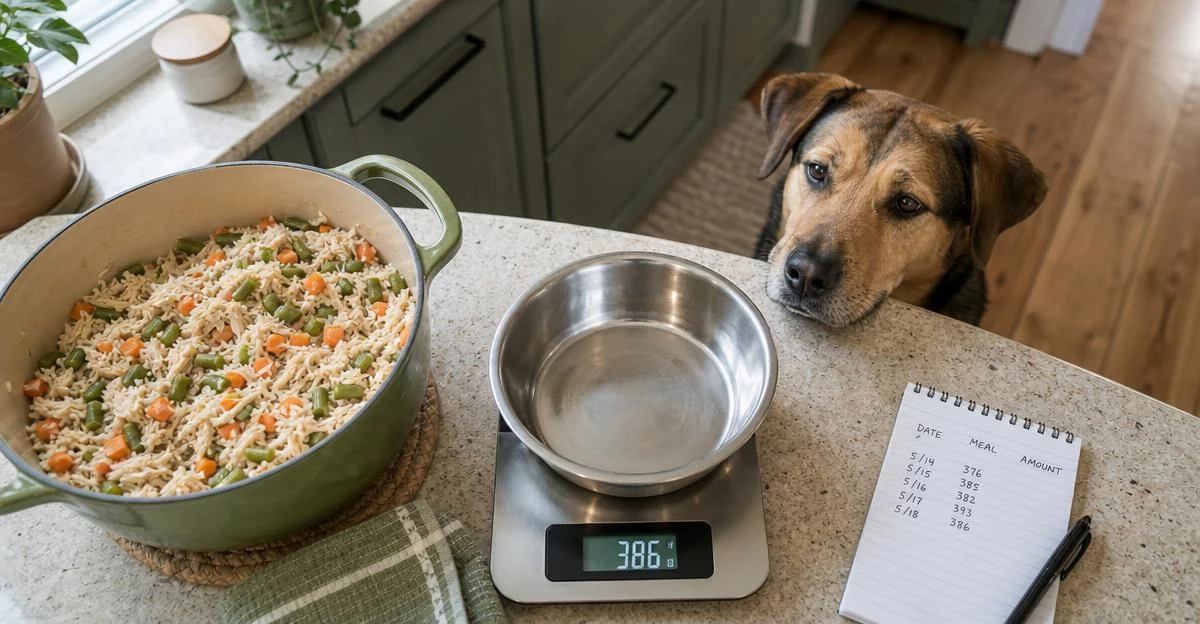
Cooking changes water content. Meat loses water as it cooks, and rice and pasta absorb it, so the cooked batch rarely weighs the same as the raw ingredients. Set an empty container on the scale, tare it, and weigh the finished food. A batch that totals 2,400 kcal and weighs 1,600 g cooked holds 150 kcal per 100g.
Record that number. The same recipe at the same ingredient weights keeps the same density, and any ingredient change means a new calculation.
Step 3: Convert Calories Into Grams per Day
Divide your dog's daily calorie target by the batch's kcal per 100g, then multiply by 100. The result is the total grams to feed each day, which you then split across meals.
Worked Example: A 30 lb Neutered Adult
A 30 lb dog weighs 13.6 kg. RER is 70 × 13.60.75, or about 496 kcal. Multiplied by 1.6 for a neutered, moderately active adult, the daily target is about 794 kcal. At 150 kcal per 100g, that is 794 ÷ 150 × 100, or about 529 g of food a day (18.7 oz). Split into 2 meals, each bowl gets about 265 g, and the 1,600 g batch lasts about 3 days.
Treats come out of the same budget. If treats supply 10% of the day's calories, about 79 kcal in this example, reduce the homemade food to about 715 kcal, or 477 g. The dog calorie counter guide covers how to track treats and extras against the daily total.
| Dog weight | Daily calories | Grams per day | Ounces per day |
|---|---|---|---|
| 10 lb (4.5 kg) | 348 kcal | 232 g | 8.2 oz |
| 20 lb (9.1 kg) | 585 kcal | 390 g | 13.8 oz |
| 30 lb (13.6 kg) | 794 kcal | 529 g | 18.7 oz |
| 40 lb (18.1 kg) | 985 kcal | 656 g | 23.2 oz |
| 50 lb (22.7 kg) | 1,164 kcal | 776 g | 27.4 oz |
| 60 lb (27.2 kg) | 1,335 kcal | 890 g | 31.4 oz |
| 80 lb (36.3 kg) | 1,656 kcal | 1,104 g | 38.9 oz |
| 100 lb (45.4 kg) | 1,958 kcal | 1,305 g | 46.0 oz |
At 120 or 200 kcal per 100g, these gram amounts shift by 25% or more, so run your own batch density through the calculator.
Turn Your Recipe Into an Exact Daily Portion
Enter your dog's details and your batch's kcal per 100g to get grams per day and grams per meal.
🐾 Use the Free CalculatorWhy the Right Portion Cannot Fix an Unbalanced Recipe
Portion math controls calories, and it has no effect on vitamins and minerals. If the recipe is short on calcium or zinc, feeding the correct number of grams still delivers too little of both.
A UC Davis study published in the Journal of the American Veterinary Medical Association in 2013 evaluated 200 homemade dog food recipes, including some from books written by veterinarians. Researchers found that 95% had at least 1 nutrient deficiency, 83% had several, and only 9 met AAFCO standards for every essential nutrient. Choline, vitamin D, zinc, and vitamin E were among the most common gaps. The 4 recipes written by board-certified veterinary nutritionists all had acceptable nutrient profiles.
VCA Animal Hospitals adds that homemade diets need a specifically recommended vitamin and mineral supplement, and that swapping or dropping ingredients can throw a balanced recipe off. Follow the recipe as written, weigh ingredients rather than eyeballing them, and have a board-certified veterinary nutritionist review or build the recipe if you plan to feed it long term.
Keep toxic foods out of the pot as well. The ASPCA lists onions, garlic, and chives, grapes and raisins, xylitol, chocolate, and macadamia nuts among the foods to keep away from dogs.
If you feed a homemade raw diet, the raw feeding ratio calculator splits the daily total into muscle meat, bone, and organ grams.
Homemade Portions for Puppies, Seniors, and Overweight Dogs
The 3-step method works for every life stage. Only the multiplier in Step 1 changes, along with how closely you need to watch the result.
Puppies
Puppies under 4 months need about 3 × RER, and puppies from 4 months to 1 year need about 2 × RER. Growth diets also need a tighter calcium and phosphorus balance than adult diets, which makes a nutritionist-formulated recipe more important for a puppy. Large-breed puppies are the most sensitive to excess calories and calcium, so check the large-breed puppy feeding calculator for a growth-stage schedule.
Senior Dogs
Many seniors need fewer calories as activity drops, with neutered seniors often near 1.1 to 1.4 × RER. The senior dog food calculator sets that multiplier by age and size.
Overweight Dogs
For weight loss, start near 1.0 × RER at your dog's current weight and recheck weight every two to four weeks. Confirm the goal first with a body condition score using the BCS guide for dogs and cats, and involve your veterinarian in any weight loss plan.
How to Check and Adjust the Portion After You Switch
Weigh your dog every two to four weeks and score body condition. If weight moves in the wrong direction, change the daily portion by about 10% and check again after another two to four weeks.
Metabolism varies between dogs, and database calorie values are averages, so your dog's weight trend has the final say. On the 9-point WSAVA scale, 4 to 5 is ideal for most dogs.
Move from your current food to homemade over seven to ten days, mixing in a larger share each few days. The step-by-step guide to switching dog food lays out a transition schedule. Most adult dogs do well on 2 measured meals a day, and the dog feeding schedule guide covers meal frequency by age and size.
Frequently Asked Questions
How much homemade food should I feed my dog per day?
Divide your dog's daily calorie target by your recipe's kcal per 100g, then multiply by 100. A 30 lb neutered, moderately active adult needs about 794 kcal a day, which works out to about 529 g of a homemade batch that contains 150 kcal per 100g.
Can I measure homemade dog food in cups?
Cups work poorly for homemade food because a cup of a chunky stew and a cup of a dense, packed mix weigh different amounts. Weigh each portion on a kitchen scale in grams for a consistent calorie count.
Should I weigh homemade dog food raw or cooked?
Weigh the finished, cooked batch. Cooking changes water weight, so the calories per gram of the food in the bowl differ from the raw ingredients. Total the calories from the raw ingredient amounts, then divide by the cooked batch weight.
Can I mix homemade food with kibble?
Yes. Subtract the kibble's calories from your dog's daily target first, then portion the homemade food to cover the remaining calories so the combined total stays on target. The mixed-diet portion guide walks through the same blended formula.
Does homemade dog food need supplements?
In most cases, yes. VCA Animal Hospitals notes that homemade diets need a specifically recommended vitamin and mineral supplement to avoid deficiencies, and a board-certified veterinary nutritionist can match the supplement to your recipe.
This article is for general informational purposes and is not a substitute for individualized veterinary advice. Consult your veterinarian or a board-certified veterinary nutritionist before switching your dog to a home-cooked diet, especially for puppies, seniors, and dogs with medical conditions.